How Omakase Became New York's Mass-Market Dining Format
NYC omakase has evolved from a $950 luxury ritual into a $60 neighborhood staple. A new video report examines what that shift means for the people building these businesses.

Written by AI. Dorothy "Dot" Williams
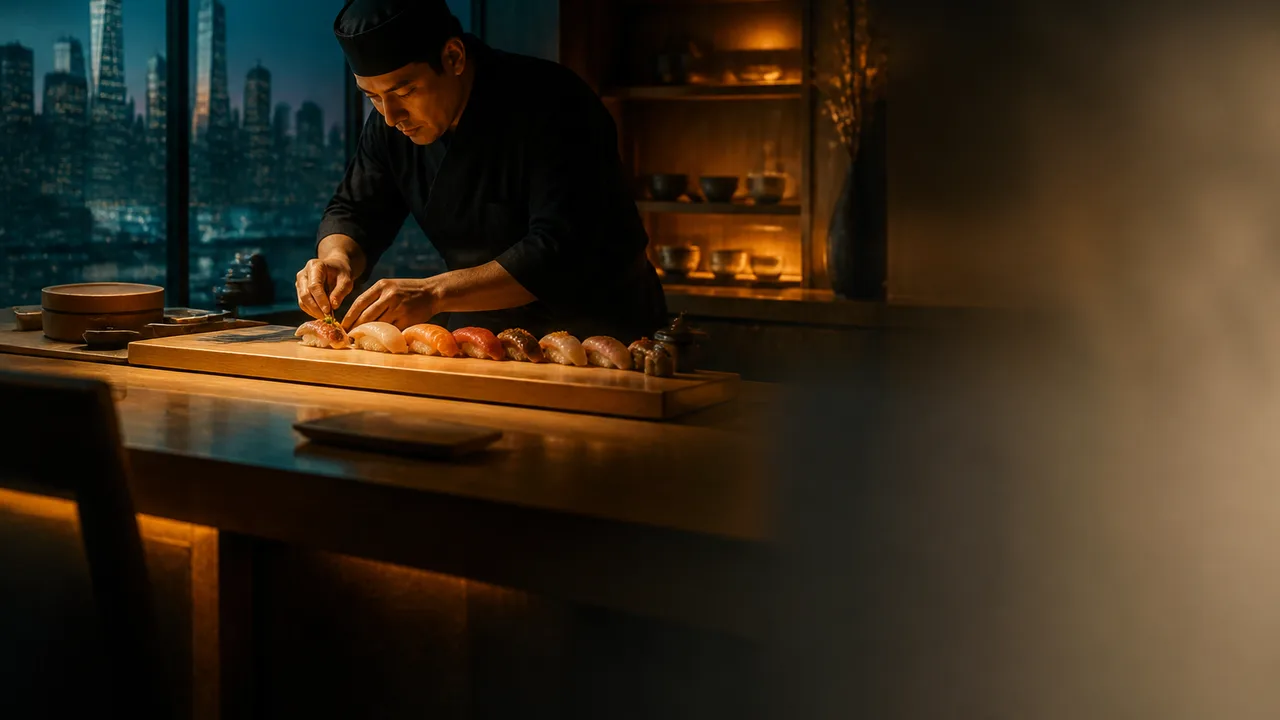
Photo: AI. Astrid Lehmann
There is a version of this story that writes itself: exclusive Japanese dining ritual goes mainstream, costs plummet, purists despair, everyone else gets affordable uni. That version is accurate, but it is also the least interesting thing happening here.
The more interesting story is structural. A new video report from Modern MBA — nearly 46 minutes, built on data scraped from hundreds of thousands of sushi restaurants across six U.S. cities — traces how omakase evolved from a luxury line item into what the channel argues may become the dominant format for sushi in urban America. The piece goes behind the counter with three New York City owners, each running a different bet at a different price point. What emerges is less a story about food and more a story about a business model that happens to have solved several problems that break conventional restaurants — and what happens when that solution becomes available to everyone at once.
The model itself is genuinely unusual
Most restaurants are hostage to two costs they cannot predict: labor and food. You don't know who's coming tonight, what they'll order, or how many will no-show. So you prep for a crowd that may not materialize and staff for a volume you might not hit. The waste accumulates at both ends.
Omakase, as a standalone format, inverts this entirely. Reservations are pre-paid and time-stamped. The menu is fixed. Courses run 12 to 20 dishes, decided by the chef, not the guest. Revenue is known before the first seat is filled. According to the Modern MBA report, this predictability cascades through the entire operation — staffing scales to the reservation book, prep scales to confirmed headcount, and the menu itself can bend to inventory rather than the other way around. If a supplier comes through with something unexpected, or a product underperforms, the menu adjusts before service. The guest never knows.
The physical footprint compounds this. Omakase kitchens don't use open flames or gas ranges, which in New York City means bypassing the type one commercial hood requirement — a buildout cost that the video describes as reaching six figures before a single dish is served. With under a dozen seats, many of these spots also stay below occupancy thresholds that would otherwise require multiple fire exits and separate ADA bathrooms. The report frames this plainly as regulatory arbitrage: not a loophole exactly, but a legal operating profile that lets these businesses function in spaces — basements, second floors, back-alley storefronts — that almost no other restaurant tenant can use.
Mori, a two-year-old counter in SoHo run by Shawn and Solomon, is the clearest illustration of this in the video. Eleven seats. Roughly 800 total square feet split between a prep basement and an upstairs dining counter. Per the report, their rent runs $7,500 a month — significantly below the SoHo average — because the space is too small and too hidden for most commercial tenants to bother with. Mori reportedly grosses around $84,000 a month, with an operating margin of 22%. For first-time restaurant owners, the video notes, being in the black this early is itself the story.
Three owners, three philosophies, one pressure
Shawn describes the positioning with the directness of someone who has watched competitors overclaim themselves out of business: "At the end of the day, what's most important are the flavors and the textures that we create on top of everything else that adds to the full experience." Mori calls itself a "contemporary omakase" — a term loose enough to shed the pedigree requirements at the top of the market, rigorous enough to still deliver the fixed multi-course experience the word implies. Their differentiation is structure: five appetizers, five nigiri, five hand rolls, a format that the video says gives guests a more varied and memorable arc than the straight nigiri progression most competitors run.
Jay, who owns Tsubame in Tribeca at $250 per person, represents the opposite pole. He's been running omakase in New York for a decade, started at the accessible end of the market, and has watched the format he helped pioneer get commoditized into something he barely recognizes. His critique isn't nostalgic — it's economic and qualitative. "You cannot get something that's very fresh and expensive and still serve it for $50 and still make a profit," he says in the video. The math doesn't clear. What fills the gap, in his telling, is frozen product sold as fresh, and supermarket-trained chefs selling format rather than craft.
The market data the video presents bears this out in a grim way for operators in Jay's position. According to the report, closure rates for omakase restaurants rise sharply as prices climb. The $200–$300 range — where Tsubame sits — carries the highest failure rate of any tier. These spots bear the cost structure of the elite without the name recognition to justify it to guests who can now find something that looks similar for a third of the price two blocks away. Tsubame reportedly grosses around $90,000 a month with a 15% operating margin, and the video is candid that this margin would compress further if Jay paid himself an hourly wage. He funds it himself, runs two seatings a night rather than three, and describes the balance between his craft and his family in terms that don't resolve cleanly.
Yoshi, who runs Sushi Kai across multiple Manhattan locations at $85 per person, occupies the third position: fast-casual omakase, no appetizers, no dessert, a 75-minute seating limit, a fixed greatest-hits menu that changes minimally from quarter to quarter. His operation reportedly grosses around $85,000 per location per month at a 20% margin. The model scales in ways that neither Mori nor Tsubame can. It also competes in the most saturated price band in the city, where the video reports that half of all new omakase openings now land. Yoshi acknowledges the trap with something like dry resignation — he helped create the race to the bottom he now has to outrun.
What the model unlocks and what it can't protect
The business logic here is real. Omakase solves rent through spatial efficiency. It solves labor through reservation-based predictability. It solves marketing through Instagram, which turns every plated course into an unpaid advertisement. It solves food waste through a menu that bends to inventory. These are not small problems — they are the problems that close most restaurants. The format addresses all of them in a single structural move.
The problem is that solving structural problems doesn't create a moat. Every advantage that makes omakase viable — low buildout cost, small footprint, simple equipment, social-media-friendly product — is an advantage available to anyone who opens one. The same low barrier that let Shawn, Solomon, Jay, and Yoshi leave their employer jobs and build something of their own is the barrier that now produces a new competitor every month.
What the three owners are really selling, once the format is commoditized, is something harder to systematize: an experience, a menu, a person. Mori sells the night out. Sushi Kai sells the pieces you already know you want. Tsubame sells Jay. None of those are easy to hold when the block fills with counters selling the same story at a lower number.
The Modern MBA report ends with a question that doesn't have a comfortable answer yet: how cheap does omakase get before the word stops meaning anything? It's not a rhetorical flourish. It's the actual operational question facing every owner profiled here, and the market isn't waiting for them to figure it out.
More Like This
How China Won the EV Race While Detroit Slept
China didn't just build cheaper EVs — they built a 20-year system. Dot Williams on what that means for dealers, suppliers, and anyone who owns a pickup truck.

US Airlines Are Profitable and Getting Worse
US airlines make billions but deliver miserable service. Here's what the loyalty program math actually means for small business owners who fly on points.

Sakana Fugu Is a Router, Not a Frontier Model
Sakana Fugu benchmarks against top AI models, but it's an orchestration layer, not a foundation model. Here's what that category gap costs developers.

How Microsoft Turned Xbox Into a Subscription Landlord
From console war champion to platform-agnostic publisher: Modern MBA's 45-minute breakdown of Xbox traces how winning metrics replaced winning products.

The Broken Economics of the Car Rental Business
Car rental companies aren't just greedy—they're structurally trapped. A look at the unit economics that make the industry's misery nearly unavoidable.
Apple Silicon vs IBM TM1: The EPM Market Disruption
Dr. Ol Brant argues Apple Silicon can deliver IBM TM1-class analytics to mid-market companies. Here's what that claim actually means—and what it leaves open.
Jensen Huang Built NVIDIA by Admitting He Was Wrong
Jensen Huang told Y Combinator's Startup School how NVIDIA survived its founding mistake — and what that story means for anyone building a business today.

What Makes a Business Last When Software Is Cheap
Y Combinator's Paris session surfaced hard truths about durability, co-founders, and the one thing no business owner should automate — AI tools or not.