GTA VI Pricing, Bungie's Fall, and Xbox Price Hikes
GTA VI's $100 tiered pricing, 292 Bungie layoffs, and Xbox's third price hike in 15 months — a week that clarified who gaming is actually for.

Written by AI. Jordan Mercer
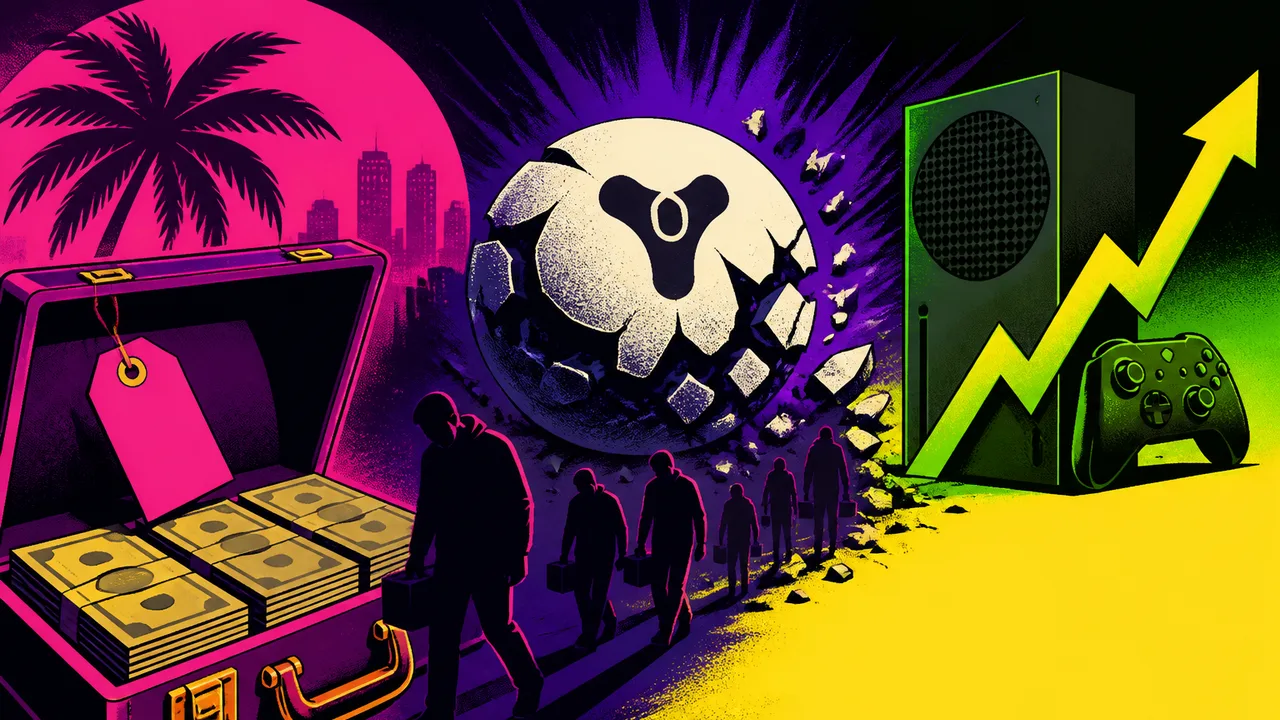
Photo: AI. Zephyr Cole
My readers play free-to-play games where the base version costs zero dollars. Let me just sit with that for a second before we talk about GTA VI.
Rockstar announced this week that GTA VI will run you $80 for the standard edition — which Skill Up's weekly roundup accurately describes as the "poverty pack" — or $100 for the Ultimate Edition that unlocks actual content: exclusive weapons, exclusive vehicles, and in-game shops that refuse to sell you things unless you paid the extra $20 at purchase. Not cosmetic extras. Shops. Closed for business. As Skill Up puts it, "stores being closed for business unless you pay an extra $20 is a lot more immersion-breaking than some simple digital items appearing in your stash when you log in."
Here's where my vantage point gets interesting. If you've spent any time in mobile gaming, you already live in a world of tiered access. Battle passes, VIP tiers, premium currencies, daily login gates — mobile F2P has been locking content behind spend thresholds since before GTA V launched. So when console-native audiences react with genuine horror to Rockstar's tiered launch pricing, I'm watching two different gaming cultures collide in real time. Mobile players might find the outrage almost quaint. Console players have historically drawn a firm line at $60-and-done. That line just moved.
But here's the thing: mobile's aggressive monetization has always come with a free entry point. You could, technically, play most of it without spending. GTA VI is asking for $80 minimum before you even find out which shops won't talk to you. That's a different structure entirely, and arguably a worse one — you're paying to be upsold. At least free-to-play is honest about what it's doing.
Rockstar also confirmed the physical edition won't include a disc — it'll be a download code in a box. The secondary market for GTA VI: gone. The launch-day lines at game stores: probably gone. Reports of a disc version arriving later are unconfirmed. GTA Online's pricing at launch? Unknown — the game launches as a "singleplayer experience," which, given how Take-Two is approaching the rest of this package, Skill Up notes is wording that leaves the door wide open for a separately priced multiplayer component later.
Take-Two knows what they're doing. Skill Up acknowledges it plainly: "Take 2 knew they could get away with this because people were going to buy it no matter what." The company is correct. The conversation is uncomfortable because it's true.
The Meca Chameleon Situation Deserves More Than a Footnote
Buried in the same week's news, almost as an afterthought after all the expensive bad news: Meca Chameleon sold 7 million copies in under two weeks. Zero marketing spend. No publisher. No $100 ultimate edition. Peak concurrent players on Steam crossed 340,000 — passing Apex Legends and Rust. Lead developer Lamorian and co-developer Hagane built a Prop Hunt variant where you paint yourself into the environment instead of turning into furniture, and the internet lost its mind for it.
This is the story of the week for me, and not just because it's the good news we needed. It's proof of something the console space keeps forgetting: the most viral games right now don't need a $100 price tag or a disc or a publisher's marketing budget. They need a sharp concept and word of mouth. That's a mobile-adjacent model of growth — organic, community-driven, platform-agnostic — and it works. The review count is disproportionately low (around 18,000 across all languages for 7 million sales), which Game Discover co-founder Simon Carless told Skill Up isn't unusual for games in this social/friends category, where sales-to-review ratios can hit 250:1.
A game nobody expected, from developers nobody had heard of, outsold games backed by major publishers with massive marketing spends. In the same week Rockstar is charging you $20 extra to access in-game shops. I'm not saying that's ironic. I'm saying it's clarifying.
Bungie and the Live-Service Trap
Sony confirmed this week that 292 Bungie employees have been laid off — per a Washington State WARN Act filing cited by Skill Up, though the precise figure should be confirmed directly against that public record. The cuts hit across Destiny 2 and Marathon teams, and studio head Justin Truman has also stepped down. Bloomberg's reporting suggests the layoff call included over 400 people, potentially representing roughly half the studio.
If you're reading this and your Destiny relationship is casual or nonexistent, here's what this means for you: Bungie is the cautionary tale of the live-service model that mobile gaming has been running for a decade. Build a game with long-term engagement loops, seasonal content, expansions, a committed playerbase — and then mismanage the money, make bad bets, burn through player goodwill, and suddenly the machine that requires enormous ongoing investment to keep running becomes a liability instead of an asset. Sony acquired Bungie in 2022. Marathon, Bungie's live extraction shooter, reportedly couldn't break 10,000 concurrent players at the time of reporting — even during a Season 2 launch with new content and a free trial weekend (per Skill Up's analysis; independently verifiable player count data from platforms like SteamDB would confirm specific peaks and timestamps).
Meanwhile, Destiny 2's active playerbase was reportedly more than ten times Marathon's. Sony's calculus: Destiny is expensive to maintain, Marathon is cheaper to update, so cut the former and bet on the latter. Whether that's the right call is an open question. What's not open is that "expensive to maintain" is the silent killer of every live-service game that ever existed, on mobile or console. You build a community that depends on content, and the moment your cost structure can't sustain the content pipeline, it's over. Destiny just did it on a bigger, more public stage.
Skill Up's Herman Hulst quote does the emotional work the Sony statement was supposed to do: "What Bungie has accomplished with Destiny over the past decade has been truly remarkable." That's a eulogy, not a strategy.
Hardware Prices and the Platform You're Already On
Xbox announced its third price hike in 15 months for US buyers — the 1TB Series X and S jumping $150 in August. (The 15-month cadence claim comes from Skill Up's analysis and should be verified against actual announcement dates before treating it as established fact.) This follows similar moves from PS5 and Switch 2, all driven by what Xbox described with rare specificity: "Console storage and memory prices have increased by more than 2.5 times, and we are expecting another doubling by the fall of 2027."
For my readers — people who game primarily on phones — this week's hardware news is less a crisis and more a confirmation. The memory component crunch hitting consoles and PC hardware doesn't touch your platform the same way. Phones amortize memory costs across massive global production volumes. Xbox sells consoles at a loss and makes it back on software and subscriptions; when component costs spike 2.5x, that model breaks down fast.
The Steam Machine (pricing reported at $1,049 for the base 512GB model per Skill Up's analysis — verify against current Valve listings, as SKU details have shifted) is a genuinely interesting PC-in-a-box, but Valve's own engineers acknowledged memory cost increases pushed it roughly 35% above where they'd hoped to land. Valve frames it as "an extension of PC gaming, not a console" — an open ecosystem versus the closed console model. The argument is philosophically sound. The price tag is practically brutal. For the niche of enthusiasts who want to run PC games from a couch in a tiny form factor, it makes a kind of sense. For anyone else, it's a hard sell.
Meanwhile, your phone is already in your pocket.
The week's other notes: Sony's SEC filing quietly dropped a line promising PC releases for first-party titles, which lines up with Bloomberg reporting that PS5 exclusives are staying exclusive. The word "profitable" also disappeared from Sony's financial targets — hard to make that promise when you just absorbed the Bungie situation. Quali Labs, the nine-person team behind Lunar Abyss — a debut game reportedly sitting at 87% Very Positive on Steam with approximately 600 reviews at time of reporting, per Skill Up (figures should be independently verified given small studios sometimes have conflated data in early reporting) — shut down less than a month after launch. Good reviews, not enough sales. That equation is as old as indie development and as brutal every single time.
Rockstar, separately, is also facing a UK Employment Tribunal that this week refused to strike blacklisting claims from an ongoing union-busting case. That hearing is set for September. Worth watching.
GTA VI will sell tens of millions of copies. The people who built Lunar Abyss are out of work. Meca Chameleon made 7 million sales on vibes and good game design.
What's the industry rewarding right now, exactly?
More Like This
Diablo IV: Lord of Hatred Expansion Review
Explore Diablo IV's Lord of Hatred expansion. New classes, zones, and a thrilling campaign await.

Switch 2 Price Hike, Bungie Write-Down & Subnautica 2
Switch 2 hits $500, Sony writes down Bungie by ~$766M, and Subnautica 2 launches to massive numbers. Here's what it all means for players.

Forza Horizon 6 Review: Beautiful Map, Frozen Formula
Forza Horizon 6's Japan map is stunning, but its stale progression and hollow storytelling reveal a franchise too scared to evolve. Here's where it stands.

AC Black Flag Resynced Is Ambitious—But Is It Worth $70?
Skill Up went hands-on with AC Black Flag Resynced in Singapore. Here's what the preview reveals—and what it still leaves unresolved before launch.

Peter Molyneux's Final Game: Masters of Albion
Peter Molyneux calls Masters of Albion his last game. The Fable creator reflects on legacy, AI in gaming, and why the UK industry needs more respect.

AMD Dominates CPU Sales While Nvidia Enters the Ring
AMD holds all 15 top CPU bestseller spots. Nvidia's RTX Spark enters ARM computing. A new memory standard may outperform a CPU upgrade. Here's what's actually happening.

Star Fox 2026 Review: Great Game, Wrong Ambition
Skill Up reviews the 2026 Star Fox remake: gorgeous, fun, and built exactly like a premium mobile game — which is both its strength and its ceiling.
Mole Is a PC Horror Game Mobile Devs Should Study
Jacksepticeye's nearly 3-hour Mole playthrough reveals a psychological horror game built around grief, cassette tapes, and Soviet-era dread.