GTA 6 Will Avoid Naming Trump and COVID, Rockstar Says
Rockstar plans to keep Trump and COVID out of GTA 6's direct references. Its satire can still speak to the present, but the choices will shape its bite.

Written by AI. Jordan Mercer
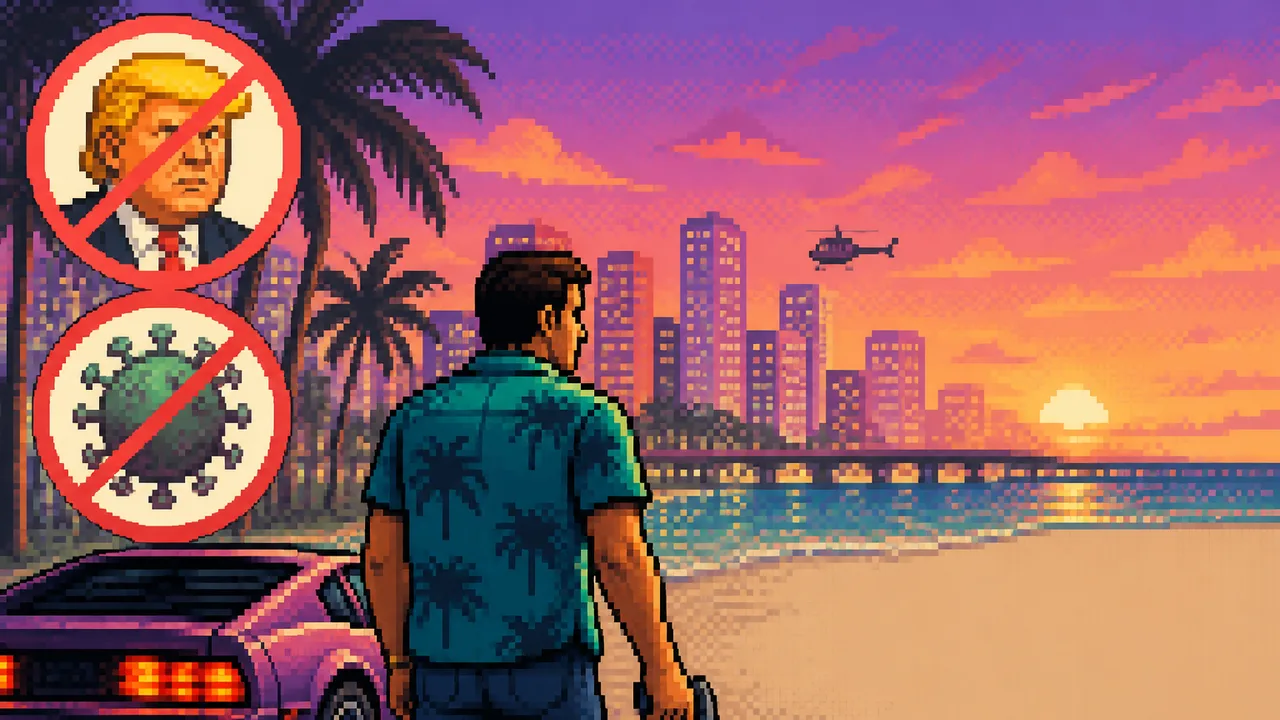
Rockstar plans to keep Donald Trump and COVID-19 out of Grand Theft Auto 6 by name. The game will avoid direct references to both, drawing a line around two subjects that have shaped recent public life. It’s a line around references, though, not a promise that GTA 6 will have nothing to say about the present.
Rockstar’s concern is how quickly a topical joke can age. “We just have to be careful what we pick,” the company said in comments reported by IGN. That’s a practical problem for a game built to hold players’ attention long after its writing is finished. A politician’s name pins a joke to a person and a moment. A fictional scandal can give the writers more room to examine the behavior around it.
The exact characters, missions and jokes that will carry that approach remain an open question. For players, the useful distinction is between recognizing the world outside the game and hearing it named inside the game. Rockstar has ruled out two names. The shape of the satire is still up for grabs.
Why Rockstar is Avoiding the News Cycle
GTA’s worlds have room for a lot more than their main crime stories. Advertising, entertainment, public figures and everyday chatter can all help set the tone while a player drives to the next mission or ignores the next mission entirely. Those details also make a direct reference hard to contain. Put a real political name into a joke, and players may reasonably ask what the rest of the game is saying about that person.
Time makes the choice trickier. A line written as a current-events gag has to survive development, release and years of play afterward. Its target may remain recognizable, but the context that made the line sharp can move. That doesn’t make topical writing a mistake. It means a writer has to decide whether the precision of naming someone is worth the expiration date it might put on the joke.
The COVID-19 pandemic presents a different version of the same problem. A direct mention would place a public-health crisis inside GTA’s fictional history. That could be fertile ground for writing about institutions or people’s behavior. It would also invite questions about what happened to the characters and the wider world during it. Steering clear of the name lets Rockstar choose how much of that history its fiction needs to carry.
One account of the series’ approach gives Rockstar’s decision some context: GTA has rarely focused closely on national politics, apart from GTA 4’s engagement with the war on terror. A game can satirize a country through the ambitions it rewards, the stories its media sells and the people its institutions protect, without turning a mission into a commentary on one politician.
A Fictional Name Can Still Point Somewhere
The strongest case for Rockstar’s choice is creative freedom. An invented public figure can borrow traits from several recognizable people. An invented crisis can put pressure on the game’s characters without asking players to match every detail to a real event. That can give a joke a longer life and keep its target on a pattern of behavior rather than a single headline.
There’s a cost to that flexibility. Broad satire can become so broad that everybody gets mocked and nobody gets examined. If a game evokes a recognizable political climate, players may expect it to identify who benefits from the mess and who has to live with it. Fictional names give writers distance; distance can also make consequences easier to dodge.
The challenge is making its satire feel sufficiently heightened when real-world events already seem extreme. Its ambition is to go more over the top. That creates a sharper test than whether a familiar name appears on a screen. An exaggerated figure needs a point of view behind the exaggeration. Otherwise, louder is simply louder.
That point of view can show up in small choices. Does a fictional scandal change anything for the people caught in it, or does it exist to supply a punchline? Does the game let powerful characters walk away from the chaos they create? Those are questions about how a story works, rather than predictions about GTA 6’s plot. They offer a better way to judge its satire than keeping score of real-world references.
The Setting Raises the Stakes
GTA 6 also has to contend with the expectations created by its own setting. Vice City’s relationship to Miami gives Rockstar a recognizable backdrop to work with. The company has even used Vice City supercars on Miami streets in its promotion. The connection helps make the fictional place legible at a glance: players bring associations with a real city before they hear a line of dialogue.
That makes the refusal to name Trump or COVID more interesting than it would be in a wholly invented fantasy world. Rockstar can draw on familiar places and cultural cues while keeping two recent reference points outside the script. Players will decide whether that distance gives the game room to say something lasting or leaves conspicuous gaps in a world meant to feel contemporary.
A joke that works when encountered once differs from one that holds up in an open-world game. Players spend time between plot beats. They return to locations, overhear incidental details and notice how the setting treats different people. A fictional news item might get a laugh on first contact; the wider world around it determines whether the joke has any teeth. GTA’s format gives Rockstar plenty of space to build that context, and plenty of space for thin satire to become repetitive.
For now, the most productive thing to watch is how the game connects its targets to its world. A recognizable celebrity stand-in or invented scandal can be funny. If Rockstar wants the satire to stick, the people and systems surrounding that joke need to make sense together. Trump and COVID can stay unnamed. The city still has to speak.
More Like This

GTA 6 Drops Microtransactions at Launch, But Read the Fine Print
Rockstar confirms GTA 6 launches in November without microtransactions or generative AI. Here's what that promise means, and what "at launch" actually guarantees.

Miami Beach Split 4-3 Over Rockstar's $4 Million GTA 6 Ad Deal
Miami Beach commissioners approved negotiations on a $4 million GTA 6 marketing campaign, and the vote split 4-3. What the deal means for the city and the game.
GTA 6's Deliberate Miss Mechanic Changes the Series
GTA 6 lets players deliberately miss shots to avoid killing cops and civilians. What this mechanic means now—and what it will mean when the servers go dark.
GTA 6 Leaker Says Leaks Will Stop After Token Misses Goal
Cyberleek says the GTA 6 leaks will stop and a claimed game build will stay private. The token missed its target, but players still face unanswered questions.
Xbox Says GTA 6 Won't Stream to PC, PC Release Undated
Xbox says GTA 6 will not stream to PC through its cloud service. The correction, Take-Two's PC remarks and Rockstar's past launches leave players without a PC date.
GTA 6's Storms Are Confirmed, but Their Effects Aren't
Rockstar has confirmed hurricanes, localized rain and persistent puddles for GTA 6. What remains unclear is whether storms will change driving, routes or missions.
Xbox Workers Push Back as 1,600 More Jobs Loom
Xbox workers are organizing across six studio locations as 1,600 more jobs hang in the balance. Here's what the unions are demanding—and what it means for gaming.
Xbox Cuts 3,200 Jobs and Guts Its Best Studios
Xbox's 'Great Reset' means 3,200 layoffs, five studios gone, and id Software decimated. Here's what actually happened and what it means.