Google's Gemini Glasses Face a Test Beyond the Demo
Google's Gemini glasses promise translation, navigation and visual help. Their real test is daily usefulness and whether privacy controls reassure people nearby.

Written by AI. Yuki Okonkwo
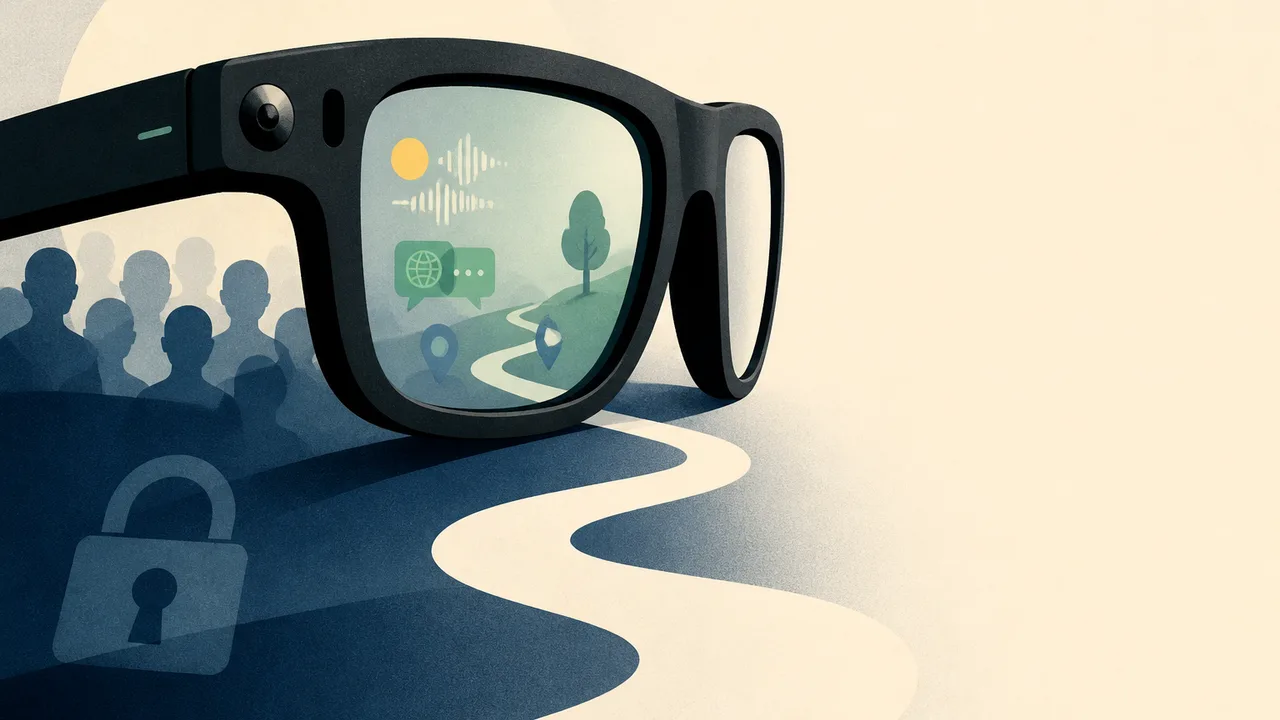
Google opened preorders on November 12 for Gemini-powered glasses made with Warby Parker, Gentle Monster and Samsung. They’re scheduled to go on sale December 10. You can ask the frames about something you’re looking at, hear directions or get speech translated in your ear. The interesting question starts after the demo ends: Which of those jobs would make someone put the glasses on again tomorrow?
Google calls them “intelligent eyewear,” and the name fits the pitch. Gemini can take a question about an object in view and connect it to Google services. The company describes looking at an event poster and checking your Calendar, or asking the assistant to add something you see to a grocery list. Those examples combine a camera, an AI assistant and the apps that already organize parts of a person’s day. A frame that spares you from juggling a phone while your hands are full has an understandable appeal.
The collections also look like an attempt to make the hardware choice feel like shopping for glasses rather than selecting a developer kit. Warby Parker frames start at $395, with prescription and fit options; Google says the frames weigh around 41 grams and offer up to nine hours of battery life. Gentle Monster offers another set of styles, starting at $449. A choice of frames can make the product easier to imagine wearing. It cannot decide whether you need its camera, assistant or translation on a Tuesday.
The Useful Demo is the One with a Job
The glasses have several different ways to be helpful. Google says Maps can deliver turn-by-turn directions through their open-ear speakers. Translate is supposed to detect the language being spoken and translate speech across more than 70 languages. Guided Vision offers conversational audio descriptions for people who are blind or have low vision, as well as anyone seeking visual assistance; Google also describes a way to connect to a human visual interpreter through Aira Explorer. These are distinct tasks with distinct stakes. A missed street-art fact is mildly annoying. An inaccurate description for someone relying on it to find an item could be far more consequential.
In a short hands-on demonstration, Gemini answered visual questions about redecorating a room and identifying a Keith Haring print. Gizmodo’s James Pero found the answers satisfactory but struggled to think of regular reasons to ask those questions. Translation made a stronger impression: Portuguese-to-English speech came through quickly enough for him to follow it nearly in real time. In another staged exchange, two Google representatives spoke different languages, and the glasses continued translating without manual language selection. That demonstration gives a sense of the feature’s speed under those conditions; it cannot tell a buyer how accurately it will handle accents, noisy streets or everyday conversations.
The contrast suggests a practical way to judge this product. Start with the task, then ask what being worn on your face improves. Translation has an immediate answer for someone trying to follow speech while keeping their hands free. Spoken navigation might have one for a person exploring an unfamiliar place. Asking who painted a print can work, too, but occasional curiosity faces stiff competition from the phone already in your pocket. How frequently any buyer needs each task will depend on their day, rather than the length of Google’s feature list.
Guided Vision raises another question that a general-purpose AI demo can’t answer for everyone. Google’s description spans both everyday convenience and assistance for people with low vision. Those users may value hands-free descriptions for different reasons and may need different levels of reliability. The Aira option adds a human interpreter to the picture, with the user streaming the glasses’ camera feed for support. Lumping all of that into “AI can see” flattens the choices a prospective wearer would make.
A Familiar Shape, with Different Bets
Google has tried face-worn computing before. Its earlier Glass Explorer program sold an experimental device to early testers. Later, Google X leader Astro Teller said the company had encouraged too much attention and that people treated the prototype like a finished consumer product. He also identified battery life and privacy around photo-taking glasses as problems Google needed to address. That history explains why a polished demonstration deserves a second question: how will the device hold up when someone expects it to work routinely? Teller’s account describes one problem with Glass’s launch; it does not predict how buyers will respond to these new frames, partners and tasks.
Meta’s smart glasses offer a closer present-day comparison. Both approaches put cameras, audio and an AI assistant into eyewear, and Pero found the new glasses functionally similar to using Meta’s during his limited test. Google’s Warby Parker and Gentle Monster collections offer different frame choices; the reviewer said the new hardware felt slightly lighter than Meta’s glasses, while he could not yet judge its music audio as closely. Those observations help a shopper decide what to try on and listen for. They cannot settle which pair performs better over a full day or which one people will keep wearing.
Privacy makes that decision public, too. A wearer can decide whether a voice assistant helps with a grocery list. The person standing nearby has less say over a camera pointed in their direction. Google says the glasses show an indicator light when taking a photo or video for the gallery and are designed to stop recording if that light is covered or disabled. Wearers can change which apps have camera and microphone permissions, review or delete Gemini chats, and turn the glasses completely off.
Google told Gizmodo it would not store visual information in Gemini History, although queries can be saved there. Google says it blurs detected faces; Meta also claims to blur faces, and both companies use capture lights. Those are described controls, rather than a tested ranking of how reliably either device protects people nearby. A light can signal a gallery recording, but it cannot ask a bystander for consent. The effectiveness of automated face blurring remains an open question.
A Qualcomm survey of wearable owners and prospective buyers across six markets illustrates the competing demands: around 70% of respondents wanted an AI agent to manage devices and tasks, while nearly 60% wanted wearable data kept private or wanted to approve sharing. Because Qualcomm commissioned the survey and its respondents were wearable users or prospective buyers, those figures should not be read as a forecast for these glasses. They do, however, put two plausible requests on the same shopping list: make the assistant useful and give the wearer control over their information.
That leaves a separate request from the person across the table. Gemini History settings concern what the wearer can manage in their account. The recording light is a signal someone else may be able to see. A buyer can test the first by checking the controls; the second asks whether nearby people can tell when the camera is capturing something. Preorders and guided demos let shoppers try the frames before December 10. A useful demo question is concrete: “What did wearing these let me do while my phone stayed put?” The next question belongs to everyone in the room: “Can I tell what this camera is doing?”
More Like This

Google's Pixel 11 Call for Me Puts AI on the Line
Google's Pixel 11 lets Gemini call businesses, but its live transcript, limited preview and burden on staff reveal the tradeoffs of cautious AI agency.
Meta's Luna Glasses Test a Camera-Free Middle Ground
Meta's reported Luna smart glasses remove the camera but keep six microphones and AI, testing whether slimmer hardware can ease wearable privacy concerns.
InMo GO3 Smart Glasses Real-World Review: Translation Tested
The InMo GO3 promises real-time translation, all-day wear, and a swappable battery. Alex from Gear & Tech tested it in Munich. Here's what actually held up.
Meta's AI Glasses Will Recognize Your Dinner Guests
Meta has patented AI glasses that use facial recognition to identify people and auto-edit highlight reels. A look at what's filed, what's already in code, and what's missing.

Meta's Muse Charm Tests the Ambient AI Hardware Race
Meta's reported Muse Charm spotlights the race for ambient AI hardware, where battery life, privacy, latency and daily usefulness will decide what sticks.

Google's Gemini Glasses: What the I/O Demo Actually Showed
Google unveiled Gemini-powered AI glasses at I/O 2026 with live translation and habit memory. Here's what the demo showed — and what it leaves open.

Plaud One AI Earbuds: Listening So You Do Not Have To
Plaud One earbuds record, summarize, and act on workplace conversations via 4G. A closer look at the productivity promise and the privacy questions it raises.

How AI Is Personalizing the Live Sports Fan Experience
Scott Gutterman of Next League breaks down how AI is reshaping fan engagement, smart venues, and sports consumption—and what the industry still has to figure out.