InMo GO3 Smart Glasses Real-World Review: Translation Tested
The InMo GO3 promises real-time translation, all-day wear, and a swappable battery. Alex from Gear & Tech tested it in Munich. Here's what actually held up.

Written by AI. Tyler Nakamura
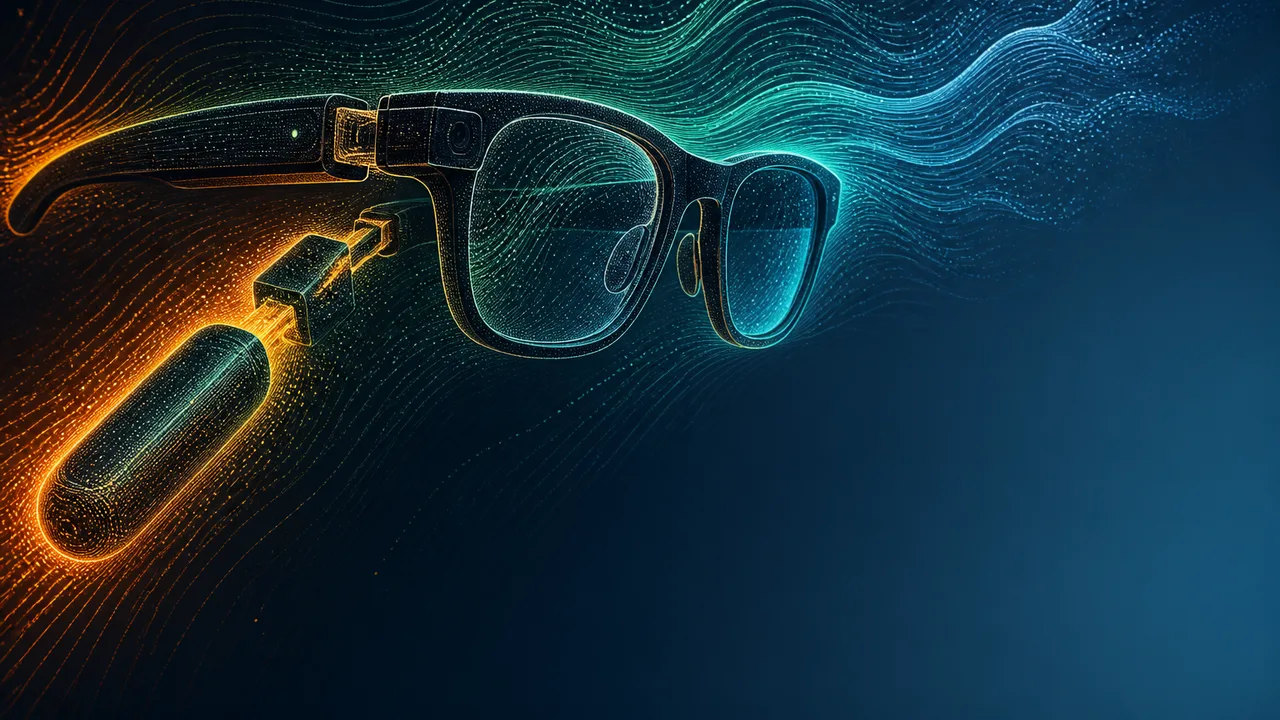
Photo: AI. Dexter Bloomfield
I'll be honest — I've watched a lot of smart glasses videos where I already know the ending by minute three. The product looks cool. The demo is clean. The reviewer nods enthusiastically. And then somewhere around the battery section, the word "compromise" shows up like a bad roommate that never actually leaves.
So when Alex from Gear & Tech dropped his review of the InMo GO3 — sponsored video, full disclosure, he says so immediately — and I watched him have an actual conversation with a Munich taxi driver entirely in German without touching his phone, I stopped scrolling. Not because the demo was perfect. Because it wasn't. And he said so.
That combination — real use, real trip, real admission that it misfires sometimes — is the most useful thing a gadget reviewer can give you. Let me break down what he found, what I actually think about it, and who should genuinely consider spending money here.
The feature that makes everything else a footnote
The GO3's headline capability is live translation. Someone speaks in German (or any of the supported languages), and subtitles appear immediately in your eyeline. When you respond in English, a clip-on speaker translates and speaks your reply aloud — no phone passed back and forth, no app fumbling, no one waiting while you squint at a screen.
Alex describes the real-world version of what this replaces: "No phone, no passing the handset back and forth like some sort of hostage situation. Been there so many times. I was in China a couple of months ago and passing the phone back and forth in a taxi — you want the taxi driver to be driving the car and not focusing on handing the phone."
Yeah. I know exactly what he means. We've all done the awkward Google Translate hand-off, the phone rotation of shame. The GO3's pitch is that you get to be present in the conversation instead — maintaining eye contact, reading the person's face — while the subtitles just... appear. That's a fundamentally different experience than staring down at a phone screen and it's the reason this product exists.
Is it perfect? Alex is clear that it isn't: one or two words can drop depending on background noise. He compares it to iPhone and Samsung's translation features and says those will "get you out of jail," but they're not as fluid — and critically, they require a connection. The GO3 also supports offline, on-device translation, which matters more than people realize. The moment you land in another country without a local SIM or roaming sorted, your phone's translation just becomes a very expensive paperweight. Downloadable language packs mean you don't get stranded at customs.
Photo translation rounds this out — point at a menu, say "translate what's in front of me," and it snaps a photo and reads the text back. Again, your phone can technically do this. But your phone isn't already on your face while you're seated at a restaurant.
The design reality and what InMo says about it
Every smart glasses generation before the GO3 has basically forced users into a choice: look like you're wearing a prop from a 2014 sci-fi movie, or accept a battery that barely survives a long lunch. Alex is pretty emphatic that InMo has meaningfully moved on from this, citing improved weight balance that reduces the nose-heavy pressure points that plagued earlier models — including InMo's own GO2.
According to Alex's review (and InMo's own product positioning), the GO3 accepts custom prescription lenses, which matters if glasses are already part of your face every day. A smart gadget you swap in and out isn't a daily driver. One that can hold your actual prescription might be.
The display — per InMo's product specifications — runs on a binocular green micro LED setup. There's a privacy angle here that Alex raises and that I find genuinely interesting: the display is apparently invisible to people sitting next to you, so you can read a notification in public without anyone seeing it. InMo's marketing calls this an "anti-leakage optical engine." Take that framing with the appropriate grain of salt, but the underlying physics of waveguide optics do make this possible in principle — the light is directed toward your eyes specifically.
The battery system, which is actually clever
Here's where the GO3 does something I haven't seen executed this way in the category: swappable batteries with a case that charges the one you're not using.
Alex explains it in the video: when your battery runs low, you swap it with the charged one from the carrying case. The depleted one goes back in the case to charge while you keep using the fresh one. It's the same psychological trick that made early iPhone battery cases popular — you never feel the "oh no" moment of watching the percentage drop, because the fix is already in your pocket.
Per InMo's specifications as cited by Alex, the glasses battery is 270 mAh and the carrying case holds a 1,300 mAh reserve — which Alex describes as providing "three to four full charges," though he's quoting InMo's framing there. He called this system "exactly what saved me in Munich more than once" during a full day of use at a car launch.
The reason this matters beyond the engineering is behavioral. Most smart glasses get taken off. People use them for the demo, charge them on the desk, and gradually they become a shelf decoration. A battery system designed around real all-day use changes that dynamic. Alex puts it plainly: "I really think that this battery design is what takes this from a gadget to a tool that you can rely on."
Beyond travel: the accessibility case
This is the moment in Alex's video that actually made me stop and rewind, because it's easy to miss if you're just tracking the travel use cases.
Set both speakers to the same language in the GO3 app, and the glasses become live captioning for the deaf or hard of hearing. Every word someone near you speaks rolls across the inside of the lens in real time. Alex's framing: "If the person speaking doesn't know sign language, suddenly you don't need to."
That's not a travel feature. That's an access feature. And it's the kind of thing that gets buried in spec sheets under "additional features" when it deserves to be front and center in how this product gets talked about. A gadget that makes international travel slightly smoother is nice. A tool that changes how a deaf person navigates a hearing world is a different category of useful entirely.
The productivity stack and the teleprompter thing
Alex also covers meeting transcription — the GO3 locks onto your voice, filters ambient noise, and generates a summary with a to-do list fired to your phone afterward. He comes from a consulting background and frames this as collapsing multiple devices into one. Reasonable use case.
The teleprompter feature surprised me more. Bullet points or scripts floating in your vision while you maintain direct eye contact with a camera — with AI smart scrolling that tracks your pace if you improvise. Alex uses it for his own content creation. Content creators reading this: that's a legitimate workflow change if you're currently glancing at phone notes or paper, which breaks your eye line and is obvious on camera.
So what does this actually cost, and should you buy it?
I want to be straight with you here because my editor will rightfully call me out if I'm not: I can't give you a precise, confirmed price as of today, because pricing on hardware like this shifts. The GO3 is available through InMo's official site and on Amazon — both linked in Alex's video description — and you should check current pricing before making any decision.
What I can tell you is who this is actually for, based on what Alex tested:
Buy it if: You travel internationally with any frequency and the language barrier costs you real stress. You attend a lot of meetings and would genuinely use AI transcription. You're deaf or hard of hearing and the live captioning use case is something you'd actually lean on daily. You're a content creator who'd use the teleprompter for outdoor shoots.
Skip it if: You only travel domestically, your phone translation is already good enough for your needs, or you're not someone who naturally keeps things on their face all day. Also — this is a sponsored review, and while Alex is upfront about that and vouches for his own editorial standards, independent third-party testing of specs like translation accuracy across different noise environments would make me more confident recommending this at whatever price point it lands at.
Alex's conclusion landed correctly: "It's the first time I'd call this not just AI glasses I'd use as a toy and as a bit of a gimmick, but as a tool that I use every day." Coming from someone who has used previous InMo generations and other XR glasses, that's a meaningful statement. The category has been trying to cross that "gimmick to tool" line for years.
Whether InMo has actually crossed it for you depends on one honest question: do your daily friction points match the problems this solves? If the answer is yes — the translation, the captions, the battery — the GO3 deserves a serious look. If the answer is "sort of, maybe," that's probably a no at smart-glasses prices.
More Like This

Google Gemini Omni Flash Opens API Access
Google's Gemini Omni Flash is now available via API, bringing conversational video editing and multimodal inputs to developers. Here's what it can and can't do.
World's Fastest Drone Reclaims Record with V4
Discover how Peregreen V4 reclaimed the world's fastest drone title with a speed of 657 km/h.

Google Pays $250K for 16-Year-Old Linux KVM Flaw
A 16-year-old Linux KVM flaw called Januscape earned a $250K bounty after enabling guest VM escapes on Intel and AMD systems. Here's what it means for cloud security.

Google's Imagen 2 Fills the Gap Between Cheap and Good
Google's new Imagen 2 model balances quality and cost for AI image generation, excelling at text rendering and multi-reference consistency.

GoPro Mission 1 Pro Review: 960fps Changes Everything
GoPro's Mission 1 Pro packs 8K60, 960fps slow-mo, and a 1-inch sensor. Here's what DC Rainmaker's month-long testing actually tells us about who should buy it.

This Tool Treats Your Home Lab Like Infrastructure Code
RackPeek documents home labs as YAML code in Git. Brandon Lee shows how this infrastructure-as-code approach beats static diagrams and spreadsheets.

Eminent Domain Is Being Used to Build Data Centers
Power companies in Georgia and Pennsylvania are using eminent domain to seize private land for AI data center infrastructure. Here's what that actually means.

Smart Sensors Are Changing Home Fermentation
From sourdough starters to homebrewed beer, smart sensor kits are giving fermentation hobbyists precision control once reserved for commercial producers.