Google Gemini Omni Flash Opens API Access
Google's Gemini Omni Flash is now available via API, bringing conversational video editing and multimodal inputs to developers. Here's what it can and can't do.

Written by AI. Bob Reynolds
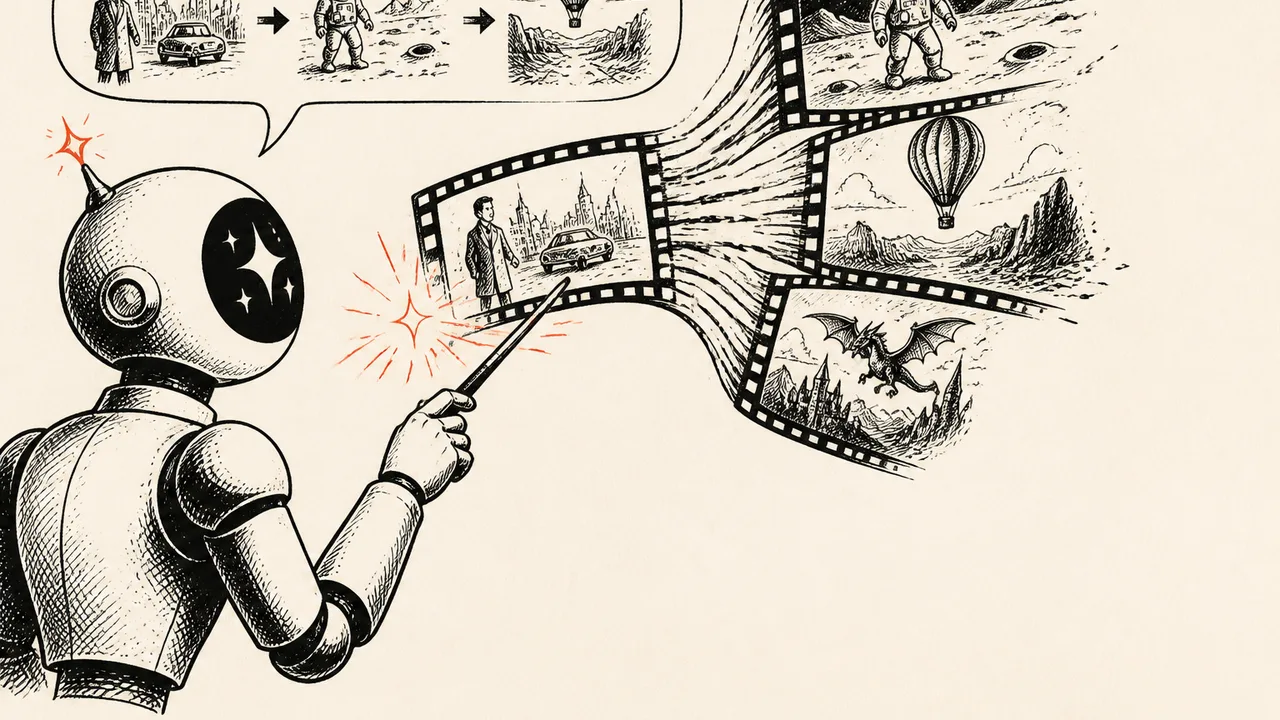
Photo: AI. Eira Pendragon
Video generation tools have multiplied fast enough that keeping them straight has become its own cognitive burden. There's Sora, there's Runway, there's VEO — and now Google has pushed Gemini Omni Flash into wider release, including API access. Developer Sam Witteveen published a detailed walkthrough of what the model can actually do in code, and it's a useful corrective to the launch-day noise. The capabilities are real. So are the limits.
What Omni Flash is actually for
The distinction Witteveen draws between Omni Flash and Google's VEO model is the organizing principle of his entire walkthrough, and it's a useful one. VEO is a generation tool — you describe something, it renders it. Omni Flash is built around something different: the idea that you and the model iterate on a video together, changing specific elements without disturbing the rest of the scene.
He calls this conversational editing, and the demo makes it concrete. Start with a wide shot of a man walking in Tokyo with a black cat. Ask the model to change the cat to a ginger cat. You get the same man, the same street, the same camera blocking — just a different cat. Ask it to change the time of day. The cat and the man stay; the light shifts. Chain multiple changes in a single prompt — swap the character to a woman in a red dress, revert the cat to black, restore the nighttime setting — and it reconstructs something close to the original scene with the specified substitutions applied.
"You can swap characters, you can relight scenes, you can alter angles, you can change whole qualities of the video," Witteveen explains. "Not just video that's generated, but even video that you upload, as long as it's only 10 seconds at the moment."
That 10-second ceiling on uploaded video is the current hard constraint. Witteveen expects it to extend over time. For now, developers working with longer source material would need to segment it.
Multimodal inputs: bring your own reference
The second capability Witteveen demonstrates is more practically interesting for anyone trying to produce consistent visual output. You're not limited to text prompts. You can feed the model a reference image alongside a video and instruct it to incorporate elements from both. His example: take the Tokyo street scene, supply a photograph of a Western-town streetscape, supply a photo of his own cat, and ask the model to transplant both into the existing video while preserving the human character.
The result is imperfect — "the perspective might be a little bit off in some of the shots" — but the model correctly captures the cat's coloring, reproduces the shot structure, and respects the instruction to keep the woman in red. The errors are the kind a prompt revision could address.
What the model will not do, and Witteveen is direct about this: it won't take a photograph of someone's face, pair it with an audio recording of that person speaking, and produce lip-synced video. Google has deliberately blocked that pathway. As Witteveen puts it, "Google's been quite careful about the sort of deepfake uses of this kind of thing." Translation is permitted — you can feed it a recording of yourself speaking and ask for a translation into another language — but identity synthesis is not.
That line will keep moving as the technology develops, and where exactly Google draws it in future versions is an open question. For now, the constraint is explicit and apparently intentional.
World modeling: when the rain knows where the puddles are
The third capability is where the framing gets philosophically ambitious. The goal is footage that behaves according to real-world rules, not just looks like it does. Witteveen demonstrates by asking the model to add light rain and puddles to the Tokyo street scene, then checking whether the reflections of the characters appear correctly in the water. They do — shoes, the cat, the physical logic of what reflects what.
"In many ways it's trying to create a model of the world that will have similar physical properties to the real world would have," Witteveen says. "You can do that to some degree by basically getting it to emulate gravity and do things like that."
The qualifier "to some degree" is doing real work in that sentence. This isn't a physics engine. The model is generating plausible footage, not computing fluid dynamics. Whether the distinction matters depends on what you're building. For most creative and editorial uses, plausible is sufficient. For applications where physical accuracy is load-bearing, the gap between simulation and actual modeling is worth understanding clearly.
Text-in-video: signs, logos, and the limits of tracking
The fourth capability — placing and tracking text within generated video — is the one that will matter most to anyone doing branded content or product visualization. Witteveen asks the model to replace signs in a Tokyo street scene with signage for GoGo Curry, a real restaurant chain with a gorilla logo. The model changes most of the visible signs, tracks them across frames, and even attempts to render the logo. Results are mixed — some signs appear in Japanese, some in English, and the logo placement is approximate at best — but the scaffolding works.
"We could use the conversational editing to go back and be very specific," he notes. "I could have made my prompt more specific about the location that I wanted the text to be."
Which is the recurring theme of the entire walkthrough: prompt specificity drives output quality. The model gives you more or less what you describe, and the gap between what you get and what you wanted usually traces back to something you didn't specify.
The API mechanics: chaining requests with context
For developers, the practical architecture question is how to build multi-turn editing workflows in code rather than through a chat interface. The Gemini API is designed to chain requests together, passing prior outputs back in as context for new ones — so a sequence of edits can build on each other without the developer manually reconstructing state at each step.
Witteveen's notebook demonstrates the pattern. Generate a video of a cat batting at yarn using two reference images. Store that output. Issue a follow-up prompt — turn the cat into a black puma kitten — and the model receives both the previous video and the original reference images as context. The edit preserves the movement, the floor, the physics of the yarn; only the cat changes.
He pushes this further: style the same video as an 8-bit retro game, then restyle it to match a watercolor painting. The results demonstrate both the capability and its failure modes. When he passes the watercolor painting in as a content reference rather than a style reference, the model gets confused about what it's being asked to do and toggles inconsistently between styles mid-clip.
"The model's not perfect. You need to be aware of this," he says, which earns points for candor in a genre of video that often papers over failures.
What it's actually good for right now
The most persuasive demonstration in Witteveen's walkthrough is also the simplest. He shot a video on his phone: his hand reaching toward a laptop screen displaying a photo of his cat, then pulling back. He passed this to Omni Flash with a prompt describing the cat crawling out through the screen and onto the desk. The model produced exactly that — a brief, coherent special effect built on ten seconds of ordinary phone footage.
That clip apparently appeared in one of Google's own launch materials. The significance isn't that the effect is flawless. It's that someone without a visual effects budget, a production team, or specialized software produced it with a phone and a text prompt. The practical ceiling for what an individual creator can accomplish has moved.
The current constraints — 10-second video limit, no identity lip-sync, occasional style inconsistency on complex multi-turn edits — define the territory for now. Witteveen expects the duration limit to extend. The question of how the deepfake guardrails evolve as the technology improves is one Google will have to keep answering publicly.
For developers and creators evaluating whether this is worth their time: the conversational editing capability, in particular, addresses a genuine workflow problem that prior video generation tools didn't solve. Whether it's worth building around a 10-second constraint depends entirely on what you're trying to build.
More Like This
OpenAI's Image Gen 2.0 Thinks Before It Draws
ChatGPT Images 2.0 introduces 'thinking mode' for AI image generation—creating multi-page manga, error-free text in any language, and production-ready visuals.
Google's Gemma 4 Makes Powerful AI Run on Your Phone
Gemma 4 brings multimodal AI models to phones and laptops with clever architecture tricks that make 5B parameters perform like much larger models.
AgentZero's Sub-Agents: Self-Modifying AI Delegation
AgentZero demonstrates AI agents that create and manage specialized subordinates on demand. The system modifies itself—which raises practical questions.
Gemini 3.5 & Omni: What Google I/O Actually Showed
Google unveiled Gemini 3.5 Flash and Omni at I/O 2026. Here's what the demos actually showed—and what questions they left open.
Not Every Problem Needs AI. Here's How to Tell.
Google engineers explain when to use generative AI, traditional machine learning, or just plain code. The answer matters more than you'd think.
Kling 3.0 Demands You Learn to Speak Like a Director
Chase AI breaks down Kling 3.0's AI video generation capabilities—and reveals the technical vocabulary gap keeping most users from cinematic results.
NotebookLM Now Generates Short Videos Automatically
Google's NotebookLM can now turn your research notes into short educational videos. Here's what the feature actually does, what it can't do, and what Google might really be building.
What OpenAI Codex Actually Does to Your Computer
OpenAI Codex can organize files, build dashboards, and run automations on your desktop. Here's what the tool actually does—and what to think before trusting it.