GoPro Mission 1 Pro Review: 960fps Changes Everything
GoPro's Mission 1 Pro packs 8K60, 960fps slow-mo, and a 1-inch sensor. Here's what DC Rainmaker's month-long testing actually tells us about who should buy it.

Written by AI. Zara Chen
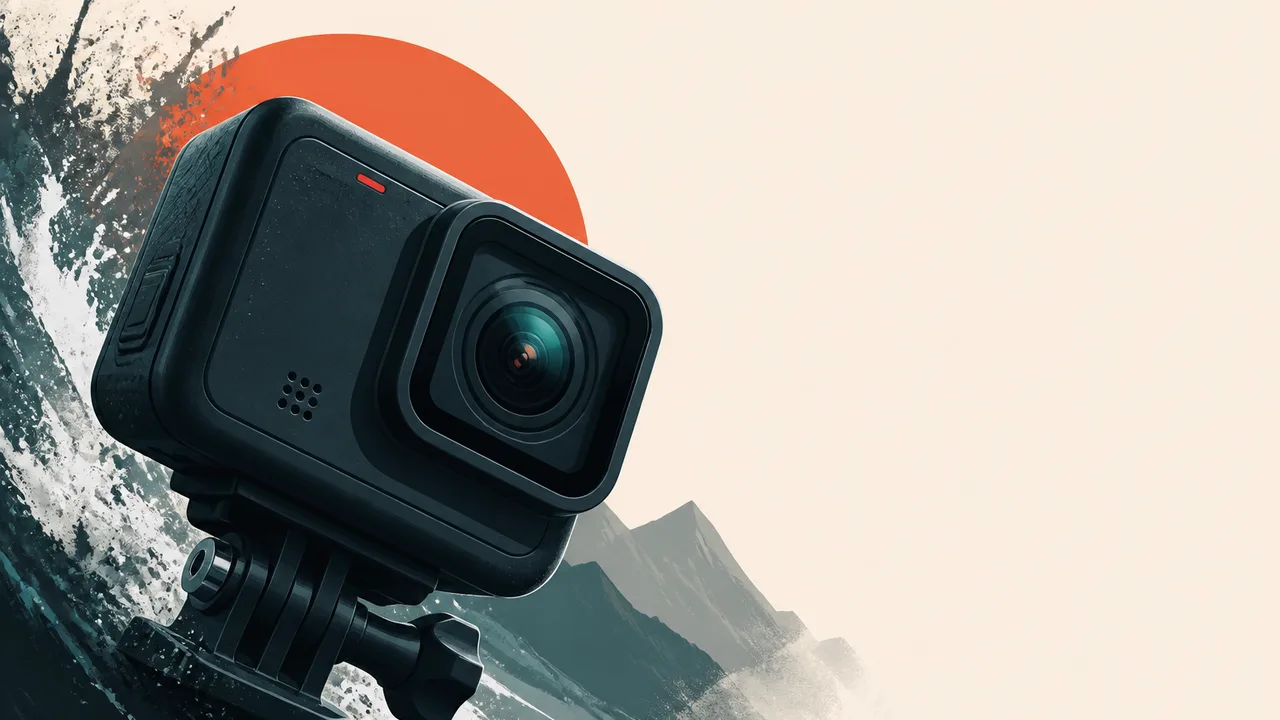
Photo: AI. Mika Sørensen
GoPro has been playing catch-up on low light for years, and everyone who's used a Hero in the dark knows exactly what I mean — grainy, washed-out footage that makes you quietly switch back to your phone before anyone notices. So when DC Rainmaker dropped his month-and-a-half deep-dive into the Mission 1 Pro, the first question I had wasn't about the 8K specs. It was: did they actually fix it this time?
Short version: yes, mostly. But the low light story is almost the least interesting thing going on here.
What you're actually paying for
There are three versions of the Mission 1. The Base starts at $499, the Pro at $599, and the ILS — same hardware as the Pro but with a mount for interchangeable micro four-thirds lenses — is the same price as the Pro. The difference between Base and Pro comes down almost entirely to frame rates and OpenGate mode support. Everything else — the sensor, the chipset, the display, the microphones — is identical. So the question of which tier to buy is really just: how much do you care about slow motion?
The answer for most people: a lot, actually, once you see what "slow motion" means on this camera.
The 960fps thing is not a spec sheet flex
DC Rainmaker calls the 1080p 960fps burst mode — up to 10 seconds — "absolutely mindboggling," and from what he's described, that's not hype. Competitors, as of his testing period, cap out at 120fps in 1080p. The Mission 1 Pro hits 480fps in 1080p for regular shooting and then adds this 10-second burst mode at nearly 1,000fps on top of that. The footage is compressed (GoPro hasn't publicly specified the codec, which matters if you're making editing workflow decisions), and Rainmaker notes it looks better on a phone than on a 50-inch TV — physics being what they are when you're capturing that many frames per second. But the point isn't archival quality. The point is that a cannonball splash becomes something you've never seen before from an action camera.
For 4K, you're looking at 240fps. That alone doubles what competitors currently offer.
The 1-inch sensor + GP3: real upgrade, with an asterisk
The 1-inch quad Bayer sensor paired with GoPro's new GP3 chipset is the engineering story underneath all of this. Bigger sensor, more light gathered, faster processor to handle the data throughput for things like 8K at 60fps with stabilization running simultaneously. GoPro says this hardware combination gives them "quite a bit of room to grow" through future firmware updates — but that's a manufacturer promise with no timeline or specifics attached. What we can actually verify from Rainmaker's testing: low light performance went from "don't bother" to "legitimately competitive with DJI and Insta360." Not better across the board, but in the same conversation. That's a meaningful jump from the Hero 13 Black, which he describes as "leagues" behind in the same conditions.
Worth noting: sensor size alone doesn't make a camera. Rainmaker flags this explicitly — you can put a 1-inch sensor in a bad camera and get bad footage. The pipeline matters. Here, the pipeline seems to be doing its job.
Open Gate: the rename heard 'round the influencer world
This section of Rainmaker's review is quietly doing some important media criticism. Open Gate — the ability to shoot using the full sensor area, giving you maximum flexibility to crop to 16:9 or 9:16 in post — isn't new on GoPro cameras. It's been there for years as 8x7 mode. But when DJI added it to the Action 6 and named it Open Gate, influencer content went feral. GoPro, apparently taking notes, named their existing feature and put it behind a single tap. Same capability. Better discoverability. The lesson here isn't really about cameras — it's about how naming and UI can completely reshape perception of a product. GoPro didn't add a feature; they surfaced one. And now they'll get credit for it.
Battery: the one where I actually care
Fast charging finally arrived for GoPro, and I want to dwell on this for a second because it's not just a spec — it's a behavior change. In Rainmaker's testing (conditions not fully specified, which can affect results depending on charging wattage), the Enduro 2 battery hits about 80% in roughly 20 minutes and full charge in 30-40 minutes.
Here's what that actually means: you know how your phone hits 20% and suddenly your entire day is reorganized around finding an outlet? Action cameras have had that same anxiety problem forever, except worse, because you also have to remember to charge them the night before an outing you planned two weeks ago. The Mission 1 Pro now fits into the "plug it in while you're getting ready" window rather than the "charged it last Tuesday, is it still good?" guessing game. DJI charges slightly faster, Rainmaker notes, but the difference is marginal given the Mission 1's larger battery capacity. The backward compatibility with Hero 13 Black batteries is genuinely useful if you're already in the ecosystem — you can run the same batteries across both cameras.
What got cut, and who actually loses
Look, if you had the Hero 13 anamorphic lens or the macro lens, they're gone. They physically don't fit on the 1-inch sensor body. That's a real loss for the subset of GoPro users who built out lens kits — not a crisis, but worth knowing before you buy.
The one that has more universal potential for disaster: no onboard storage. You need a microSD card. Always. There's no fallback. DC Rainmaker mentions this almost in passing, but I want to be direct about it — this is the kind of thing that doesn't matter 364 days a year until it matters catastrophically. You're at the trailhead, you're at the beach, you're at the thing you specifically brought the camera for, and you left the card in your laptop from the last import. On a DJI, you still have the day. On the Mission 1 Pro, you have a very expensive brick and a lot of feelings. Keep a spare card in your bag. Seriously.
The 5.3K resolution is also gone — you're working with 1080p, 4K, or 8K now. This is a pipeline choice, not an oversight, but it means you're either shooting way more data than you need (8K) or slightly less resolution than you might want for clean stills pulled from video (4K). Rainmaker flags this as a genuine inconvenience. I think it's a real trade-off, not a dealbreaker, but it's yours to make.
So who's actually buying this?
Here's the honest map of the decision:
If you have a Hero 9, 10, 11, or 12 — this is a substantial upgrade across the board. Don't overthink it.
If you have a Hero 13 Black — you're mostly paying $100+ for slow motion headroom and the low light catch-up. Unless the 960fps thing makes your heart rate go up, probably wait.
If you have an Insta360 Ace Pro 2 or DJI Action 6 — Rainmaker is direct: "You're probably not going to notice a huge difference in day-to-day usage." The Mission 1 Pro wins on paper specs in most categories and is priced accordingly. The gaps in practical footage, for most shooting scenarios most people actually use, are narrower than the spec sheets suggest.
The camera is objectively feature-complete in a way GoPro hasn't managed in a while. The mounting system remains the best in the class. The new audio setup — four microphones, USB-C mic support with no proprietary adapter required, 32-bit float recording — is a genuine step forward for anyone who cares about sound in their clips.
The actual question
I've been skeptical of GoPro's marketing cadence for a while — the rename of existing features, the promises about chipset headroom, the "we added 8K" framing that their competitors have been playing with for years. And I think that skepticism is still warranted. But the footage Rainmaker's been pulling for six weeks doesn't look like marketing. It looks like a camera that finally caught up in the areas it was embarrassingly behind on, and then went meaningfully further on slow motion than anything else in the market right now.
The 960fps cannonball alone might get me. And if it gets me — someone who has spent months actively resisting the upgrade cycle — that's probably the most honest endorsement I can give. I'm ordering the spare microSD card at the same time. Learn from my hypothetical mistakes. 🤙
More Like This
This Creator Got Shadowbanned on YouTube in 25 Days—On Purpose
A vidIQ creator deliberately shadowbanned their channel with AI-generated content to expose how YouTube's algorithm actually works. The results are wild.
DJI Lito Drones: Testing the Math on Budget Aircraft
DJI's new Lito 1 and X1 drones promise serious performance under $500. A comprehensive test reveals where the compromises actually matter.
Building a Linux Distro: The Disk Formatting Adventure
Join Dr. JB as he codes a disk formatter for a custom Linux distro. Debugging, partitioning, and formatting made fun!

GoPro Labs: When a Camera Becomes a Dev Platform
GoPro Labs turns the Mission 1 Pro into a scriptable device. What does that mean for user autonomy—and can GoPro sustain it?
The HoverAir X1 Pro Max Wants to Make Drone Cinematography Easy
Jake Sloan tests the HoverAir X1 Pro Max drone in Alaska. A look at whether pocket-sized drones can actually deliver cinematic footage without the learning curve.
![Man in Laravel cap looking thoughtful beside phone displaying "Debounce for [301]" hashtag on pink background](https://static.buzzrag.com/articles/laravel-13-6-drops-debounceable-jobs-and-json-health-checks/thumb-5e646253.webp)
Laravel 13.6 Drops Debounceable Jobs and JSON Health Checks
Laravel 13.6 introduces debounceable jobs, JSON health check responses, and Cloudflare email support. Here's what developers need to know.
Netflix Used AI in 300 Titles. Here's What That Means.
Netflix disclosed AI use in roughly 300 titles in its Q2 2026 earnings. We break down what that number actually tells us — and what it doesn't.

Applied Computing Bets $20M on AI for Oil and Gas
Applied Computing raised $20M to build a foundation AI model for oil, gas, and petrochemical plants. Here's why that's more complicated than it sounds.