Gen Alpha's Reading Decline Is Bigger Than Screen Time
Gen Alpha's reading crisis isn't just about phones. A new ColdFusion video maps the deeper structural failures—testing culture, burned-out teachers, and checked-out parents.

Written by AI. Marcus Obi
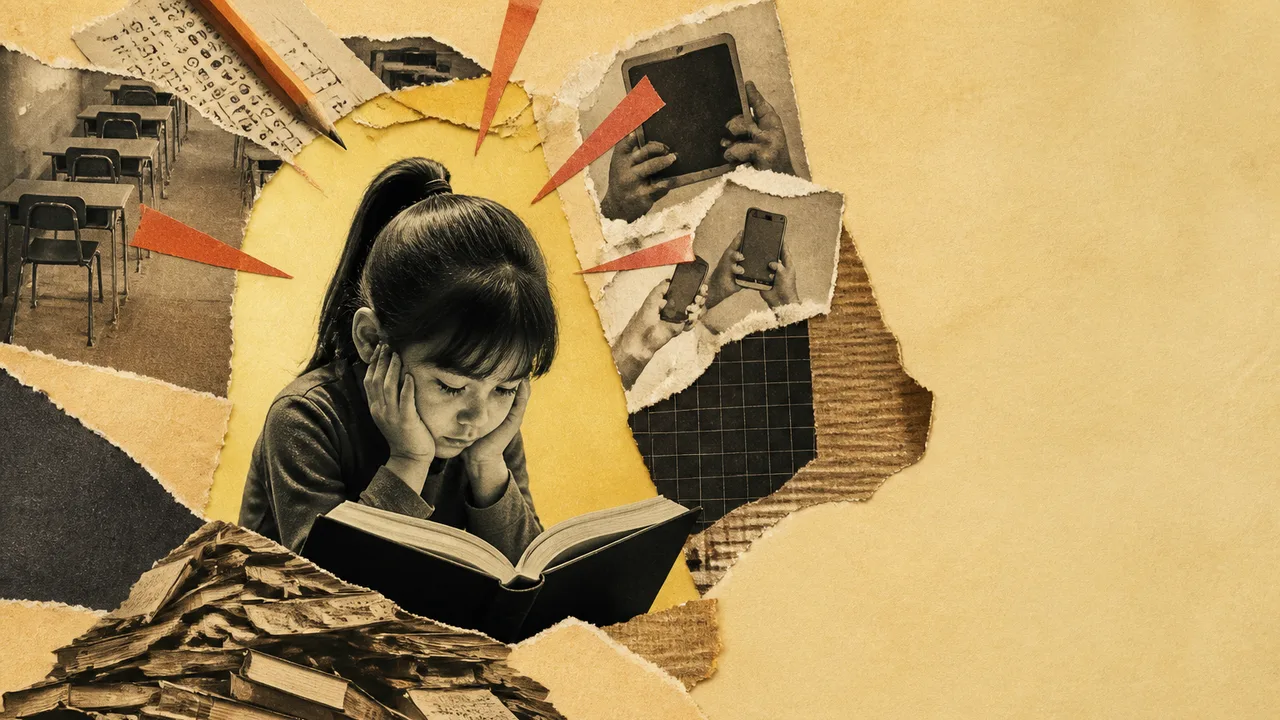
Photo: AI. Wren Sugimoto
There's a video clip making the rounds where a teenager is asked to read an index card aloud. What comes out is something like: "president affection... reflected... deeply engraved... diver de viral resilience." The words are right there. They have not moved. And still—nothing.
My twins are seven. They're currently at the age where reading feels like a magic trick they're slowly, painstakingly, gloriously learning to perform. I watch them sound things out and I feel it—that specific parental cocktail of pride and dread. Pride because look at them go. Dread because I've read enough to know what's waiting for them on the other side.
A recent ColdFusion video by Dagogo Altraide digs into that dread with some real rigor, and it's worth unpacking—not because it delivers easy answers, but because it refuses to.
The Headline Number Is Real, But It's Misleading
You've probably seen the statistic: 40 to 65 percent of American kids can't read. It's been circulating in various forms, and it's technically drawn from the Nation's Report Card—the large-scale national assessment that sorts students into basic, proficient, and advanced categories across grades 4, 8, and 12.
Here's what the video gets right: that framing is doing a lot of work. When you look at what's actually shifted in the data, advanced and proficient readers have barely moved. The kids who are falling are the basic readers—the ones who were already behind. The gap that standardized testing was supposed to close is, by this measure, wider than ever.
That's a more precise and more troubling claim than "half of kids can't read." It says the system is failing the kids who most needed it to work.
Teaching to the Test: A 40-Year Experiment With Mixed Results
The video traces the structural origins of this to the 1980s, when governments across the UK, US, and Australia started noticing wide regional disparities in educational outcomes and decided the fix was standardization. National curricula. Shared benchmarks. High-stakes testing. No Child Left Behind in the US. The Education Reform Act in the UK. The logic seemed sound: set common targets, measure performance, let schools compete to be better.
What happened instead, the video argues, is that teachers—reasonably, rationally, in response to real professional pressure—started narrowing their curriculum to what the tests measured. A researcher cited in the video made this point as far back as 2007, arguing that standardization pushed educators to orient lessons around short-term score gains rather than long-term comprehension and growth.
By 2015, author Anya Kamenetz was documenting in The Test how students were sitting through as many as 113 standardized assessments before graduation. One expert interviewed for the video put it plainly: the psychometricians who design these tests will tell you they're being used in ways they were never intended for, and that "proficiency"—the legal standard under No Child Left Behind—doesn't have a single scientific definition.
So we built a multi-decade accountability infrastructure on a metric that doesn't mean what we think it means, and then we're surprised the outcomes are soft.
Okay, But What About the Phones
Yes. Obviously. The phones.
The ColdFusion video is honest that technology is the easy scapegoat—and then makes the case that it's also genuinely part of the problem, just not in the way most of the discourse assumes.
The more interesting angle isn't screen time as a moral panic. It's the neuroscience of handwriting. Norwegian neuroscientist Audrey van der Meer published a 2024 paper—the result of two decades of research—showing that writing by hand involves thousands of coordinated micro-movements that engage memory, sensory integration, and spatial reasoning simultaneously. Typing, by comparison, barely registers. Every keystroke is identical; the brain has no work to do.
As van der Meer explains in the video: "You use your intricate finger movements to produce forms on a surface. Whereas when you're typing, it's just these simple finger movements that are actually exactly the same for every letter that you're trying to produce."
The practical implication is already showing up in classrooms. In some schools where older students were given the choice to opt back into pen and paper, most did. One teacher described the shift as "chalk and cheese"—more comprehension, more dialogue, more critical thinking. That same teacher was careful to note: "I don't think devices are making kids dumber... What I think they are doing is stopping kids thinking for themselves."
That distinction matters. The device isn't the villain. The outsourcing of cognition is.
On the AI front, the video raises a separate concern: schools are not only letting students use AI to avoid thinking—some schools are using it to avoid teaching. The example offered is a JCPS school agenda where Kentucky appeared as "Vineki," Indiana as "Anol Lano," Louisiana as "Lukong." These are not typos. These are hallucinated state names, copy-pasted into a student handout because somebody let a chatbot write their lesson plan. That's not a technology problem. That's an institutional abdication.
The Parent Problem Nobody Wants to Talk About
Here's the part of the video that's hardest to sit with: the reading crisis isn't only a school crisis.
A reading researcher cited in the video argues that the modern environment simply isn't structured around deep reading—and that this starts at home. Fewer than half of parents with kids up to age 13 say they find reading aloud fun. According to the video, the share of children aged 0 to 4 who are read to regularly dropped from 64 percent in 2012 to 41 percent more recently.
That one stops me cold every time I see it. Because I know, rationally, that reading to my kids is one of the most impactful things I can do for their development. And I also know that by 7pm on a Tuesday after a full day of twin-wrangling, the book sometimes stays on the shelf while everybody watches something that requires zero effort from anyone. I know the right answer. I don't always do the right answer.
That gap—between knowing and doing—is real for a lot of parents. And the video is right to name it, even if naming it alone doesn't fix it.
What Singapore and Finland Are Actually Doing
Both countries get cited in the video as counterexamples, and the pattern between them is worth noting: both have moved away from high-stakes standardized testing as the center of their educational philosophy, and both give teachers more professional autonomy rather than managing them to a narrow metric.
Singapore still has technology in classrooms. Kids still have phones and tablets. But the video notes that administrators monitor use carefully, restrict devices during class and recess, and have set boundaries around nighttime access. Finland, meanwhile, limits technology in primary education and pushes low-stakes assessment over the kind of test-prep culture that's consumed so many American classrooms.
I read these sections and I feel that particular mix of inspiration and exhaustion that I suspect most parents feel. It's one thing to know Finland is doing it better. It's another thing to live in a system that has 40 years of institutional momentum pointed in a different direction—and to have your actual children enrolled in that system right now, today, while the policy debates continue.
The Kids Are Not the Problem
The video saves its most clarifying point for near the end: when British kids aged 6 to 15 were asked what they actually wanted to learn, they said financial literacy, psychology, music, how to survive in the wild. A 14-year-old named Sam said he wanted money management skills. A 15-year-old named Tara wanted to understand why people judge each other so quickly.
These are not the answers of a generation that has given up on learning. These are the answers of kids who are curious about real things and are sitting in classrooms that aren't offering them real things.
As the video's host puts it: "The kids are still curious. They still want to learn... But the only thing that appears to be stopping them is a system that's failed."
The reading crisis is real. The data on struggling readers, on attention spans shaped by short-form content, on the 2025 Common Sense Media Census showing 40 percent of two-year-olds already on tablets—all of it points somewhere. But the place it points is complicated. It's a 40-year policy bet that didn't pay off. It's a technology rollout that happened faster than anyone could study. It's parents who are exhausted and under-supported. It's teachers who are burned out and over-tested.
The question isn't whether Gen Alpha is dumber. The question is what a generation of curious kids looks like when the system built to serve them is optimized for everything except their curiosity.
More Like This

Eckhart Tolle Says You're Not Who You Think You Are
Eckhart Tolle's 'historical self' vs 'deep eye' framework is either profound or a very elegant dodge. A parenting writer tries to figure out which.

Handwriting Beats Typing for Learning, Studies Find
New research shows handwritten notes improve memory and recall more than typing. Here's what the science says — and what it actually means for kids and parents.
Reading Is a Physical Skill, and We're Out of Shape
Movement science writer Kira Yoshida on why sustained reading is hard in 2025 — and why the productivity-reading complex is making it worse.
Dr. K Walked Into Chaos and Won the Room
Dr. K's Tiger Belly appearance is a masterclass in social dynamics. Here's what the Charisma on Command breakdown gets right—and what it glosses over.

Smartphones and the Global Baby Bust
John Burn-Murdoch's data on falling global birth rates points to smartphones as a key driver—and the mechanism looks familiar to anyone who covers collective action failures.
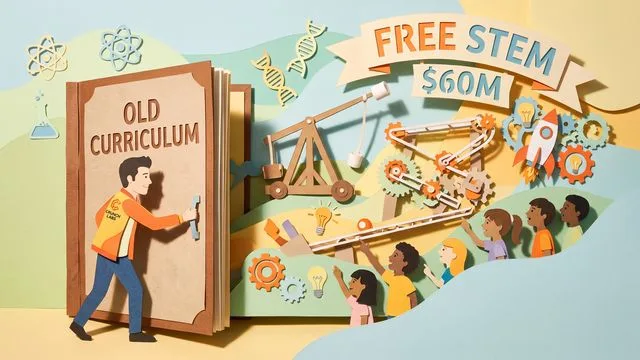
Mark Rober's $60M Free Science Curriculum Bet
Mark Rober is spending $60M to give free STEM curriculum to every teacher in America. The education bet is the headline. The business story underneath it is what caught my eye.

Animal Empathy: What Science and Instinct Both Get Right
Do some people genuinely connect with animals in extraordinary ways? Marcus Obi explores the science of animal empathy, what research actually supports, and what it means for the rest of us.
Active Recall: The Study Method Worth Knowing
Active recall means testing yourself instead of re-reading. Here's what the science actually says — and what the tidy frameworks leave out.