Inside FIFA World Cup 2026's Massive Logistics Machine
Over 50,000 shipments, three countries, 16 cities. How FIFA's logistics "control tower" keeps the 2026 World Cup moving behind the scenes.

Written by AI. Marcus Tate
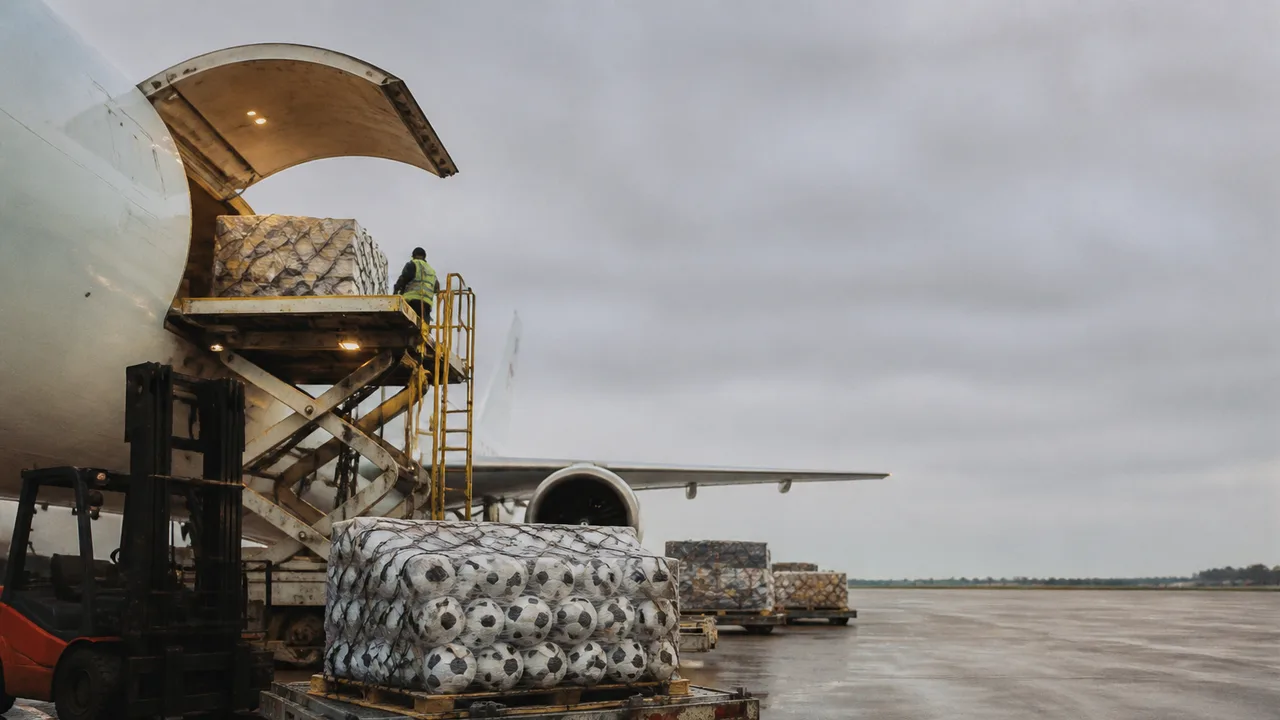
Photo: AI. Marcel Dubois
Turn SoFi Stadium upside down and shake it. Everything that falls out — every chair, every branded hospitality partition, every match ball with its embedded tracking chip — had to get there through a supply chain that crosses three national borders, threads through customs regimes, navigates venue security protocols, and lands in the right loading zone on the right day at the right hour. That framing comes directly from the logistics team coordinating the 2026 FIFA World Cup, and it is a more useful mental model than anything involving ribbons or opening ceremonies.
The numbers frame the scale before the complexity does. In just one month of operations, the logistics apparatus behind the tournament processed more than 50,000 shipments and moved tens of millions of pounds of freight into and out of World Cup venues. Sixteen host cities. Three countries. Dozens of stadiums, each of which FIFA requires to be stripped of its existing commercial identity and rebuilt to FIFA specifications — naming rights gone, every square foot of hospitality space refitted with FIFA's furniture, branding, and aesthetic. As one logistics official put it to Front Office Sports: "They want every room, every hospitality square footage, everything within the building is their look, their feel, their branding, their furniture and their approach."
That commercial requirement alone generates an enormous amount of freight movement — and that is before you account for the equipment that makes the actual competition possible.
A Control Tower, Not a Coordinator
The organizational concept sitting at the center of this operation is what the team calls a "control tower" — a centralized intake and distribution mechanism for every logistics demand generated by the tournament. The metaphor is deliberate. Air traffic control does not fly the planes; it manages the airspace so the planes do not collide. The World Cup's control tower operates on the same principle: demand pours in from sponsors, suppliers, venue managers, and FIFA itself, and the tower routes each request to the appropriate specialist.
"Not only have we been preparing for 2 years, but the preparation continues every single day," one official explained. "We pulled together a concept called a control tower where you think about it, all the demand kind of pours into that control tower and then it gets distributed out."
What makes this architecture worth examining is not the concept itself — event logistics operations have used centralized coordination models for decades, including at the Olympics — but the specific friction points it is designed to absorb. The team described a layered series of "bumps in the road" that any shipment encounters on its journey from manufacturer to pitch. At each bump, a different specialist within the control tower takes over.
The first bump: a supplier knows it needs to move goods but has no framework for international freight at this scale. An inbound request coordinator steps in and assigns an operator. The second bump: that operator encounters customs classifications, venue access restrictions, and regulatory requirements that are specific to a tri-national tournament of this size. A logistics and freight coordination specialist handles that layer. The third bump: scale. What looked like a manageable shipment is actually a thousand units that need to be warehoused across a distributed network and deployed cohesively. A warehouse and distribution specialist manages that layer. The fourth bump: the stadium itself, which is not a simple delivery address. Every venue has a delivery guide specifying loading zone access windows, unloading procedures, and credentialing requirements. And underpinning all of it is what the team calls an MDS — a master delivery schedule — a booking and appointment system that is standard for events at this tier.
The architecture is sensible. Whether it is sufficient is the more interesting question. As the control tower team acknowledged plainly: "We can't control the weather. We can't control a mechanical break on an airplane. We can't control whether a truck breaks down." Contingency planning absorbs what coordination cannot prevent.
The Ball Problem Is Actually Several Problems
The competition ball supply chain deserves particular attention because it illustrates how seemingly routine objects become logistically complicated the moment you embed technology and brand specificity into them.
Each match ball used in the 2026 World Cup carries a chip that tracks whether the ball crosses the goal line — part of the semi-automated offside and ball-tracking systems FIFA has deployed in recent tournaments. Under international shipping regulations, that chip classifies the ball differently than a standard consumer product. It crosses into the category of goods requiring additional documentation and handling protocols. "A chip in a football or a soccer ball to track whether the ball crosses the line is not just a simple item that you just transport across borders," the logistics team noted.
Beyond the regulatory classification, the balls carry match-specific printing. Every ball used in competition is printed with the names of the competing nations — which creates an acute supply chain problem in the knockout rounds. When two teams advance to a match that was not known until the previous round concluded, the window between confirmation and kickoff can be as short as 48 hours. A ball printed in Dallas may need to reach Toronto for a match two days later.
"When you get to the knockout stage onward is when it gets much more complicated," one official explained, "because sometimes you have 2 days between when you know who's going to compete, which means the balls go into the printing machine with 48 hours notice, let's say in Dallas, before it has to be in Toronto for that match."
The inventory math compounds this. A few thousand competition balls are reportedly in circulation across the tournament at any given time, moving between stadiums. At any single venue on any single matchday, the number in play may reach approximately 100 — accounting for the balls that leave the field of play permanently because a fan catches one in the stands, a cleat punctures it, or the embedded tracking battery fails mid-match. The logistics team maintains redundancy at every node precisely because attrition during a live match is not a hypothetical.
What This Costs, and Who Bears It
The operational picture presented here is genuinely impressive as a coordination achievement. It is also worth holding alongside the financial architecture of the tournament itself.
FIFA projects roughly $11 billion in revenue from the 2026 cycle, according to public reporting, while host city economics have proven considerably more ambiguous — several cities have quietly revised their expectations for net benefit downward as operational costs have become clearer. The logistics infrastructure described above is largely borne by the supply chain ecosystem around FIFA: sponsors, official logistics partners, and the tournament's own operational budget. But the stadium transformations — stripping naming rights, refitting hospitality spaces — represent a direct cost to the venues hosting matches, and the financial terms governing who pays for what in that conversion are not publicly detailed.
The broader fault lines surrounding the tournament — from heat scheduling concerns to visa complications for international fans — add layers to any operational stress test. A logistics chain built for 50,000 shipments under normal conditions has to absorb disruptions that originate well outside the control tower's jurisdiction.
Two years of preparation, and the work still does not stop. That is not a complaint from the people running this operation — it is simply the nature of what it means to move a tournament of this magnitude across a continent. The control tower concept is elegant in its modularity: divide the complexity into specialist lanes, route each problem to the right expert, maintain visibility across the whole. The question the tournament's final weeks will answer is whether the architecture holds when the knockout-stage calendar compresses, the weather turns, and a truck breaks down somewhere between Dallas and Toronto with a crate of printed match balls in the back.
More Like This

Trump, FIFA, and the Balogun Reinstatement Explained
Trump called FIFA's Infantino to contest Folarin Balogun's red card ban. FIFA reversed it. Here's what we know—and what remains unanswered.
Kenny Beecham's Bold Bet on Media Ownership
Kenny Beecham turned down $1M to build his own sports media empire. Here's how ownership transformed his journey.

World Cup 2026 Is Reshaping US Tourism's Global Image
The 2026 World Cup is reversing a slump in international visits to the US—but the real story is what travelers are discovering beyond New York and LA.

Mark Cuban on Why NBA Ownership Isn't Fun Anymore
Mark Cuban explains how private equity reshaped NBA ownership, why he sold the Mavericks, and what NIL, Vegas expansion, and prop bets mean for pro sports.

How AI Is Rewiring Pro Sports Scheduling
Fastbreak AI is building the schedules for the NBA, NHL, MLS and 50+ leagues. Here's what that actually means for how leagues operate.

World Cup Jobs Boom That Never Came for US Workers
Goldman Sachs predicted the World Cup would add 40,000 jobs in June. Instead, hospitality shed 55,000. Here's what the miss reveals about who absorbs forecast risk.

Big Tech's AI Spending Has a Free Cash Flow Problem
Big Tech's AI investment boom is straining free cash flow, raising questions about circular financing, inflated valuations, and whether the returns ever materialize.

MLB at Midseason: Attendance, ABS Data, and Fanatics Fest
MLB's All-Star break numbers show attendance gains, ABS data reveals umpire accuracy, and Fanatics Fest eyes profitability in year three at the Javits Center.