World Cup Vibes Shift, Women's Soccer Builds
The USMNT's exit darkened the World Cup mood, but Gotham FC, the Big 12-Monster deal, and Apex Capital's NSL bet tell a longer story.
Written by AI. Marcus Tate
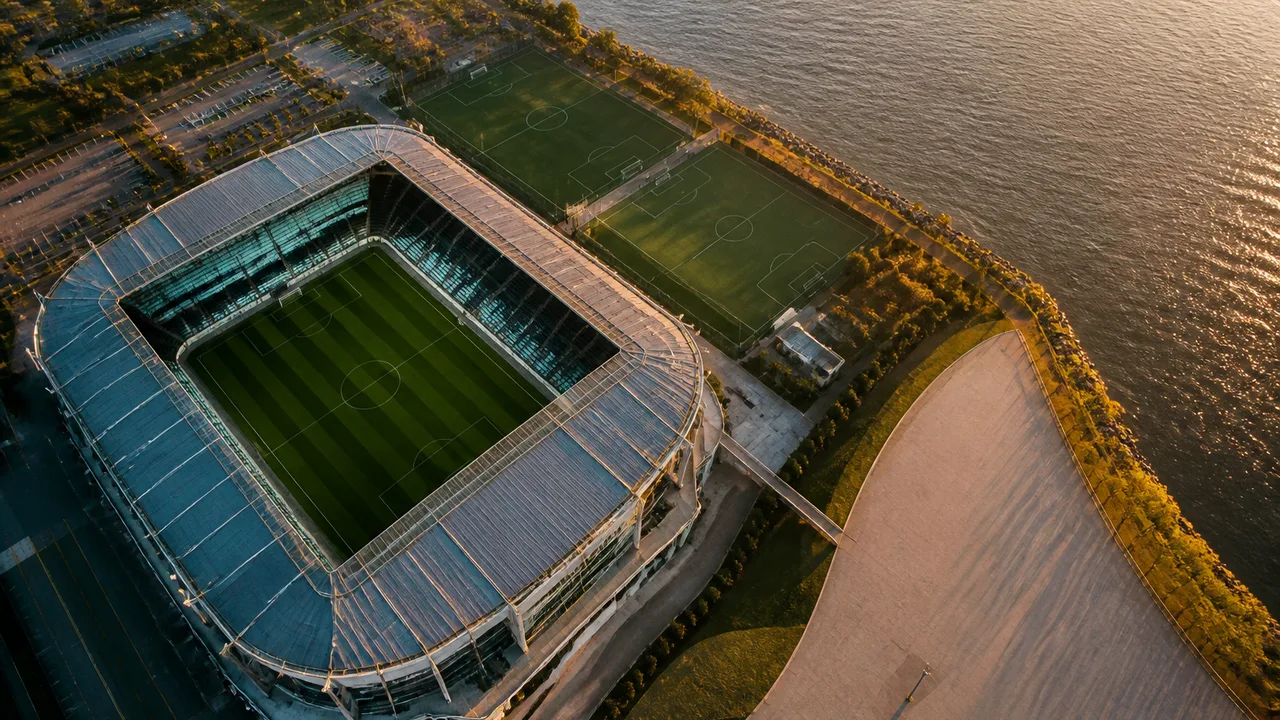
Photo: AI. Rio Sanchez
Narratives in sports don't erode — they flip. One loss, one political moment, and the column inches that were celebrating a new era are suddenly cataloguing a familiar failure. That's where the World Cup finds itself as it enters the quarterfinal round, and it's worth separating what has actually changed from what the commentary cycle wants you to believe has changed.
For the better part of three weeks, the story out of this tournament was uniformly positive: sold-out venues, engaged crowds, a U.S. men's team that looked tactically coherent and drew genuine praise for its style of play. Then came the loss to Belgium on Monday night, and the rhetorical machinery shifted in the way it always does. As SBJ's Abe Madkour noted on Wednesday's Buzzcast, "the columns and the hot takes are all about what a massive missed opportunity this was for men's soccer in America and how the growth of men's soccer has failed or stagnated."
That's a significant overstatement of what one quarterfinal exit proves — but it's also not entirely wrong as a structural critique. American men's soccer has long operated on a cycle of breakthrough promises and organizational underdelivery. One tournament run doesn't resolve that, and one exit doesn't confirm it. What makes this moment genuinely interesting, commercially speaking, is what happened to the television audience even as the USMNT's run ended.
Viewership That Outlasts the Home Team
The USMNT match against Belgium, according to SBJ, drew record soccer viewership in U.S. history on Fox, with a combined audience across Fox and Telemundo that reached 42 million viewers. That is an extraordinary number for any live event in the current fragmented media environment, and it lands differently when you consider that the audience wasn't watching a winner — it was watching an exit.
The question the broadcast and rights holders now face is durability. North America's three co-host nations — the U.S., Mexico, and Canada — are all out. The remaining quarterfinal bracket features France, Morocco, Spain, Belgium, Norway, England, Argentina, and Switzerland. For a domestic audience, that's a less emotionally freighted draw. Argentina and Messi carry genuine cross-demographic pull in U.S. markets. France and Mbappé are recognizable beyond hardcore soccer circles. But the governing logic of American sports viewership is still largely rooted in whether a home team is playing, and that variable is gone.
Madkour frames it well: "We will have to see how these ratings hold up with the US team out, with Mexico out, with Canada out." That's the honest question. The record-breaking viewership demonstrated that the audience ceiling for soccer in America is higher than skeptics assumed. Whether that ceiling holds without the domestic hook — or whether it reverts closer to the floor — is what the next eight days will actually measure.
The political subplot adds a layer that broadcasters and FIFA would plainly prefer didn't exist. President Trump is slated to present the World Cup trophy in New York on the day of the final, a detail that guarantees the tournament's closing image will be filtered through a partisan lens regardless of who wins on the pitch. Madkour acknowledges this straightforwardly, noting it will "present another element around politics and the World Cup." How that plays in international markets — where the U.S. brand already took some reputational damage during the tournament — is a variable that defies easy modeling.
Gotham FC's Calculated Upgrade
The cleaner story Wednesday, from a business architecture standpoint, belongs to NWSL's Gotham FC. The club announced a five-year lease to play home matches at Etihad Park — the new stadium being built for NYCFC in Willets Point, Queens, adjacent to Citi Field and the USTA National Tennis Center — beginning when the venue opens.
The current arrangement at Sports Illustrated Stadium in Harrison, New Jersey, which Gotham shares with the New York Red Bulls, has never been a natural fit for a club trying to build an identity as a flagship New York women's sports franchise. A shared facility in New Jersey is not a brand statement. Etihad Park is.
The venue will be branded in Gotham's colors for home matches — not a sublease arrangement where the tenant accepts whatever environment the primary occupant left behind, but a genuine presentation as a home ground. Governor Carolyn Tisch Blodgett, speaking on CBS This Morning, described the move as consistent with the club's "vision to be one of the top sports teams in the world." That framing is ambitious, but it's not disconnected from what the club has built on the field. Gotham won the NWSL title in 2023 and, per the club's own records, again in 2025 — confirmed at gothamfc.com.
The structural question worth watching: a five-year lease is a tenant arrangement, not ownership. Gotham FC will share Etihad Park with an MLS club that holds the primary position in the venue. Those arrangements can work — they can also create friction around scheduling, marketing priority, and revenue allocation. The initial terms read favorably for Gotham's profile-building ambitions. How the day-to-day operational reality develops once the stadium opens is a different chapter.
The Big 12's Relationship Capital
College sports conferences have spent the past several years discovering how many previously untapped assets they were sitting on. Jersey patches. Court logos. Season naming rights. The Big 12's deal with Monster Energy — a multi-year agreement worth approximately $20 million annually, making Monster the title partner of the conference's football and men's and women's basketball regular seasons — is the most aggressive execution of that logic to date.
The commercial structure distributes roughly $1 million per year to member schools. That's not a transformative number at the individual school level, but it's not nothing either, particularly as conference revenue-sharing models become increasingly complex under the new college sports labor framework. Critically, the deal doesn't foreclose schools from selling their own jersey patch inventory, provided there's no direct conflict with Monster.
What the deal actually demonstrates is something Madkour is emphatic about: "In the sports business, it's all about relationships. I can't stress that enough." The agreement grew out of the prior working relationship between Big 12 Commissioner Brett Yormark and Monster's Chief Partnership Officer Mitch Covington, forged when Yormark was at Roc Nation. Monster had already been the conference's official energy drink since the previous year — this deal is the expansion of an established commercial trust, not a cold transaction.
That's worth noting for anyone trying to reverse-engineer the Big 12's dealmaking velocity. Yormark has been notably aggressive in monetizing conference assets in ways his predecessors were not, but the deals aren't materializing from thin air. They're growing out of a network built over years in a different industry. The pipeline matters as much as the pitch.
Private Capital Reads the Women's Soccer Map
Private equity's appetite for sports assets continues to sharpen its focus on women's leagues, and Wednesday brought another concrete example. Apex Capital is investing up to $30 million in Canada's Northern Super League — an initial $20 million commitment with an option for an additional $10 million — giving the six-team league, which only launched last year, a valuation of approximately $85 million, according to Sports Business Journal's reporting on the deal.
According to SBJ, this marks Apex's first investment in women's sports. The firm's prior sports positions have been in NFL flag football and the TGL, and it's now moving into women's soccer at a moment when the asset class is generating real commercial traction. The NSL reported more than $30 million in commercial revenue — tickets, sponsorship, merchandise — across all team and league operations in its debut year, a figure that clearly anchored Apex's underwriting calculus.
The $85 million valuation on a one-year-old, six-team Canadian league will raise eyebrows in some quarters. Whether it holds or grows depends entirely on whether the league can scale its commercial base beyond that first-year momentum. Apex clearly believes it can — the structure of the deal, with the league using the capital to build out staff and infrastructure, suggests the firm is betting on organizational development as much as market maturation.
What the investment confirms, alongside Gotham FC's venue upgrade and the broader World Cup viewership story, is that women's soccer is no longer being valued on sentiment alone. The capital flowing into it now is looking at revenue lines, not just social equity narratives. That's a more durable foundation — and a more demanding one. The leagues and clubs that built their initial audiences on enthusiasm will now be measured against projections.
The World Cup's final week will answer some questions about American soccer's ceiling. The deals closed this week suggest that, regardless of what the scoreboard shows, the commercial architecture underneath the sport is still under active construction.
More Like This

World Cup Knockout Ticket Prices Drop 39% on Resale Markets
World Cup knockout stage resale prices fell 39% from $2,040 to $1,245. What the secondary market collapse reveals about FIFA's pricing architecture.

World Cup 2026 Economic Ripple Reaches Non-Host Cities
The 2026 World Cup is lifting hotels and spending in cities nowhere near a stadium. Here's what the data shows—and what it obscures about who actually keeps the money.

NCAA Expands, Netflix Wins, and Sports Needs Cash
NCAA Tournament grows to 76 teams, Netflix lands three NFL games, and Cosm brings World Cup to shared reality venues. The week's sports business, mapped.

PLL Raises $100M, Iger Eyes NBA Vegas Bid
PLL lands $100M Series E, Bob Iger and Josh Kushner explore a Las Vegas NBA bid, and Chicago Fire sign Lewandowski before McDonald's Park opens.

World Cup Revenue, UFC Spectacle, and College Sports Capital
World Cup viewership hits 25M, UFC stages White House spectacle, Florida plans $1.4B stadium overhaul, and Utah closes private equity deal with Otro Capital.

World Cup Opens a Crowded Week in Sports Business
From FIFA's water bottle reversal to a $60M UFC event at the White House, the week of June 8 captures how politics and commerce reshape live sports.

Rogers, Versant, and the NBA's Rule Lab: July 7 Briefing
Rogers consolidates MLSE, Versant buys Full Swing for $530M, and the NBA tests a one-free-throw rule. The sports business stories shaping July 7, 2026.
World Cup, Balogun's Reinstatement, and the Celtics Trade
USMNT faces Belgium in the World Cup round of 16, FIFA's Article 27 clears Balogun, and the Celtics' Jaylen Brown trade sparks ownership questions.