FAA's AI Air-Traffic Planning Faces a Human Test
The FAA is preparing an $875 million AI-assisted traffic planning rollout. Its value will hinge on data, transparency, stress tests and human judgment.

Written by AI. Kael Maddox
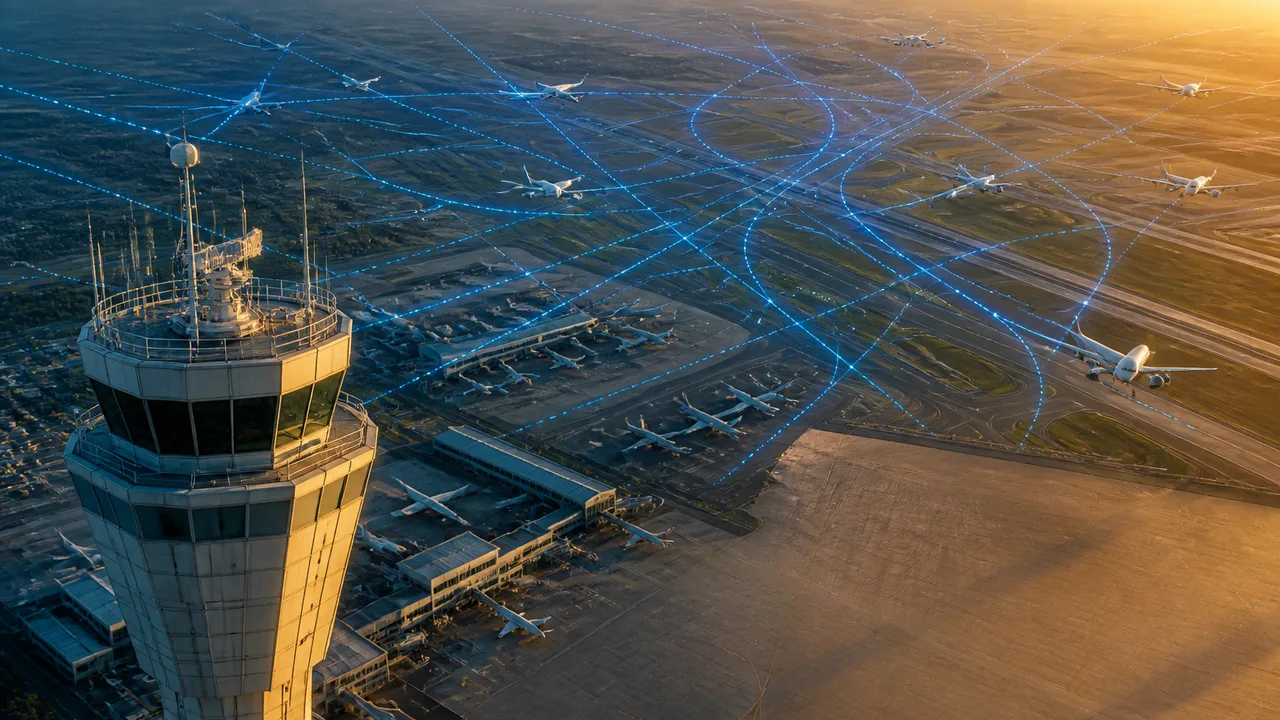
The Federal Aviation Administration is expected to begin rolling out an AI-assisted air-traffic planning system as early as Monday, September 21. Its initial role is decision support: helping planners manage disruptions and coordinate traffic across congested hubs while leaving final authority with human operators.
Calling this “AI air traffic control” oversells what the system is actually doing. It is expected to work farther upstream, helping planners manage pressure before it reaches the tower or cockpit. That could mean adjusting departure timing, spreading demand across airports and airspace, or intervening early enough to keep one bottleneck from becoming a network-wide problem.
The ambition is substantial. Ars Technica puts the program's value at $875 million, a figure also reported by TechCrunch. The public record supplied for this story does not establish how that money breaks down among software, infrastructure, integration, maintenance and training. It also leaves basic questions about the model, deployment locations and performance milestones unanswered.
Those gaps will matter long after the first press release has gone stale.
What the System is Supposed to Do
Air traffic produces an ugly planning problem. Weather moves. Runways close. Aircraft arrive late from previous legs. Demand can pile up at one airport while staffing or equipment constraints narrow the amount of traffic another facility can accept. Each intervention can push consequences hundreds of miles away.
Planners already use forecasting, scheduling and traffic-management systems to wrestle with that network. An AI layer could compare larger volumes of weather, airport and traffic data faster, then flag conflicts or propose responses while people still have room to act.
The system is expected to work before flights leave the gate, where planners still have more room to act. Once aircraft are moving, gates are occupied and weather starts closing routes, the number of good options can shrink quickly.
Imagine a line of thunderstorms threatening several major hubs. A planning tool could compare projected demand, available capacity and downstream connections, then test different restrictions before the disruption spreads. Human planners already do this work. The potential advantage of software is speed: running more scenarios, updating them faster and giving staff more options to consider.
But speed is only useful if the data is right. Late, incomplete or outdated information can undermine the entire recommendation. Bad data does not become good advice just because AI delivers it faster.
The Word “AI” Carr Too Much Luggage
The coverage shows how quickly language can outrun function. Travel Noire connects the system to flight safety and air traffic control, while Futurism's headline calls AI the “brain” of control towers. The supplied description supports a narrower role centered on planning and congestion management.
“AI” can refer to systems with very different capabilities, from machine-learning forecasts to optimization software and interfaces that generate recommendations. Without documentation on the architecture, training data and operating limits, the label says little about how the tool reaches an answer.
The $875 million figure has a similar problem. A large program price can reflect years of integration and support across a sprawling federal system. It cannot, by itself, establish that the underlying model is powerful, mature or appropriate for high-consequence operations.
That ambiguity is manageable if the FAA defines the tool through its behavior. What data does it ingest? How recent must those inputs be? Does it attach confidence levels to recommendations? Can supervisors reconstruct why it preferred one option? Under what conditions must staff disregard or disable it?
An answer such as “the model identified a better plan” would be useless in an operations room. Planners need to see the constraints, assumptions and trade-offs that produced the recommendation, especially when the proposal conflicts with experience.
Where Good Recommendations Go Bad
Routine days are easy. The real test comes when the system is under pressure, bad weather, equipment failures, staffing shortages and airport restrictions piling up at once. Those are exactly the situations where AI can be most useful, and most dangerous. A system trained around normal patterns may struggle when several unusual problems collide. At the same time, overloaded staff may be more willing to trust whatever answer appears fastest.
That is where automation bias becomes a real concern. If a system is usually right, presents its recommendations confidently and saves time, people may gradually stop questioning it. A tool does not need formal authority to become influential.
But trust can disappear just as quickly. If early recommendations waste time, miss obvious operational realities or trigger too many false alarms, users may start ignoring the system altogether. Then the one warning that really matters could arrive after its credibility is gone.
That makes training part of the safety system, not an afterthought. Operators need clear rules for when to follow, change or reject a recommendation. Supervisors need escalation procedures. Investigators need a record of what the system knew, what it suggested and what people ultimately decided.
Human oversight only works when humans still have the information, time and authority to say no.
Measuring More than Minutes Saved
Delay reduction will get attention because passengers feel it immediately. Everyone knows the misery of a rolling 30-minute delay, when leaving the gate feels risky and staying put feels like punishment.
But average delay is an easy number to celebrate and an easy one to game. Total minutes can fall even if the pain is simply shifted elsewhere—to smaller airports, less crowded routes or regions with less political visibility. One major hub can look more efficient because another part of the system absorbed the disruption.
So the real question is not just whether delays went down. It is where they went.
A credible evaluation would separate several questions:
- Did the recommendations reduce delays compared with the plans people would otherwise have chosen?
- How often did operators accept, alter or reject them?
- Did performance hold up during storms, outages and abrupt capacity changes?
- Were recommendations distributed fairly across airports and carriers, or did some parts of the network repeatedly absorb the cost?
- Could reviewers explain each consequential recommendation after the fact?
- How often did faulty or stale inputs affect an output?
Safety needs to be measured separately. A large investment may show commitment, but money spent is not proof that a system is safer. The real test is how it performs when conditions go wrong during unusual failures, overlapping disruptions and other scenarios where mistakes carry the highest cost.
The same standard should apply to public claims about performance. Minutes saved sound impressive, but they mean little without context: compared with what period, under what conditions and at which airports? A system tested mainly on smooth operating days can look far better than one measured during storms, outages and heavy congestion.
A good number is meaningless if the test was easy.
Monday Starts the Audit Trail
A cautious rollout can still reveal a lot. Used as decision support, the system gives the FAA a chance to compare AI recommendations with human judgment without handing over operational control. That should show where the tool helps, where staff reject it and where the process starts to strain under pressure.
What remains unclear is just as important. Public reporting has not established how broad Monday’s rollout will be, how quickly it will expand or what results the FAA intends to release. Without that, sweeping conclusions—positive or negative—would be premature.
Passengers may barely notice the system at all. Its impact could show up as a shorter ground delay, a cancellation avoided or simply a trip that runs as planned. For controllers and planners, though, it will become one more input competing with weather, traffic and the clock.
Trust should follow the evidence, not arrive before it.
More Like This

JetBlue BlueFirst: What the A320 Cabin Shift Means
JetBlue's new BlueFirst cabin adds 12 first class seats to its A320 fleet. Here's who gains, who quietly loses, and what it signals about the airline's direction.

Hotel AI Visibility: Why Google Rank No Longer Guarantees Discovery
Hotels that rank well on Google are disappearing from AI chatbot results. Here's what's driving that gap and what properties need to rethink about their content.

Flight Attendants Share Honest Tips for Air Travel
Flight attendants reveal what they actually do on planes, from skipping the coffee to packing smarter. Here's what their habits tell frequent flyers.

Light Rail Automation Borrows Tech from Cars and Satellites
Cities are automating light rail using car sensors and satellite positioning. Here's what that shift means for urban transit, safety, labor, and city design.

GPT-6 Astra Puts Action Ahead of Answers: What We Actually Know
OpenAI's GPT-6 Astra arrives days after Claude Fable 5.1, pitched around tool use and multi-step work. Here's what the coverage shows and what it leaves out.

American Airlines AI Is Rebooking Passengers Uninvited
American Airlines' AI is rebooking passengers onto later flights before they miss connections — even when they make it to the gate on time. Here's what that means.

The World's Longest Domestic Flights, Explained
From Boston to Honolulu to Paris to Réunion, the world's longest domestic flights reveal how borders, customs zones, and sovereignty really work.
Unveiling the Intricate Engineering of Runways
Explore the hidden complexities of runway design and how these choices impact safety and military operations.