Ed Sheeran Row Tests Who Controls the Stadium Stage
The Macklemore dispute around Ed Sheeran’s tour revives a question from Sun City: who controls political speech when artists enter a modern stadium today?
Written by AI. Margaret "Maggie" Holloway
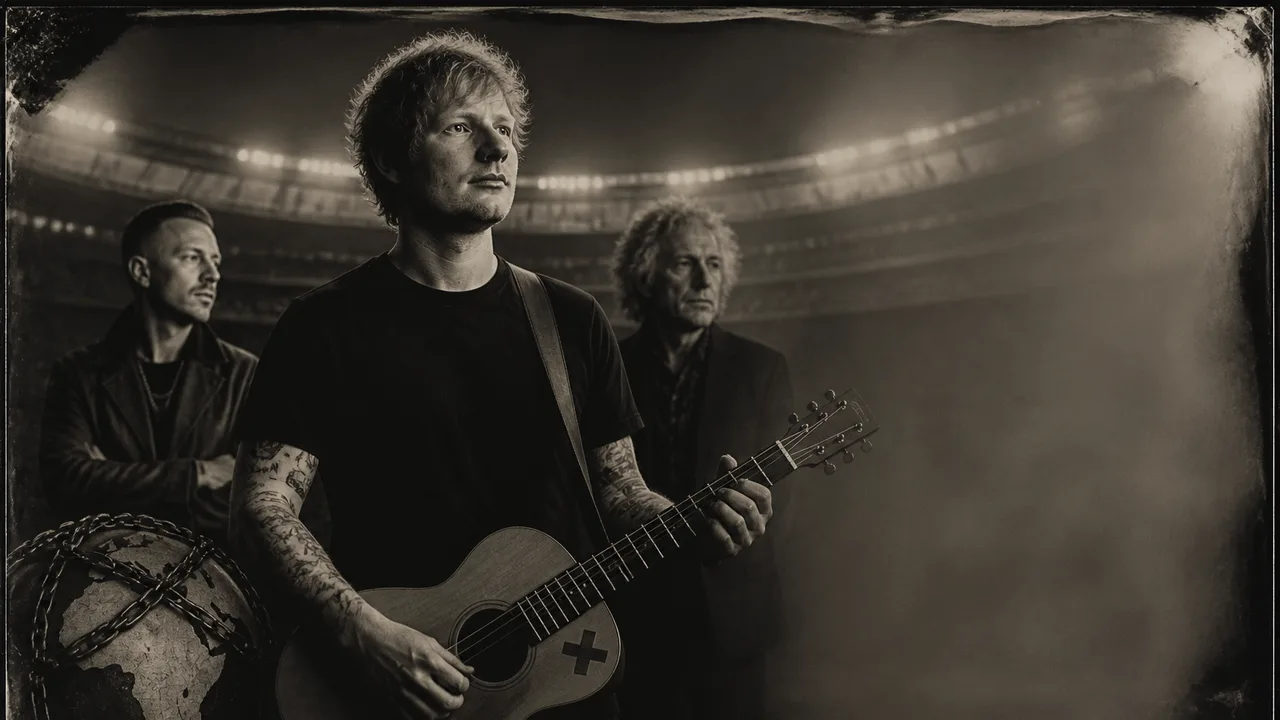
Bob Geldof has placed responsibility for Macklemore’s removal from Ed Sheeran’s Loop tour at the doors of Gillette Stadium owner Robert Kraft and the tour’s promoters.
“Shame on Kraft, and shame on the promoters,” Geldof told the Belfast Telegraph, as reported by NME. “But not shame on Sheeran.” His verdict divides a quarrel that has been presented as one argument into two. The first concerns what famous musicians owe the public during a humanitarian catastrophe. The second concerns who controls a musician’s speech once the trucks, ticketing systems and contractual machinery of a stadium tour begin moving.
Those questions overlap, but they assign responsibility differently. Geldof argues that “fame is a currency” and artists may decide how to spend it. He praised Macklemore and the musicians who left the tour while defending Sheeran’s freedom to choose when he speaks. Billy Bragg and Massive Attack have made the stronger case against that separation: a headliner retains responsibility for what happens beneath his name, even when somebody elsewhere in the touring apparatus makes the immediate decision.
The dispute therefore asks readers to follow the power cables behind the stage. A concert poster puts one face in enormous type. A stadium tour distributes authority among the star, management, promoter and venue owners. The available accounts establish that several of those actors objected or responded to objections. They do not yet provide an independently verified chain of command for Macklemore’s dismissal.
The Argument over Who Made the Decision
Macklemore gave a “Free Palestine” speech while supporting Sheeran at MetLife Stadium in New Jersey and performed “Hind’s Hall” alongside footage from Gaza. Pink and the Israeli American Council subsequently called for his removal. Kraft, whose Gillette Stadium was scheduled to host the tour, said Macklemore’s remarks were “deeply offensive and hurtful to the Jewish community.”
Sheeran maintains that promoter Messina Touring Group made the final decision after several venues objected. One NME account described Kraft’s intervention as resulting in Macklemore’s dismissal, but the published material does not establish that Kraft personally possessed or exercised final authority. That distinction matters because three different claims are circulating: Kraft objected, venues exerted pressure, and the promoter made the final call. All can coexist, yet none alone identifies every conversation or contractual power behind the decision.
FINNEAS, Lukas Graham, Aaron Rowe and Beoga withdrew after Macklemore was dropped, while Sheeran’s backing musicians also pulled out. Rowe then directed public anger toward Kraft. He described the removal as a rushed “panic stations” decision made under pressure “from all angles.” Rowe acknowledged that Sheeran’s first statement “could have been a lot better,” but defended the headliner’s character and said Macklemore should have remained on the tour.
Rowe’s account supports an inference rather than a settled finding: commercial and institutional pressure appears to have constrained the stage more directly than ticket holders did. The inference rests on Sheeran’s description of venue objections and Rowe’s characterization of a panicked response. Neither man supplied a contract, internal correspondence or a statement from Messina Touring Group in the available reporting. The machinery is visible; its control panel remains behind a locked door.
Sheeran’s own Philadelphia speech pointed toward that machinery. He said he was “deeply worried about the idea that venues should pre-approve content for performers,” adding that such approval “should never happen in the free world.” He also called the Hamas-led attack at the Nova music festival on October 7, 2023 “horrific” and described events in Gaza as “catastrophic, unjustifiable, and disproportionate.” Having previously avoided political commentary, he said the controversy had forced him into an argument about freedom of speech.
That speech claims two freedoms at once: an artist’s latitude to remain outside political commentary and a performer’s ability to speak without venue approval. Geldof defends both. Critics question whether a headliner can invoke the first after the touring organization has curtailed the second.
What Sun City Clarifies, and What It Cannot
Geldof reached for an older stage when explaining his position. During the cultural boycott of Sun City under South African apartheid, he said, he participated in the boycott while Elton John and other performers played the resort. “That’s their absolute prerogative,” Geldof recalled, adding that it was not his job to dictate what others thought or believed. The recollection was carried in Far Out’s account of the interview.
The comparison exposes a useful difference in where pressure falls. In Geldof’s telling, Sun City posed a decision to performers: play or refuse. The Loop tour dispute includes that same moral choice, visible in the departures of the support acts and backing musicians. It also contains an institutional decision running in the opposite direction: a performer was removed following objections from people and organizations surrounding the tour.
The analogy has firm limits. The available account gives Geldof’s recollection, rather than a complete history of the anti-apartheid cultural boycott, and the political circumstances of apartheid South Africa and Gaza cannot be collapsed into a single morality play. Sun City still works as a narrow comparison of mechanisms. One pressure campaign asked artists to withhold their labor. The present dispute, on Sheeran’s account, involved venues seeking control over what appeared on their stages.
A stadium has never been an empty bowl awaiting culture. Its owner can object, its promoter can cancel, its insurers and security operation can alter what happens, and its headline artist can accept, resist or try to renegotiate the result. Only some of those powers are documented in this case. Geldof’s argument assigns responsibility to the actors he believes exercised institutional control. Bragg’s argument assigns it upward to the person whose name sells the ticket.
Massive Attack sharpened the latter position by arguing that neutrality amid the reported killing of children in Gaza “can never be neutrality.” Bragg warned that Sheeran risked becoming a “pariah,” then criticized the proposed humanitarian response. Their case does not require proof that Sheeran personally dismissed Macklemore. It holds that prominence brings responsibility for the organization operating under the star’s name.
That position has also reached comedy. Saturday Night Live UK portrayed Sheeran as a fence-sitter who supports “causes that are allowed.” Satire compresses a disputed chain of authority into a recognizable target, which is why the headliner remains the joke even when the promoter may have signed the paperwork.
When Donations Become Part of the Argument
Money has now become another language in the dispute. Macklemore pledged his $1 million tour earnings to six named organizations: Palestine Children’s Relief Fund, Heal Palestine, Gaza Soup Kitchen, Medical Aid for Palestinians, UNRWA USA National Committee and Anera. Kraft said Sheeran asked him to match a $2 million humanitarian contribution, but the destination of Kraft’s pledge was not identified in the account.
That asymmetry explains part of Bragg’s objection. He criticized both the phrase “aid in the region” and what he saw as an attempt to “buy back your integrity.” The named recipients make Macklemore’s pledge more legible; they do not establish that funds have already been transferred or settle the ethical dispute. Likewise, the reported size of Kraft’s pledge says little about purpose until recipients and terms are known.
The Loop controversy now contains three currencies: Geldof’s currency of fame, the literal money being pledged and the institutional power to decide who reaches a microphone. Public attention naturally follows Sheeran because his name towers over the tour. Understanding what happened requires looking lower on the poster, toward the promoter’s office and the stadium gates, where artistic freedom becomes a question of who holds the keys.
More Like This
George Washington: The Man Behind the Monument
From battlefield defeats to a death made worse by his own doctors, Washington's life is more complicated than the marble monument version suggests.
Homer's Odyssey and Mycenaean Religion: Fact vs. Myth
Homer set the Odyssey in the Bronze Age but wrote it 500 years later. How accurate is his religion? Linear B tablets reveal a startling gap.