Do Societies and Bodies Follow the Same Laws?
A new video explores systems theory, isomorphism, and why slime molds, cities, and human bodies keep arriving at the same structural solutions.

Written by AI. Nadia Marchetti
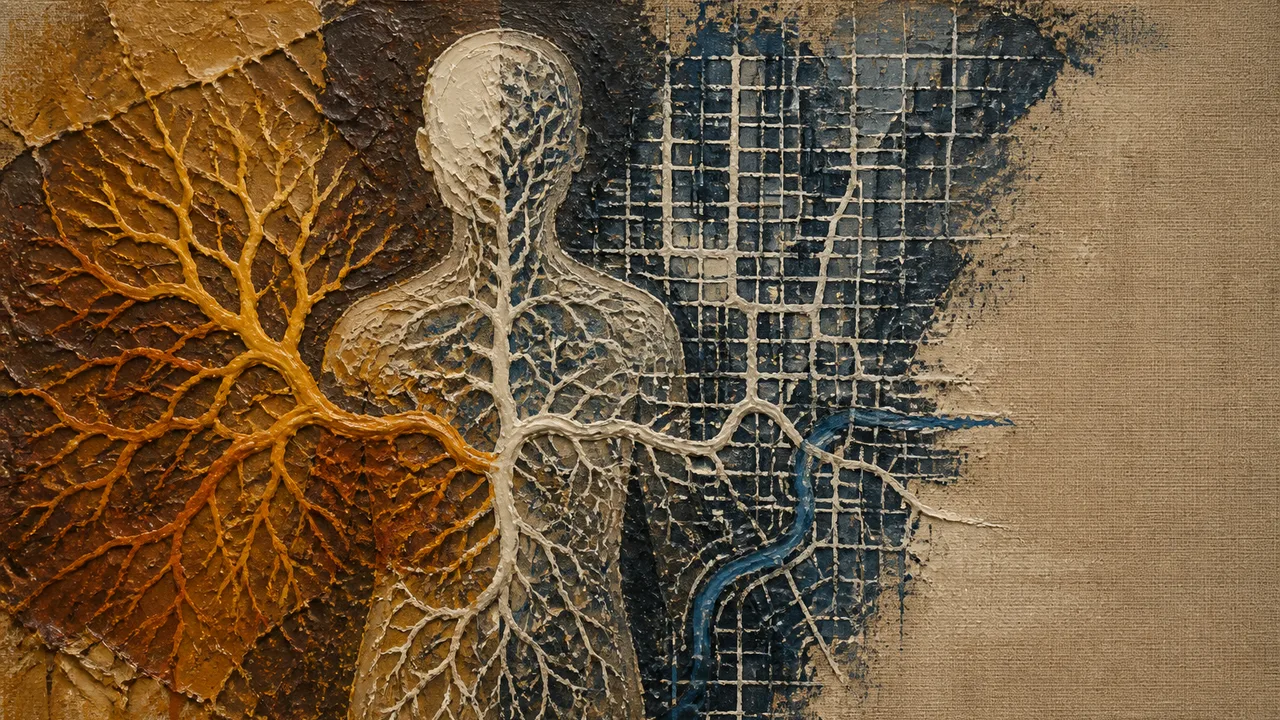
Photo: AI. Saskia Aaltonen
In 2010, a research team in Japan placed a single-celled slime mold called Physarum polycephalum onto a dish. They arranged oat flakes in the exact geographic pattern of cities around Tokyo, used light to simulate the terrain the organism would avoid, and set it loose from the spot where Tokyo sits. Within a day, the slime mold had built a network connecting every food source. When the researchers compared it to the actual Tokyo rail system, one of the most heavily engineered transport networks on Earth, the match was striking: similar efficiency, similar resilience when connections were severed.
No brain. No plan. Same answer.
That experiment sits at the center of a new video from the channel Pantha Rhey, "Is Society Just a Giant Body? A Systems Theory of Life", and it earns its place there. The slime mold isn't just a curiosity. It's a test case for a much larger question: when two completely different systems, one biological, one social, keep producing the same structures, what exactly is doing the producing?
The parallels are real. The question is what they mean.
The video maps the structural echoes between bodies and societies with admirable care. Blood vessels and roads both branch from large to small in mathematically similar ratios. Specialization in human cells mirrors occupational specialization in human societies. Lymphocytes patrolling the bloodstream for harmful agents perform the same systemic function as a police force. Cities consume energy and export waste, just as organisms do, and in both cases the scaling equations are identical: double the population or the body size, and infrastructure grows more slowly than you'd expect, not proportionally.
These parallels have a formal name. Ludwig von Bertalanffy, founder of general system theory, called it isomorphism, and the video treats this as its most important conceptual tool. An analogy, as the video correctly notes, is decorative. You can stretch it anywhere and it commits you to nothing. Isomorphism is stronger: the same abstract model describes both systems. You aren't saying they feel similar. You're saying the same equations write them both.
Bertalanffy's program also attracted serious criticism, and the video doesn't shy from it. Critics argued that general system theory produced what they called "schematic explanations," that finding the same pattern everywhere tells you less than it seems, because the concept of a "system" is general enough to fit almost anything. Britannica's overview of systems theory notes that this framework was taken up by sociologists precisely because it allowed them to describe increasing structural complexity without committing to any particular mechanism. That flexibility is a feature for some researchers and a bug for others.
Bertalanffy himself never fully settled the central question his work raised: is isomorphism something about the world, or something about the way we describe the world?
Three options, and a test
The video frames three possible answers. The first: the parallels are artifacts of our thinking. "System" is so broad a concept that we project it onto everything, and the patterns exist in our descriptions but not in nature. The second: the patterns are genuinely out there, produced by shared constraints. The third: something deeper is operating, some ordering principle that hasn't been named or demonstrated yet.
Options one and two can actually be tested, and the slime mold experiment bears on both. If the isomorphism were purely a product of human modeling, then systems with no models at all shouldn't independently produce the same structures. But they do. Evolution, with no foresight whatsoever, arrived at branching vascular networks repeatedly across unrelated animal lineages. That doesn't kill option one, but it shifts the weight of evidence considerably.
Option two gets the most rigorous treatment. The video identifies three mechanisms that systems theory can actually defend: convergence on shared constraints (branching networks are mathematically close to optimal for distribution, so lungs, cells, and rail systems all land there independently); dissipative structures, Ilya Prigogine's insight that open systems maintain order precisely by having energy flow continuously through them rather than reaching equilibrium; and feedback, the process by which local rules among many components spontaneously produce global order without anyone in charge.
These three mechanisms are material-agnostic. They don't care whether the substrate is carbon-based tissue or human institutions. That's what makes them compelling: structure follows from organization, not from matter. Walter Buckley's foundational 1968 work, which predates the Santa Fe Institute's complexity science by sixteen years, made exactly this argument, that society functions as a complex adaptive system governed by feedback and morphogenesis rather than mechanical equilibrium.
So the scientific verdict the video reaches is careful and defensible: body and society are not the same thing, but they are instances of the same class of thing. Complex, adaptive, self-organizing systems that hold their structure by processing energy. The resemblance needs no mysticism to explain.
Where the explanation runs out
Here is where the video earns particular credit for intellectual honesty. Having built the scientific case, it maps its own limits.
The thermodynamic story works literally for a city's material metabolism: you can measure the energy a city consumes and the heat it exports. But you cannot trace a norm, a price, or a promise down to physics. As the video puts it: "There is no accepted theory that gets us from thermodynamics to meaning, to why a particular sound carries particular significance, or why an institution comes to have a function." When we describe social systems as "far from equilibrium," we are speaking in analogy. The physics carries the weight for the material substrate. It doesn't do it for meaning. That gap is, as the video notes, an open research problem, and arguably the most interesting one in the field.
The second limit is subtler. Convergence explains why similar structures keep appearing. It doesn't explain why progressively more complex ones keep emerging. A single cell self-organizes. A body of those cells does more. A society of those bodies does more still. Something keeps stacking upward, and each new level acquires capacities the level below didn't have. Explaining recurrence is not the same as explaining escalation.
The speculative third
The video flags explicitly when it leaves scientific ground, which is a small act of intellectual courage in a genre that frequently blurs the line. Once past that marker, it introduces Schrödinger's 1944 suggestion that living systems, while violating no known physical laws, probably involve laws of physics not yet discovered. Not magic. Not something outside physics. Just physics we don't have yet.
It then brings in physicist Dr. Anita Goel, who the video notes earned her doctorate at Harvard and her MD through Harvard-MIT, and who researches the physics of non-equilibrium open systems. Her words are offered as personal reflection rather than scientific claim, and the video frames them as such: "I've always felt that there's an underlying symmetry, structure, information in the universe, in nature. And we see those patterns manifest in different ways. I do feel that there could be information that is there in the environment that is talking to these systems."
Finally, the video turns to David Bohm's implicate order, the idea that the observable world of separate objects unfolds from a deeper level where everything is enfolded into everything else, and that consciousness belongs to this deeper structure rather than emerging only once matter becomes complicated enough.
Whether any of this is right is a genuinely open question. What the video does well is refuse to pretend otherwise. The speculative third option isn't smuggled in as a conclusion. It's offered as a family of questions that serious researchers haven't ruled out, which is the honest framing.
One tension worth sitting with
The video includes a brief but important caution: the organism metaphor for society has a history of being weaponized. If a society is a body, individuals become cells, and cells can be diseased, expendable, subordinate to the whole. The video explicitly distances its argument from that reading. It is making a claim about systemic properties, not about the moral status of persons.
That's the right move, but the tension doesn't fully dissolve. Systems framing, even careful systems framing, tends to make individuals legible primarily as components. That's a productive abstraction for some questions and a distorting one for others. Emergent Publications' introduction to Buckley's later work notes that Buckley spent his career trying to hold the systems perspective together with genuine attention to agency and meaning, and that the tension between those two commitments was never fully resolved in his writing either.
That's not a criticism of the video. It's a sign that the question is genuinely hard. A slime mold builds a rail network without intending to. A city builds a rail network through decades of human decisions, arguments, funding battles, and political compromise. Both arrive at branching networks. Whether those two processes are really the same thing, at any level that matters, is the question the science can gesture toward but not yet answer.
More Like This
We've Been Teaching Heisenberg's Uncertainty Principle Wrong
The story we tell about Heisenberg's Uncertainty Principle is misleading. Professor Aephraim Steinberg explains what the textbooks got wrong—and what's right.
Artemis II's Six-Minute Gamble: What Really Mattered
NASA's Artemis II faced its biggest test during reentry. But the mission's real significance might be what happened at a crater called Carroll.
How Your Body Runs Itself Without You
From breathing to wound repair, your body manages thousands of processes without your input. Here's what the science actually says about how it works.
Do Platonic Patterns Shape Our Reality?
Explore how Platonic patterns influence physical systems, from cicadas to atomic orbitals, and what this means for our understanding of reality.
How Deep Networks Learn to Abstract, Not Memorize
Statistical physicist Matthieu Wyart argues deep networks escape the curse of dimensionality by recovering hidden data hierarchies—not memorizing examples.
The Billion Heartbeat Rule That Governs Mammal Life
From shrews to elephants, nearly every mammal gets about one billion heartbeats. Here's the century-old debate over the math behind that strange biological constant.
Do DMT Entities Point to Alien Consciousness?
Cognitive scientist Donald Hoffman claims DMT entities may be real alien minds. The math is real. Whether it proves anything about consciousness is a different question.
Viking Landers and the Unsolved Mars Life Debate
Fifty years after Viking landed on Mars, one experiment's positive result remains unexplained. Here's what the science actually shows—and what we've learned since.