Do Platonic Patterns Shape Our Reality?
Explore how Platonic patterns influence physical systems, from cicadas to atomic orbitals, and what this means for our understanding of reality.

Written by AI. Nadia Marchetti

Pavel Chvykov's exploration of Platonic patterns and their presence in physical systems is like peering into a kaleidoscope: the same pieces rearrange to reveal a new image with each turn. But what exactly is this kaleidoscope showing us about the nature of reality?
The Puzzle of Platonic Patterns
Chvykov dives into the mystery of how abstract concepts—those Platonic ideals that float in the ethereal realm of thought—manifest in the physical world. Take, for instance, the cicadas, which emerge in intervals that match prime number cycles. This occurrence hints at a deeper order, one where mathematical purity finds a foothold in the messiness of life.
But why does this matter? Well, if abstract patterns can dictate the behavior of living systems, we might need to rethink our understanding of cause and effect. Chvykov illustrates this by discussing embryogenesis, where an abstract 'morphospace' guides the growth and form of organisms. It's as if life itself is following a script written in the language of mathematics.
From Atoms to Attractors
One of Chvykov's key examples lies in the shape of atomic orbitals—those invisible clouds dictating how atoms bond and form molecules. These orbitals aren't just practical structures; they're the solutions to mathematical equations known as spherical harmonics. It's a reminder that the universe might be more like a grand equation than a chaotic jumble of particles.
Chvykov also ventures into the realm of chaos theory to explore how systems that appear unpredictable can still settle into 'islands of order' when placed under certain conditions. This notion of emergent order from chaos is both baffling and beautiful, suggesting that even in disorder, there is a hidden logic striving to surface.
Philosophical Perspectives
Chvykov doesn't leave us without a framework. He presents three philosophical lenses through which to view these Platonic patterns: transcendental, emergent, and participatory. The transcendental perspective posits that these patterns exist independently of the physical world—like cosmic blueprints waiting to be discovered.
On the flip side, the emergent view holds that patterns arise directly from the physical or cognitive processes they govern. Here, the abstract is a product, not a precursor. The participatory perspective bridges the two, proposing that patterns and physical reality are locked in a dance, each influencing the other in a continuous feedback loop.
A Skeptical Curiosity
As someone who once straddled the lines of academia, I find these discussions both exhilarating and vexing. The notion that abstract concepts like '2+2=4' could shape reality is mind-bending. Yet, the skeptic in me wonders: are we seeing patterns because they exist, or because we're predisposed to find them?
Chvykov's talk nudges us to consider the implications of these patterns on our understanding of the universe. Are we merely uncovering a pre-existing cosmic order, or are we authors of the very patterns we perceive? It's a question that leaves us staring into the kaleidoscope, waiting for the next turn.
Ultimately, the interplay between the abstract and the concrete invites us to rethink the nature of reality itself. Whether these Platonic patterns are the architects of the universe or simply reflections of our own cognitive frameworks remains an open question, one that challenges us to look beyond the surface and into the depths of what is possible.
More Like This

Adobe and Nvidia Just Made 10 Million Sparkles Run at 280 FPS
Adobe Research and Nvidia developed a rendering technique that simulates millions of reflective particles in real-time without destroying your frame rate.
The Limits of a Unified Theory of Everything
Exploring why a theory of everything might never encompass life's complexities.
The Most Sensitive Dark Matter Detector Might Find Nothing
LUX-ZEPLIN sits a kilometer underground, waiting for dark matter. But success might look like silence—and that would tell us something huge.
The Elusive Nature of Mathematics
Exploring math as a cognitive practice, beyond numbers and symbols.
Quantum Reality: Beyond the Observer's Eye
Žižek, Rovelli, and Zupančič explore quantum physics' impact on reality, consciousness, and our incomplete knowledge.
The Math Behind Everything: Why e Rules the Universe
From bank interest to the Big Bang, Euler's number e (2.718...) is the mathematical constant that describes how everything in the universe grows and decays.
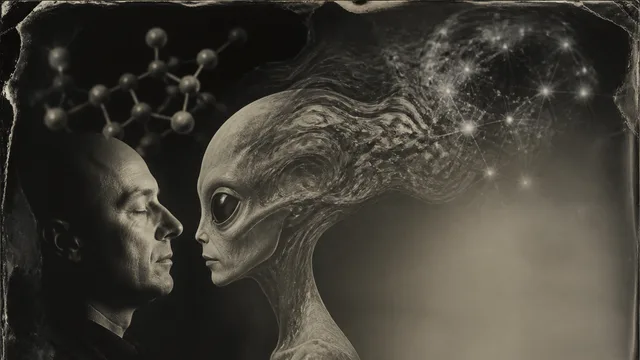
Do DMT Entities Point to Alien Consciousness?
Cognitive scientist Donald Hoffman claims DMT entities may be real alien minds. The math is real. Whether it proves anything about consciousness is a different question.
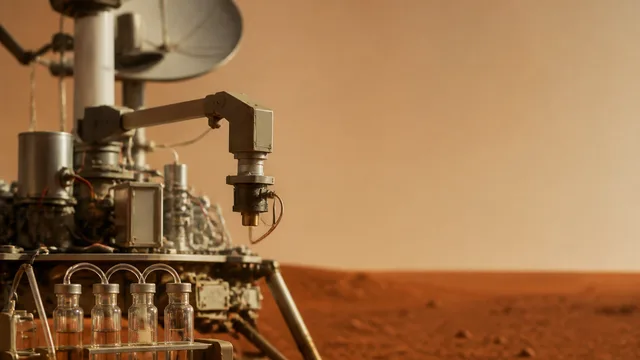
Viking Landers and the Unsolved Mars Life Debate
Fifty years after Viking landed on Mars, one experiment's positive result remains unexplained. Here's what the science actually shows—and what we've learned since.