Disagreeing Well: How Conflict Can Improve Well-Being
New research and a growing body of practical guidance suggest that learning to disagree constructively—not avoid conflict—may be key to better mental health and relationships.

Written by AI. Marcus Obi

My twins are seven. They disagree about everything—whose turn it is, who breathed on whose side of the car, whether the sky is actually blue or "kind of purple." And they are spectacularly bad at it. There is screaming. There is injustice. There is occasional biting.
What's funny—and slightly humbling—is that most adults I know aren't that much further along. We've just traded biting for subtweets.
Here's what I keep coming back to, though: the twins who fight the loudest are also the ones who figure things out fastest when they calm down. They surface the real disagreement, clumsily, and then navigate through it. Which is, it turns out, kind of the whole thing.
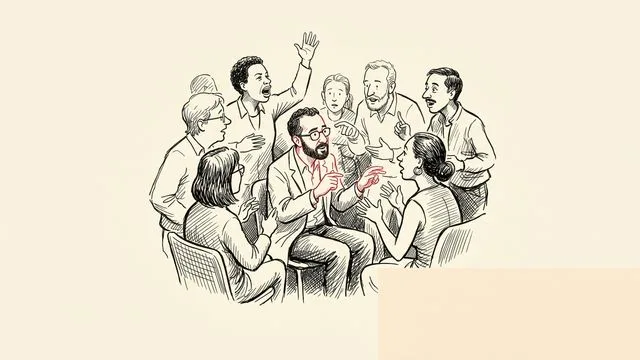
A growing cluster of voices—across psychology, theology, and conflict resolution—are making essentially the same argument: the problem isn't disagreement. The problem is that we've never been taught to do it well.
The Health Angle Is Real, and It's Specific
Psychology Today recently laid out a case for why "agreeing to disagree" isn't just a polite exit strategy—it may actually be good for you. The mechanism described is worth sitting with: "It makes the exchange less emotional. You start in a common place and can then have a more positive conversation. And a more positive conversation can have positive health effects."
That's not vague wellness talk. It's a fairly precise claim: starting from shared ground reduces the emotional heat of a conversation, and lower-heat conversations correlate with measurable health benefits. The physiological logic tracks—chronic conflict stress is linked to elevated cortisol, disrupted sleep, and cardiovascular strain. If finding areas of agreement before wading into disagreement dials down that stress response, even slightly, the cumulative effect over a lifetime of relationships is significant.
The catch is in the execution. "Finding common ground first" sounds obvious, but it requires something most of us resist in the middle of a disagreement: slowing down before we've made our point.
Two Traditions, One Intuition
What's interesting about where this conversation is happening right now is the range of voices making similar arguments from very different starting points.
On one end, you have the secular psychology framing—well-being research, emotional regulation, interpersonal neuroscience. On the other, a faith-based strand that's been circulating in evangelical circles through Gavin Ortlund's book The Art of Disagreeing: How to Keep Calm and Stay Friends in Hard Conversations.
Ortlund's argument, according to Westminster Bookstore, is that Scripture offers a model for disagreeing that "leads to greater understanding, peace and love." The Good Book Company describes the book as one that "compels us to handle the various conflict-prone situations in our lives in a way that reflects Jesus." A Shelf Reflection review frames it as offering "gospel-centered ways to handle disagreement with kindness, courage, and love."
The theological framing is obviously specific to its audience. But the behavioral prescription underneath it—approach disagreement with courage and kindness, not as opposites but as partners—maps pretty cleanly onto what the psychology literature is also finding.
The Goodreads description of Ortlund's framework puts it this way: "Looking to Jesus' example of courage and kindness, readers will be given a framework for engaging in intense disagreements with a love that furthers instead of hinders relationships." Strip the theological context and what you have is a claim that the way you disagree determines whether the relationship survives the disagreement. That's not a religious idea—it's just true.
Timothy Keller's Line Is the One That Stays With Me
The Rethreaded podcast pulled a quote from author Timothy Keller that I keep turning over: "Friends become wiser together through a healthy clash of viewpoints."
Through. Not despite. Not after recovering from. Through the clash.
That framing inverts the assumption most of us carry—that conflict is something to survive, to get past, to smooth over so the relationship can return to normal. Keller is suggesting that the clash, done right, is the growth. The friction is the mechanism, not the obstacle.
This is where the conversation gets genuinely interesting, and also where I want to flag what the sources don't fully answer: what separates a "healthy clash" from one that damages trust or entrenches positions further? Both the psychology and the theology sources point toward attitude and approach—start from common ground, bring kindness alongside courage, treat divergence as an opportunity rather than a threat. But the line between productive friction and corrosive conflict is not always obvious in the moment, and none of the sources I reviewed offer a clear test for where you are.
The Structural Problem Nobody's Naming
Here's the thing I keep bumping into when I read content like this, and I want to name it plainly: advice about how to disagree better places the entire burden on individual skill.
That's not wrong, exactly. Skill matters. Emotional regulation matters. Finding common ground before you argue matters.
But the environments where people are asked to disagree—social media platforms algorithmically optimized for outrage, workplaces where disagreeing with leadership carries career risk, family systems where certain topics have been nuclear for decades—those environments actively punish the behaviors these frameworks recommend.
Telling someone to "start from common ground" before a disagreement assumes the other party is also operating in good faith, also willing to slow down, also interested in understanding rather than winning. Sometimes that's true. Often it isn't—not because people are bad, but because they're scared, or defensive, or operating under conditions that make vulnerability feel genuinely dangerous.
The psychology and theology sources in this conversation are largely silent on this. They're addressing individual practice, not systemic incentives. That's a legitimate scope, but it means readers should understand what they're getting: guidance for improving your own approach, not a solution to the broader cultural dysfunction around disagreement.
Which is still valuable. You can only control your half.
What "Agreeing to Disagree" Actually Means
There's one more thing worth unpacking, because "agree to disagree" is a phrase that's been stretched to cover a lot of territory—some of it useful, some of it evasive.
At its best, agreeing to disagree means: I see this differently than you, we've talked about it, neither of us has shifted, and we've decided the relationship is worth more than the resolution. That's a mature, often generous thing.
At its worst, it means: I want to end this uncomfortable conversation without doing any of the work. Which is just conflict avoidance with better PR.
The Psychology Today framing—start from shared facts, have a more positive conversation, experience the health benefits—is describing the first version. The disagreement has actually happened. You've engaged. You've found the common ground and mapped the real distance between you. The "agree to disagree" landing is the honest conclusion of a genuine exchange, not a way to skip it.
That distinction matters, because the well-being benefits being described come from the process, not the outcome. The positive health effects aren't from avoiding resolution—they're from reducing the emotional charge of the conversation itself, through the work of starting somewhere real.
My twins will eventually figure this out. Probably in their thirties. Maybe when they have kids of their own who are terrible at arguing.
The question, in the meantime, is whether adults willing to do the work of disagreeing well will find enough other adults willing to meet them there.
More Like This

Adult Rage and Emotional Suppression: What We Hold In
Alain de Botton argues adults deserve the emotional honesty of a toddler's tantrum. The science on suppression is more complicated than that.

Eckhart Tolle Says You're Not Who You Think You Are
Eckhart Tolle's 'historical self' vs 'deep eye' framework is either profound or a very elegant dodge. A parenting writer tries to figure out which.

Handwriting Beats Typing for Learning, Studies Find
New research shows handwritten notes improve memory and recall more than typing. Here's what the science says — and what it actually means for kids and parents.
Dr. K Walked Into Chaos and Won the Room
Dr. K's Tiger Belly appearance is a masterclass in social dynamics. Here's what the Charisma on Command breakdown gets right—and what it glosses over.

Jocko Willink on Discipline, Detachment, and Resilience
Jocko Willink talks discipline over motivation, detachment as a trainable skill, and leading through loss. What holds up, what's worth questioning.

Communication Games That Actually Build Closer Bonds
Research backs what your awkward icebreaker already proved: structured communication games build real intimacy. Here's the science behind why games work.

Making Studying Stick: The Psychology of Starting
A YouTube video promises you can get addicted to studying in 10 minutes. The psychology is mostly real. The missing piece is who gets to use it.

Your Childhood Coping Strategies Are Running Your Life
The marshmallow test wasn't measuring self-discipline. It was measuring trust. What that means for how we parent—and how we were parented.