Data Center Backlash Is Missing the Climate Question
Data center opposition is reshaping projects over water, bills and noise, while climate outcomes depend on separate grid, generation and energy rules.

Written by AI. Samira Barnes
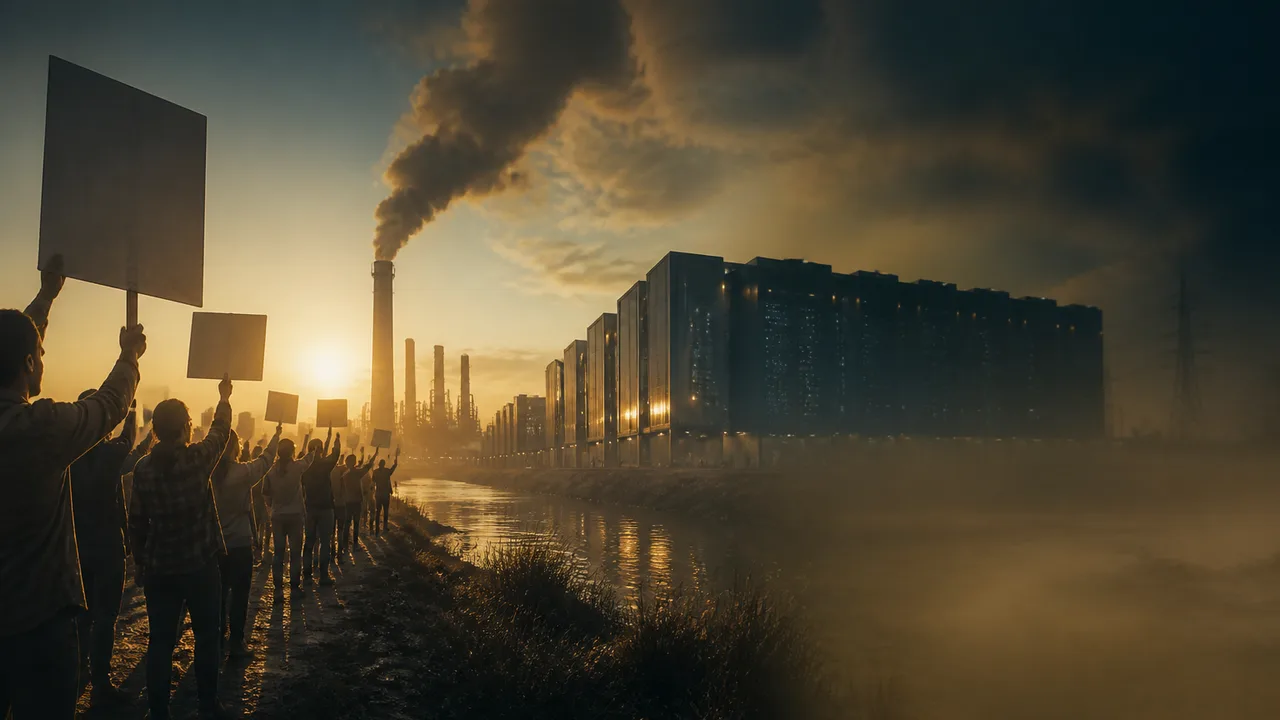
At least 46 proposed AI data center projects across 20 states were blocked, withdrawn or stalled following community opposition between January 2024 and May 2026. Those projects represented more than $170 billion in announced investment, according to an industry analysis cited by Fast Company. Data Center Watch separately estimated that $68 billion in projects were blocked or delayed from April through June 2026.
Those estimates use different periods and categories, so they should be read as measures of disruption rather than a combined total. Even with that qualification, the direction is plain: local consent has become a development risk that executives, lenders and governors can no longer file under public relations.
The organizing grievances are water consumption, electricity bills, noise, air pollution and distrust. Climate change usually sits farther down the list, Wired reported, citing polling and conversations with organizers. That ordering is understandable. A resident can hear cooling equipment, watch a utility bill rise or ask how much water a facility will draw. The emissions consequences are geographically dispersed across the power system and accumulate over time. Local politics rewards the harms that can be attached to an address.
The result is a mismatch between political leverage and climate scale. Communities increasingly have leverage over where a data center goes, what developers disclose and what compensation they offer. Those fights do not automatically determine which generators supply the electricity.
The Grid Question Sits Behind the Zoning Question
BloombergNEF projects that data centers will account for more than 5 percent of global electricity demand by 2035, roughly triple their current needs. Wired reported that the model expects most of that additional demand to be served by new and existing natural gas plants, potentially raising power-sector emissions by about 6 percent within a decade. The estimate excludes gas plants built off-grid solely to serve data centers.
That is a projection, not a scheduled outcome. Electricity demand, chip efficiency, construction delays, renewable deployment and grid policy could all change it. Yet the model identifies the policy problem with unusual clarity: stopping one project may protect one aquifer or neighborhood, while another project can move to a jurisdiction whose grid relies more heavily on gas.
Local opposition can still affect energy choices. Bloomberg reporting relayed by Futurism said Oracle sent lender Blue Owl Capital a force majeure notice after a New Mexico data center project failed to secure development permits. The facility was planned for 2.45 gigawatts of compute power. Its developers had already abandoned a proposed natural gas plant after failing to obtain state and federal land-use approvals, then pivoted toward solid oxide fuel cells. The Project Jupiter episode shows that permitting can force a redesign. It does not establish that the replacement will have lower emissions, and a single delayed project cannot stand in for the national buildout.
The policy inference is narrower. Siting rules can influence the fuel mix when permits cover on-site generation, grid connections or environmental effects. A zoning fight focused only on acreage and noise may change the location without changing the emissions trajectory.
Virginia Shows How the Politics Changed
Northern Virginia has hosted data centers for years and contains the world’s largest concentration of them. By July 2026, public protest and litigation had helped push developers to withdraw a proposed 2,100-acre Prince William County campus that could have contained as many as 37 data centers. One week later, county officials cited opposition when rejecting a separate rezoning proposal covering another 2,000 acres.
That shift toward tighter constraints reflects accumulated experience rather than a sudden discovery that server buildings use electricity. Some developers have relied on nondisclosure agreements, shell companies or selective disclosure, leaving residents unable to evaluate water, power and neighborhood effects before approval. Once a company asks a community to accept an industrial facility while withholding basic operating details, every later promise arrives with a credibility surcharge.
Researchers surveyed 1,004 residents of northern Virginia and the Richmond metropolitan area in fall 2025. Their policy-choice study tested combinations involving facility locations, power lines, electricity rates, environmental assessments, energy and water reporting, and public review. The finding available from the researchers is broad: northern Virginians supported restrictions designed to increase transparency and accountability, although they valued some measures more than others.
The history helps explain why trust now competes with tax revenue in siting decisions. Residents in a mature data center market have moved from assessing promised benefits to demanding enforceable terms. Developers face an electorate with its own institutional memory, which is generally less pliable than a slide deck.
Cash, Process and Enforcement Solve Different Problems
Three current approaches illustrate what communities can obtain from the backlash.
NorthPoint Development has proposed $10,000 checks for households near a planned 1,300-acre facility in Hazle Township, Pennsylvania. The offer accompanies as much as $120 million over 15 years for community services. Wall Street Journal reporting summarized by Tom’s Hardware found residents raising concerns about noise, utility costs, property values and distrust; some viewed the payment as a bribe. The township had already rejected the project on zoning grounds and adopted a temporary moratorium.
Direct payments compensate households if residents regard the bargain as legitimate. They cannot answer unresolved questions about recurring electricity costs, water access or who bears losses after the check has been spent. A cash offer made before adequate disclosure can even reinforce the suspicion that consent has been priced before the terms are known.
Virginia’s emerging model focuses on process: reporting, environmental review and public participation before approval. Process gives residents information and bargaining power, but it can also become ceremonial if officials define “community consent” as an ordinary zoning vote after the major design choices are fixed.
Vineland, New Jersey, supplies the third model, enforcement after construction begins. Gothamist reported, in an account relayed by Futurism, that state inspectors found 62 gas-powered generators operating at the DataOne site without approval. The New Jersey Department of Environmental Protection imposed a $1 million fine. The city had granted the project a five-year tax exemption, and residents had pressed officials for greater transparency and accountability.
Enforcement can punish violations after a developer has secured land and begun work. It cannot restore the leverage that existed before approval, and even a seven-figure fine may function as a cost of doing business unless regulators also require operational changes.
Cash, process and enforcement therefore govern different stages of the same relationship. Cash allocates some benefits. Process determines who gets a voice before construction. Enforcement tests whether promises and permits survive contact with an operating facility. None of the three necessarily limits carbon emissions unless the agreement also governs energy sourcing, on-site generation or grid costs.
The Strongest Case for Building Still Needs Rules
Industry advocates argue that data centers can expand the local tax base and help finance grid improvements. At a Climate Week panel covered by Wired, Emerald AI executive Varun Sivaram said data centers could act as “good citizens” by helping lower bills and bring cleaner energy online. That outcome is possible if large customers fund new infrastructure, adjust demand when the grid is strained and purchase additional clean power.
The same demand can support new gas generation when policy imposes no such conditions. The disagreement therefore concerns the terms of construction as much as construction itself. Communities can reasonably value jobs, tax revenue and grid investment while requiring developers to disclose water use, pay their own infrastructure costs and comply with emissions rules.
Local campaigns have discovered effective pressure points: zoning boards, utility bills, water permits and neighborhood noise. Climate policy operates through another set of levers, including generation permits, grid-interconnection standards, utility regulation and enforceable clean-energy requirements. If lawmakers treat local consent as the whole regulatory answer, the backlash may move data centers, raise their price and improve disclosure while leaving the projected gas buildout largely intact.
The next phase of the fight will reveal whether governments connect those two systems of leverage, or allow every town to negotiate over the server building while the fuel supply is decided elsewhere.
More Like This
AI Data Centers Hit a U.S. Regulatory Wall
GPU deployments are moving to Mexico and Australia. Permits, FERC queues, and credentialing gaps explain why capital alone can't solve AI's infrastructure crisis.

FastEmbed and the Quiet Politics of Local AI Development
FastEmbed's approach to local AI embeddings reveals regulatory tensions between accessibility and performance in the emerging AI infrastructure debate.

AI Agents Now Configure Enterprise GPU Clusters Autonomously
Tech enthusiasts built an 8-node NVIDIA GB10 cluster using AI agents to handle setup. The barrier to entry for complex AI infrastructure just collapsed.

Nscale IPO Tests the Economics of the Neocloud Boom
Nscale's IPO filing pairs 1,252% revenue growth with a $1.02 billion loss. CoreWeave shows why demand, debt and dilution matter for investors.

ChatGPT, Claude, Grok and Gemini All Failed at Once
ChatGPT, Claude, Grok, and Gemini failed in the same window on September 3. What each company said, and didn't say, reveals how AI designs failure communication.
UK's Phantom Data Centers Are Straining the Power Grid
Speculative 'phantom' data centers are clogging the UK's grid connection queue. Ofgem is pushing back—but the fix isn't simple when AI ambition is this loud.

Promptware: When AI Agents Become Attack Vectors
Prompt injection attacks on AI agents follow a structured kill chain — and existing legal frameworks have almost nothing to say about who's liable when it works.

Planet Labs, Orbital AI Compute, and the Chip Tax
Planet Labs CEO Will Marshall argues chip efficiency—not launch cost—will determine who wins the race to put AI compute in orbit.