How a Cut Backup Cable Disrupted Northeast Flights
A cut backup fiber and failed primary circuit disrupted Northeast flights. What the outage reveals about FAA redundancy, upgrades and traveler risk now.

Written by AI. Tomas Reyes-Kim
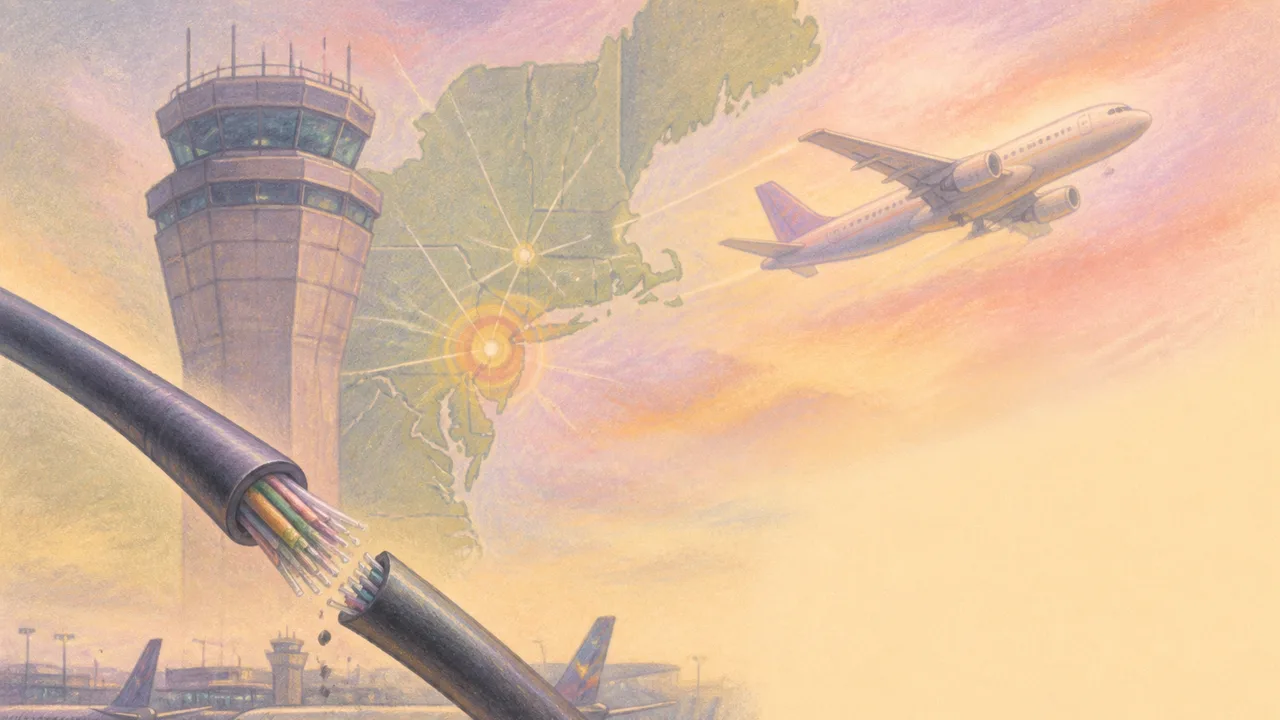
Philadelphia TRACON lost its primary communications circuit on September 21, and the backup waiting to save the day had already been sliced during construction in New Jersey.
That two-step failure forced the Federal Aviation Administration to restrict traffic at Newark, Philadelphia, Teterboro, JFK and LaGuardia. Ground stops began around 10 a.m. at Newark, Teterboro and Philadelphia before spreading to the New York airports, according to AeroTime's account of the outage. About 90 flights were diverted immediately after communications were lost.
The timing was premium-grade awful. World leaders were arriving in New York for the United Nations General Assembly, while ordinary travelers received an unplanned seminar in how much airspace can depend on telecom equipment buried beside somebody else's construction project.
How the Backup Disappeared
FAA Administrator Bryan Bedford said the first component to fail was an old L3 Verizon circuit that the agency was already replacing through its air traffic control modernization program. Separately, construction had damaged about 600 feet of backup fiber between New Brunswick and Newark.
Transportation Secretary Sean Duffy attributed the cut to an Amtrak construction crew. Verizon, which owns the cable, told the BBC that it was repairing the line but “bears no responsibility” for the incident. Those statements leave responsibility disputed, even though officials agree that the fiber had been severed.
The backup's condition was discovered only after the primary circuit failed, the BBC reported. Bedford estimated that repairing the damaged fiber would take around 13 hours.
That sequence exposes the useful distinction between owning a backup and having a backup that can actually take over. Redundancy protects a system only if the secondary path remains available and someone can detect when it stops being available. Here, the damaged fiber sat in the system as a dormant failure. The primary circuit's collapse turned that hidden defect into an operational crisis.
The available information does not show whether the primary and backup circuits occupied the same trench, followed overlapping physical routes or merely relied on infrastructure in the same broad New Jersey corridor. That detail matters. Co-located routes would point toward physical separation as the fix. A monitoring failure would point toward continuous testing and faster alarms. Shared vendors or switching equipment would raise another set of questions. For now, declaring the exact architectural flaw would be engineering cosplay with a press release as the costume.
What can be said is narrower and still uncomfortable: the primary circuit failed, the damaged backup could not cover it, and the backup damage had escaped notice until the system needed it.
One Outage, Several Versions of the Damage
Early snapshots varied because flight disruption grows over time. At about 1 p.m., Flightradar24 counted 67 Newark-bound diversions, including flights returning from Iceland, Greece, Spain and France. FlightAware counted roughly 250 delayed flights in and out of Newark, more than one-fifth of its schedule, CNBC reported.
Later reporting put Newark's disruption much higher. AirlineGeeks said almost half of its scheduled Monday flights had been canceled by 4 p.m. It also counted nearly 5,000 delays and more than 800 cancellations across the United States, while explicitly warning that those nationwide totals were not all caused by this outage.
That qualification prevents a seductive but bogus bit of subtraction: nationwide disruption on a bad aviation day cannot be dumped entirely into the cable-shaped bucket. Weather, airline operations and unrelated traffic constraints keep doing their own annoying little side quests.
Ground stops also explain why a communications failure in Philadelphia disrupted airports across several states. TRACON facilities guide aircraft arriving at and departing from busy terminal airspace. When controllers lose dependable frequencies, radar data or both, the FAA reduces the number of aircraft entering that workload. The resulting queue then spreads through airline networks, because the plane delayed at Newark may be scheduled to operate another flight from somewhere else later.
Modernization Has Money, but Replacement Takes Time
Monday's failure arrived with history attached. The Philadelphia facility was involved in communications outages that disrupted Newark flights in 2025. Congress then approved $12.5 billion for air traffic control modernization and controller hiring, while Bedford says the old L3 Verizon circuit that failed Monday was already scheduled for replacement.
Those facts support two readings. The modernization program had identified aging infrastructure and was working through it. They also show the awkward gap between funding a replacement and completing one. A circuit remains old until crews switch it out; appropriations do not travel through fiber by osmosis.
The outage alone cannot establish whether the $12.5 billion program is poorly designed, moving too slowly or confronting a backlog too large to erase quickly. The reporting does not provide a spending breakdown, replacement schedule or audit of the Philadelphia system. It does establish a practical test for the program: upgrading primary circuits will buy limited resilience if backup routes can be damaged without rapid detection.
That is a broader standard than asking whether new hardware has arrived. Modernization should also reduce the chance that one failure exposes another failure nobody knew about.
The Previous Day's Outage Offers a Warning, Not a Cause
The Northeast had suffered another air traffic control disruption one day earlier. On September 20, JFK experienced a total radar failure and Westchester County Airport a total frequency failure. Newark and LaGuardia slowed arrivals, with the FAA attributing those restrictions to equipment trouble at New York TRACON. The problems were resolved relatively quickly, and their cause remained under investigation.
Sunday and Monday therefore belong in the same operational conversation, but no established evidence connects their causes. They involved different TRACON facilities and different reported failures. Sunday's trouble centered on radar and frequency losses at New York TRACON; Monday's chain involved a primary communications circuit and severed backup fiber serving Philadelphia TRACON.
The comparison shows how repeated equipment trouble can produce similar passenger misery across the same congested region without proving a single underlying defect. Both episodes prompted traffic restrictions because controllers could not accept normal demand with degraded tools. Monday lasted longer and exposed a documented backup failure. Sunday was shorter, and its causal plumbing remains unknown.
What Passengers Can Actually Do
United, whose busiest international hub is Newark, waived change fees for affected travelers. That was an airline response, not a universal promise covering every passenger or future outage. Anyone booked through the corridor should check the operating airline's flight status and waiver terms before heading to the airport or accepting a self-funded alternative.
Diversions deserve extra attention on international itineraries. The 67 Newark-bound aircraft diverted by early afternoon included long-haul flights from four European countries. A diversion can leave travelers at a different airport, delay immigration processing and scramble onward connections. The available reports do not establish what assistance every diverted passenger received, so save receipts and deal directly with the airline rather than assuming one carrier's waiver applies across the board.
Booking a longer connection can create breathing room, but no itinerary hack can guarantee protection from a regional ground stop. Travelers choosing between New York-area airports should also resist treating JFK or LaGuardia as automatic escape hatches: both were restricted after the disruption spread.
The next useful measure of FAA modernization will be less glamorous than a new control-room screen. It will be whether a severed backup announces itself before the primary circuit dies.