A Custom GPU Cooling Mod Built Without Zip Ties
A PC builder refused the easy fix and designed a custom GPU fan bracket and PCB splitter instead. Here's what that obsession looks like in practice.

Written by AI. Bob Reynolds
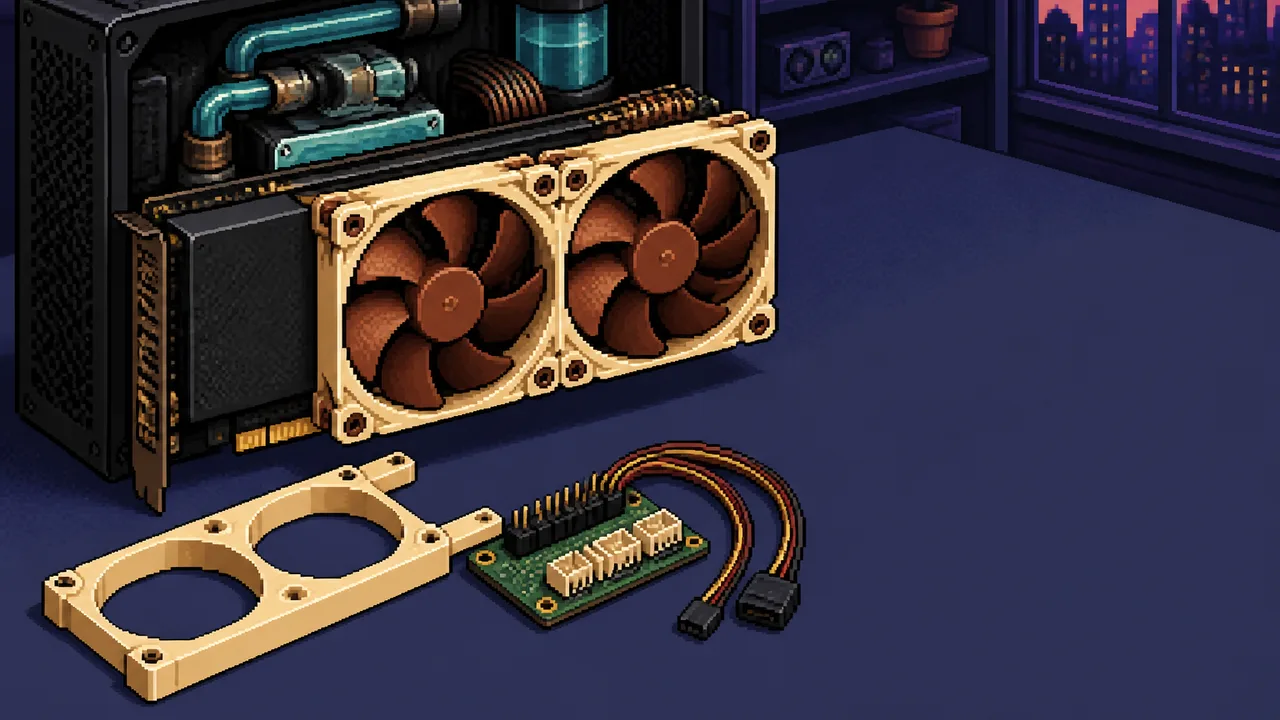
Photo: AI. Cosmo Vega
There is a moment in every long-running project when the gap between how something works and how it looks becomes impossible to ignore. For the creator behind the YouTube channel Shrike Lab, that moment arrived while looking at a small form factor PC housing an AMD Ryzen 9 5950X processor, an RTX 3090 graphics card, and 64 gigabytes of RAM — powerful enough for professional CAD and video editing work, held together by a year's worth of compromises. "The priority has been well and truly on function," the video opens. "Anytime I needed an adjustment or fix, the form was sacrificed."
Most people would leave it there. The machine worked. The rebuild that follows is an argument, made in hardware, for why working isn't always enough.
The Fan Problem, and the Refusal to Take the Easy Way Out
Graphics cards — the component that renders images, runs AI workloads, and generates most of the heat in a modern PC — ship from the factory with their own cooling systems. Those systems work, but they're optimized for the card's size constraints, not for maximum airflow. The fans are thin, they spin fast, and they're loud when pushed hard.
The standard enthusiast fix for this is a "de-shroud" mod: strip the factory cooler housing off the card, bolt on a set of aftermarket fans, and enjoy quieter, more efficient cooling. The standard method of attaching those fans is zip ties — effective, graceless, and the kind of solution that announces itself every time you open the case.
Shrike Lab's builder had other ideas.
The card in question is an MSI Ventus RTX 3090 — a workstation-class graphics card, roughly the width of a paperback novel, that the builder describes as "pretty small as far as 30 series go." The replacement fans are Noctua NF-A9s, three of them, each 92mm square and 25mm thick. Noctua is a company that makes cooling fans in a shade of brown that can only be described as industrial-agricultural, a color choice the company has defended for decades on the grounds that it correlates with certain high-quality materials. The fans are, by the near-universal consensus of the PC building world, excellent. The color remains a matter of ongoing negotiation with one's own aesthetic sensibilities.
Three of these fans, placed side by side, happen to cover the graphics card's heatsink — the metal fins that actually absorb and dissipate heat — almost perfectly. The question was how to hold them there without zip ties.
The answer was a 3D-printed bracket, designed from scratch in SolidWorks — professional-grade engineering software typically used to design machine parts and product enclosures. The bracket is split into two halves: a lower piece that cradles the three fans, and an upper piece that sandwiches them in place with four screws. Two small ears on either side of the bracket lock into dead space between the heatsink fins, anchoring the whole assembly to the card without adhesive, wire, or improvisation. It took several printed iterations to get right.
The distinction between a zip tie and a machined bracket is not just cosmetic. It's about whether the maker is satisfied with a solution, or with the solution. That instinct — applied to bridge engineering, surgical technique, or software architecture — is the difference between something that holds and something that lasts.
Too Many Fans, Not Enough Plugs
Here is the practical problem three new GPU fans immediately create: graphics cards are typically designed to receive a single power and control signal from the motherboard. Three fans need three connections. The standard fix is a fan splitter — a cable that takes one signal in and splits it to multiple outputs, like a power strip for fan wires. These splitters work fine. They also add a nest of cables to an already-cramped interior.
The builder's solution was to design a custom PCB — a printed circuit board, the green (or in this case, custom-colored) wafer of circuitry that connects electronic components — that performs exactly the same splitting function as those wired adapters, but in the form of a small, flat board that sits flush against the card. Noctua's higher-end fans happen to ship with a short cable plus a separate extension; by skipping the extension, the cable length is just right to plug directly into the board without excess slack. The result is a fan assembly that, from the outside, looks like it came from the factory this way.
The boards are simple to make, the builder notes, and the manufacturing cost is striking: at the time of recording, five boards manufactured and shipped to the door via JLCPCB — a Chinese PCB fabrication service that has become the default option for small-batch custom boards — came in at under $6. That pricing is time-sensitive and may have changed, but it illustrates something worth noting: the barrier between "I wish someone made this" and "I made this" has, for certain categories of electronics, collapsed almost entirely.
The Cooling Loop, and What a Year-Old Failure Looks Like
While the GPU mod is the headline, the CPU cooling work tells a more interesting story about what happens when a careful person encounters their own past shortcuts.
About a year before this rebuild, the custom CPU cooling loop — a closed system of pump, radiator, and fluid-filled tubes that moves heat away from the processor more efficiently than air cooling alone — had failed. An air pocket had formed in one of the lines, starving the pump of fluid until it burned out. The replacement was an NZXT X52, a standard all-in-one liquid cooler (a self-contained unit requiring no user-filled tubing), propped into place as a temporary fix. It had been there for a year.
Note: The case used in this build is described in the video as an "Iunix ZX1," a product name that doesn't correspond clearly to major documented case lines — it may be a variant spelling or regional product name. Whether the X52 — a 240mm radiator unit — fits without modification is worth verifying against the case's official specifications before attempting to replicate this setup.
The replacement pump is an Ice Bear LT Solo, described in the video as an Alphacool product. Ice Bear and Alphacool are distinct brands — Alphacool acquired Ice Bear — and parts compatibility between the two product lines is not guaranteed; anyone attempting to source replacement components should verify fitment directly before ordering. The pump is a low-profile, self-contained unit: no external reservoir, no separate pump housing, just a block that sits on the processor and handles everything internally. The builder is enthusiastic about it in the way that people who've spent time fighting inadequate tools are enthusiastic when they find one that actually works.
The rebuild of the cooling loop included re-sleeving the pump cable in blue to match the Alphacool radiator logo — the kind of detail that nobody will ever notice except the builder, which is exactly why it's worth noting.
It did not go entirely smoothly. The fittings the builder chose to connect the tubing — pneumatic push-fit connectors rated to 150 PSI, designed for air lines but theoretically capable of handling water — turned out to have threads too long for the application. The sealing O-ring couldn't compress properly before the connector bottomed out, and on first boot, there was a leak. The fix was to revert to standard EK fittings and ZMT tubing — a softer, clearer, more flexible hose that handles tight corners better than rigid alternatives. "I thought I could get away with these ones," the builder says of the failed fittings. "Apparently not."
That admission earns more credibility than a flawless rebuild would. It's also a useful data point: pneumatic push-fit connectors from the industrial supply aisle are not a drop-in replacement for water cooling fittings, even when the threads look right.
What the Numbers Actually Show
The benchmark result for the GPU mod is, on its face, counterintuitive. Stock cooler: 74 degrees Celsius average over a 30-minute load test. Noctua cooler, after adjusting the fan speed profile: also 74 degrees Celsius. Same temperature.
The difference is fan speed — and by extension, noise. The Noctua fans, physically larger and moving more air per rotation, can reach the same thermal target while spinning more slowly and quietly than the original thin fans working at full effort. Matching temperatures while running quieter is the actual result being claimed here, and it's a reasonable one. Larger fans moving air slowly tend to be more acoustically pleasant than smaller fans moving air quickly, all else equal.
The builder has also published the CAD files for the bracket and the PCB design files in a public GitHub repository, along with assembly guides — a choice that turns a personal project into a resource anyone can build on or adapt.
The machine still isn't finished. The motherboard's power phase fan needs attention. The wiring wants a complete overhaul. The failed pneumatic fittings are an unresolved problem waiting for a lathe or a better parts source. "I must say, now I've started, I'm not quite done," the builder acknowledges.
That's not a confession. In any craft, the recognition that a job is never fully done — only paused — is what distinguishes someone who builds things from someone who merely assembles them.
The zip ties would have worked. They always do. The question is whether working is enough.
— Bob Reynolds, Senior Technology Correspondent, BuzzRAG
More Like This
When Your Server Dies and Supply Chains Don't Care
Small business sysadmins face a brutal reality: servers die on their own schedule, not the supply chain's. Here's what DIY looks like in 2025.

Building a 64-Core Threadripper for a Linux Legend
Level1Techs built a custom 64-core Threadripper PC for Linux kernel maintainer Greg Kroah-Hartman. Here's why every component choice matters.

AI and 3D Printing: Is the Barrier Really Gone?
AI tools like Claude Code are changing who can 3D print. A beginner's experience with the Elegoo Centauri Carbon 2 reveals what's actually changed—and what hasn't.

When Walmart Sells Last-Gen GPUs Cheaper Than Amazon
A PC build experiment reveals an uncomfortable truth about 2026 hardware markets: sometimes the discount bin beats the cutting edge.

Intel's $199 Chip Outperforms AMD's $500 Flagship
Intel's Core Ultra 250K at $199 matches or beats AMD's $500+ 9950X in real-world creative workloads. The benchmarks tell an unexpected story.

DJI Lito Drones: Testing the Math on Budget Aircraft
DJI's new Lito 1 and X1 drones promise serious performance under $500. A comprehensive test reveals where the compromises actually matter.

Python Backtesting Tools Promise a Lot. Know the Limits.
Zipline can simulate stock trading strategies in Python — but the leverage trap and survivorship bias can make bad strategies look brilliant. Here's what to watch.

Arm's Next Mali GPU Will Carry Neural Accelerators
Arm's Neural Dawn demo signals dedicated neural accelerators in the next Mali GPU generation, bringing desktop-style upscaling and dynamic lighting to Android.