AI and 3D Printing: Is the Barrier Really Gone?
AI tools like Claude Code are changing who can 3D print. A beginner's experience with the Elegoo Centauri Carbon 2 reveals what's actually changed—and what hasn't.

Written by AI. Marcus Chen-Ramirez
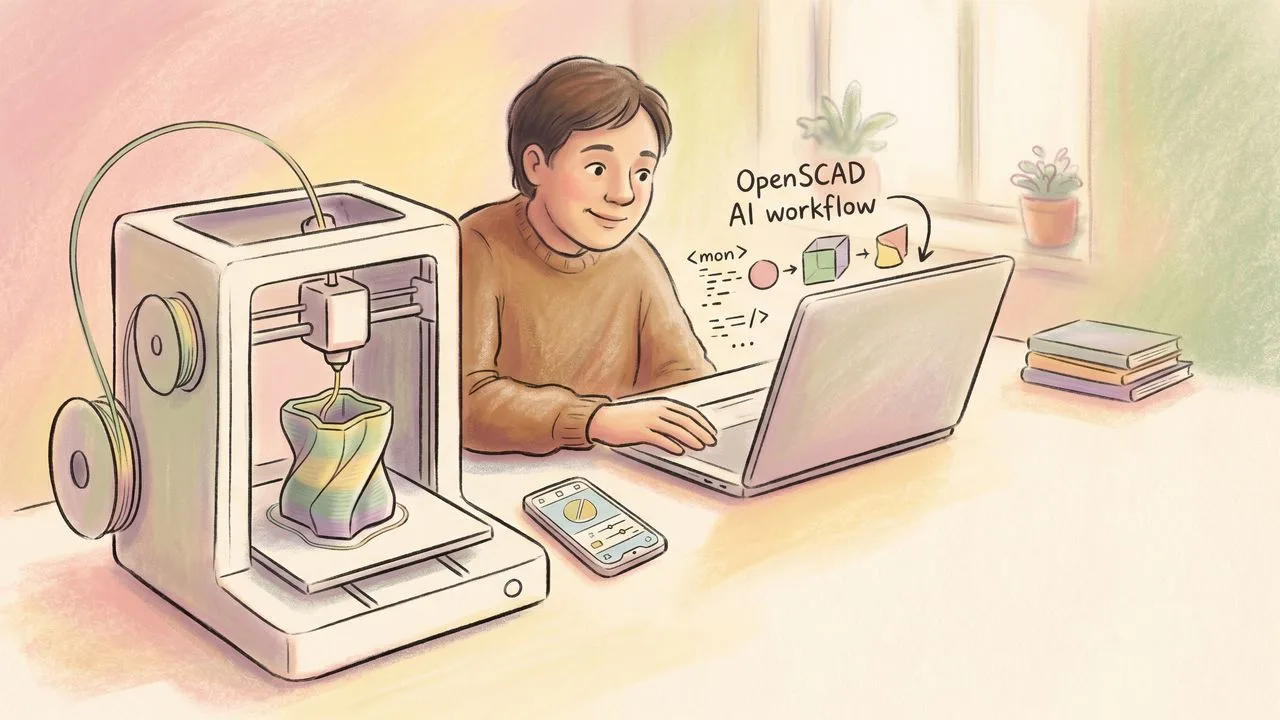
Photo: AI. Aiyana Stone
For about a decade, 3D printers occupied a particular cultural niche: technically fascinating, perpetually "about to go mainstream," and largely the domain of people who enjoyed troubleshooting at 2 a.m. The hardware kept getting cheaper. The software kept getting better. And yet the thing that kept most people out wasn't really the printer—it was the 3D model. You needed one before any of this worked, and making one well required skills that took years to develop.
That calculus may be shifting. Ben Vallack, a YouTuber who covers workflow optimization and DIY tech, recently documented his first weeks with the Elegoo Centauri Carbon 2—a disclosure-tagged gifted unit, worth noting—and the most interesting parts of his experience have less to do with the printer itself and more to do with what AI is doing to the modeling problem that's bottlenecked this technology for years.
The video is an ad, technically. Elegoo sent Vallack the machine. He has affiliate links in the description. He says his content is honest regardless, and based on the texture of what he actually reports—including fume concerns, filament waste trade-offs, and TPU settings that didn't work out of the box—I'm inclined to give him that. But the commercial context is worth holding onto as you read, because it shapes what he emphasizes and what he doesn't.
The Modeling Problem, Finally Cracked?
The traditional path to 3D printing your own stuff ran through software like Fusion 360, Tinkercad, or Blender—programs that range from "approachable but limited" to "genuinely professional and correspondingly steep." For purely functional objects with precise dimensions, the standard approach was parametric modeling: you define parameters, the model assembles itself around them. For organic shapes—characters, creatures, anything with curves that don't reduce neatly to numbers—you were in sculpting territory, which is its own discipline.
Vallack's argument is that AI collapses both of these paths into something most people can actually navigate.
For the parametric side, he used OpenSCAD—an open-source application that generates 3D models from plain text code—and fed that workflow through Claude Code. He describes the process: "I was just talking to Claude Code, and it just built the script for this. I didn't write any of that code in this application, but I could see the model in the program. I could move it around and see the issues and talk back to AI to explain where it was going wrong and tune that." The result was a custom shelf system built to the exact dimensions of his actual tools. He measured his tape measure, his pen, his screwdriver, typed those numbers into a chat window, and ended up with a printable model.
That's genuinely different from how this worked before. OpenSCAD has existed since 2010. The parametric approach to modeling has existed much longer. What's new is that you no longer need to understand the code to drive it—you need to understand what you want, which is a much lower bar.
For organic models, the pipeline is more complex: generate an image (AI can do that too), run it through an image-to-3D converter, import the result into Blender, use Boolean operations to create articulated segments. Vallack used this to make a print-in-place articulated dragon—a popular benchmark project in the 3D printing community. He calls it "way more approachable than I thought it was going to be," which is a notably hedged endorsement. Blender remains formidable software. AI removes one difficult step; it doesn't eliminate all the others.
What the Printer Actually Does
The Centauri Carbon 2 is a CoreXY-style printer with a four-filament automatic color-changing system—the "Canvas" system Vallack spends considerable time on. The machine runs Linux internally, operates independently of any connected computer once a print job is loaded, and can receive files via USB or cloud upload. The self-contained architecture is worth understanding: unlike an inkjet that needs a live driver connection, you can start a 12-hour print and walk away. The printer manages itself.
The color-changing feature is real and automatic, but it comes with a trade-off Vallack is straightforward about. Every color switch produces waste—molten filament of both colors blends in the nozzle until one flushes through—and the printer manages this by building a dedicated waste tower alongside your actual print. For a dragon model with dozens of per-layer color changes, that waste adds up fast. "I end up wasting an enormous amount of filament to just pull that off," he says of a two-tone shelf project. The slicer tells you upfront exactly how much filament you're burning; whether that's worth it is a call you make per project.
The slicer software itself—Orca Slicer, an open-source project shared across most major printer manufacturers—gets more attention than I'd expect from a beginner review, and rightfully so. This is genuinely the invisible engine of 3D printing. It converts your 3D model into the physical instructions the nozzle follows, generates internal infill structures that keep objects rigid without wasting material, and exposes a dense menu of parameters you can tune. Vallack hit real trouble with TPU (a flexible rubber-like filament) using default settings and resolved it through AI-assisted troubleshooting of slicer parameters. The point he's making: AI isn't just for modeling. It's also a dramatically better way to debug a process that used to require either deep community knowledge or patient forum-reading.
The Honest Caveats
The fume question gets less emphasis than it probably deserves. Vallack moves through it quickly: common PLA filaments aren't highly toxic, but other filaments can be genuinely dangerous, and the machine now lives in his garage. That's the right call, but "put it in a room with ventilation you wouldn't share with anyone" is a more significant operational constraint than the "vending machine" framing elsewhere in the video suggests. If you live in an apartment, or your only available space is shared living space, this is a real consideration—not a footnote.
The noise situation is similar. Version 2 improved on Version 1 via upgraded rubber feet; it's not silent but Vallack doesn't find it intrusive. He also acknowledges he has nothing to compare it to.
And the "one-and-done" claim at the end—that he doesn't see any reason he'd ever need to replace this printer—is the kind of thing first-time owners of many things say and then revise. The 3D printing community has a well-documented upgrade culture. Whether that's a failure of the hardware or a feature of the hobby is genuinely contested.
The Bigger Shift Worth Paying Attention To
There's something underneath the hardware review that's more interesting than any single printer spec. Vallack frames it as anti-consumerist: "Instead of having to buy someone else's idea of what a product should look like, you can just build it exactly what you want." He draws a direct line between making a custom shelf for his exact tape measure and refusing to use photo libraries that profit from the storage space you consume. The 3D printer, in this framing, is an infrastructure tool for a certain kind of radical personalization—where the things around you are built to your life, not the average of a market segment.
This isn't a new argument. It goes back to the original maker movement, to the RepRap project that seeded most of the consumer 3D printing ecosystem, to a whole tradition of thinking about personal fabrication as a kind of political act. What's potentially different now is that the AI layer has lowered the technical floor significantly. The question "what could you make if you could make anything?" used to be answered by the limits of your CAD skills. Now it's answered by the limits of your imagination and your willingness to iterate.
Whether that creates a new wave of genuinely self-sufficient makers or just makes it slightly easier to print organizational bins and articulated dragons before losing interest—well, that depends entirely on which humans you ask.
More Like This
Should Your Kid Use AI? A Tech Parent's Honest Answer
A tech journalist who codes for a living explains why he won't let his 8-year-old use AI unsupervised—and why the environmental argument misses the point.

Vibe Coding Grew Up. Karpathy Explains What's Next
Andrej Karpathy says vibe coding raised the floor. Agentic engineering is the harder discipline forming on top of it—and the gap between who gets it is widening fast.

OpenClaw Raises Questions Nobody Wanted to Answer
An Austrian hobbyist's open-source AI project is forcing developers to confront what happens when your assistant calls you first—and won't stop calling.
This Developer Spent $20K Building an AI Company That Never Sleeps
Alex Finn invested $20,000 in local AI models to create a 24/7 autonomous digital workforce. Here's what happened when the API costs disappeared.

Boris Reveals Claude Code Secrets for AI Mastery
Explore Claude Code insights from its creator Boris for maximizing AI-driven coding workflows.

What 1,600 Hours With Claude Code Actually Teaches You
Ray Amjad spent 1,600 hours with Claude Code and learned it's not about the AI—it's about understanding how you work. Here's what actually matters.

Hugging Face ML Intern Automates AI Development
Hugging Face's ml-intern is an open-source agent that automates the full ML research loop. Here's what it does, what it can't, and what it signals.
Small Language Models Are Reshaping Agentic AI
Small language models are outperforming larger rivals on key AI agent benchmarks. Here's what the efficiency shift means for how AI gets built and deployed.