Copper's Melting Behavior Could Shape Fusion Power
SLAC researchers found copper melts gradually under extreme heat, not instantly — a finding that could reshape how engineers design fusion power plants.

Written by AI. Zara Chen
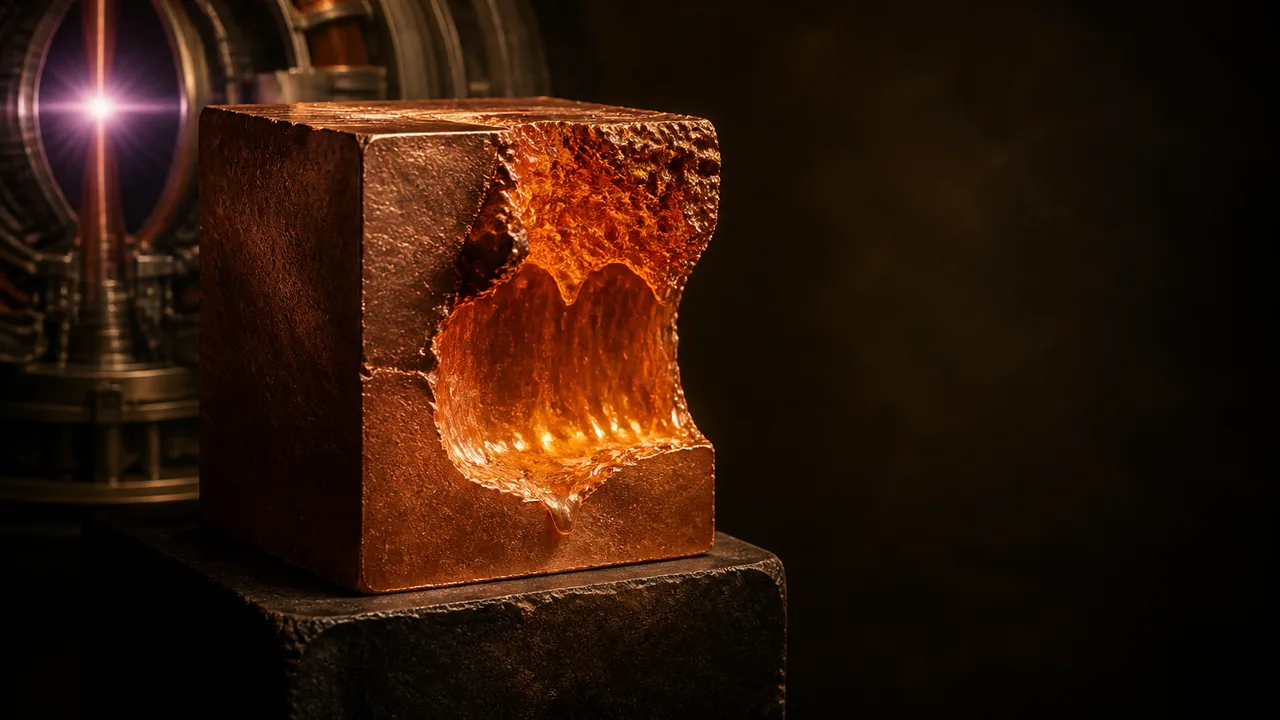
Here's a sentence I genuinely did not expect to write this week: a new discovery about how copper melts might be one of the more consequential clean energy findings of the year. Stay with me.
Researchers at SLAC National Accelerator Laboratory just published results in Nature Communications showing that copper — yes, the same stuff in your phone charger and that one decorative pot your roommate owns — behaves in a fundamentally different way under extreme heat than anyone's models predicted. According to the SLAC announcement, the team identified a key parameter that allowed copper's crystal lattice to melt steadily, rather than collapse instantaneously, as earlier simulations had predicted. That distinction — gradual versus instant — sounds almost philosophical until you realize it's the difference between a material you can engineer around and one that just fails on you mid-reactor.
The "star on Earth" problem nobody talks about enough
Fusion power's pitch has always been audacious: recreate the conditions at the core of a star, here on Earth, and harvest the energy that comes out. Cool pitch! Except the people who grew up hearing it — my entire generation, basically — have also grown up watching it stay exactly 20 years away, year after year, like a horizon that moves when you walk toward it. I've genuinely lost count of how many times I've seen a "fusion is almost here" headline since middle school.
And look, I'm not dunking on the scientists. The physics is genuinely brutal. You're talking about containing plasma heated to tens of millions of degrees inside a magnetic field because literally no physical material can touch it directly. The components that do get close — the so-called plasma-facing components and the structural supports surrounding them — are subjected to heat loads and particle bombardment that make a blast furnace look relaxed. Picking the right materials for those parts isn't a footnote. It is the engineering problem.
Which is exactly why the SLAC findings hit differently than a lot of incremental fusion news.
What they actually found (and why simulations were wrong)
Copper is genuinely great at conducting heat — that's why it was always in the conversation for fusion-adjacent components in the first place. The catch was that prior computational models suggested it would undergo a kind of catastrophic lattice collapse when pushed past its superheating limit. Instantaneous failure. The kind of material behavior that makes engineers reach for something else entirely.
Except that's not what happened in the lab. As phys.org reports, the team found a key parameter that caused the copper's crystal lattice to deteriorate slowly instead. Newswise and Slashdot both note the same core result: copper's crystal lattice melts steadily rather than collapsing instantaneously — which is almost the opposite of what the models said would happen.
Interesting Engineering characterizes the test temperatures as reaching around 2,595°F — though I'd note that figure comes from their coverage rather than the primary SLAC source, so treat it as secondary characterization until the paper itself confirms it. What the primary sources do confirm clearly is that copper held past its expected superheating limit, and that the failure mode was gradual, not sudden. That's the finding that matters.
The Stanford Report frames the implications directly: the findings substantially improve the simulation models researchers use to predict which materials can survive fusion conditions — which, if you care about fusion ever actually working, is exactly the kind of boring-sounding infrastructure upgrade that changes everything downstream.
Why simulations being wrong is actually the whole story
Here's what I think people miss when they read material science research like this: the results aren't just "copper is good, actually." The deeper finding is that the models were wrong. And models are what engineers use to decide what to build before they build it.
Think about what that means in practice. Every time a fusion project — ITER, Commonwealth Fusion's SPARC, the various national lab programs — has to spec out a component, they run computational simulations to predict how materials will behave. Those simulations are built on parameters derived from earlier experiments. If the parameters were wrong about copper's failure mode, they might be wrong about other materials too. The SLAC team didn't just rehabilitate copper; they found a new variable that the whole field's models were missing.
That's not a small deal. That's a calibration correction with compounding effects every time someone runs a future simulation. The Stanford Report notes that the results meaningfully sharpen predictions about which materials will survive fusion environments — which means every materials decision that comes after this one benefits from a more accurate baseline. 🔬
Okay but what does this actually mean for fusion timelines
Genuinely? I'm not going to oversell it. This is one paper, and the gap between "we understand how copper melts" and "we have a working fusion power plant" is still enormous. The engineering, the plasma physics, the tritium handling, the regulatory frameworks — none of that disappears because copper turned out to be more resilient than expected.
But here's the thing about how hard technology problems get solved: it's almost never one breakthrough. It's a pile of incremental findings that quietly remove obstacles until one day the obstacle course is short enough to actually run. Fusion has been stuck in part because the obstacle course included a lot of "we don't know if our materials can handle this." The SLAC result removes one of those unknowns and — maybe more importantly — suggests the removal method works. You can probe extreme-condition material behavior experimentally, catch where simulations diverge from reality, and correct the models. That's a methodology, not just a result.
People my age have grown up treating "fusion is almost here" as basically a punchline. And fair enough — the credibility debt is real. But what I find myself thinking about after reading this research isn't the timeline. It's the texture of the progress. Fusion used to feel like it was stuck on a cliff — one giant impossible leap away. Lately, including this, it's starting to feel more like a slope. Steep, yeah. But slopes you can climb.
More Like This

This Creator Got Shadowbanned on YouTube in 25 Days—On Purpose
A vidIQ creator deliberately shadowbanned their channel with AI-generated content to expose how YouTube's algorithm actually works. The results are wild.

Master Remote Access with Comet Pro KVM
Explore the Comet Pro KVM for seamless remote PC access: Wi-Fi 6, out-of-band management, and Tailscale security.
Room-Temperature Quantum Materials Are Here
LSU physicists built a quantum material that works at room temperature. Here's what that actually means for quantum computing, and why it matters right now.
Fusion Energy Is No Longer Just a Physics Problem
Fusion reactors have cleared their core scientific hurdle. What remains are hard engineering challenges—and a tight race against the clock and other clean energy sources.
![Man in Laravel cap looking thoughtful beside phone displaying "Debounce for [301]" hashtag on pink background](https://static.buzzrag.com/articles/laravel-13-6-drops-debounceable-jobs-and-json-health-checks/thumb-5e646253.webp)
Laravel 13.6 Drops Debounceable Jobs and JSON Health Checks
Laravel 13.6 introduces debounceable jobs, JSON health check responses, and Cloudflare email support. Here's what developers need to know.
Altermagnetism: Physics Just Got a Third Magnetic Class
Physicists have confirmed a third fundamental class of magnetism. Here's what altermagnetism actually is, why it matters, and who's positioned to control it.

Google Nano Banana 2 Lite Makes AI Image Generation Cheap
Google's Nano Banana 2 Lite generates images in 4 seconds at $0.034 per 1,000—and that price point changes who gets to build with AI image tools.
Renewables Hit 30% of US Electricity in Early 2026
EIA data shows renewables reached 30% of US electricity in early 2026, up from 27.8% a year ago. Here's what that number actually means—and what it doesn't.