Cognitive Rigidity, Extremism, and the Ideological Brain
Cognitive scientist Leor Zmigrod argues that susceptibility to extremism is measurable, biological, and—crucially—not fixed. Here's what the research actually shows.

Written by AI. Priya Sharma
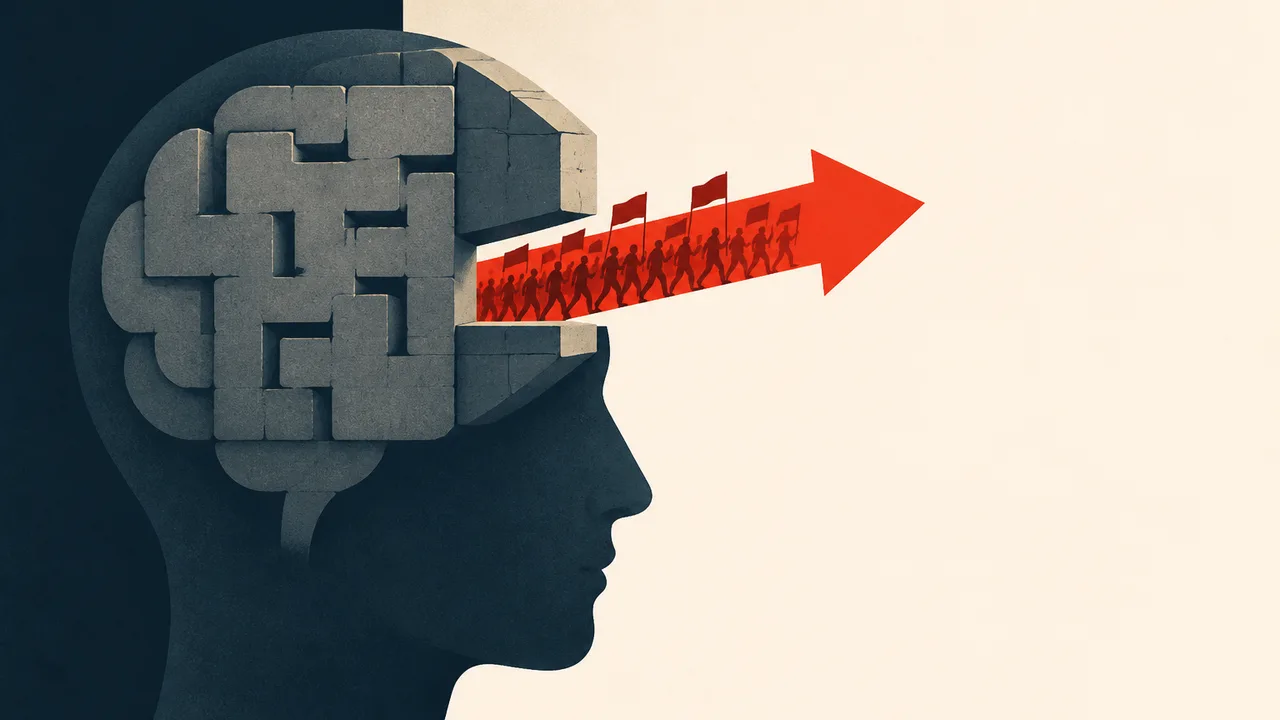
Photo: AI. Mika Sørensen
Start with the most predictable response in psychology: ask someone whether they're a rigid thinker, and the most rigid person in the room will insist they're the most open. Leor Zmigrod, a cognitive scientist whose research sits at the intersection of psychology, neuroscience, and political science, has built a career on this gap between self-perception and measurable reality—and in a recent TEDxNewEngland talk, she brought that research out of the lab and made it uncomfortable in the best possible way.
Her central argument is not that extremists are mentally defective or that ideology is inherently pathological. It's more precise and, frankly, more unsettling than that: susceptibility to extremism exists on a continuous spectrum, it has neurobiological correlates, and most of us are somewhere on it without knowing where.
The Card Game That Isn't Really a Card Game
To demonstrate what she means by cognitive rigidity, Zmigrod describes a task she has administered to thousands of participants—a card-sorting game in which players learn to match cards by color (red with red, blue with blue) and are rewarded for doing so correctly. Then, without warning, the rule changes. Points now come from matching by symbol—stars with stars, circles with circles.
What happens next is the data. Flexible thinkers notice the shift, adjust, and move on. Rigid thinkers do not. They keep applying the old rule "again and again, even though it doesn't work anymore," Zmigrod observes in the talk. "Even though there's clear evidence that there's a new pattern at play."
The elegance of this as a research tool is that it measures something the participant doesn't know they're being asked about. Self-report fails here by design. The game bypasses the narrative we tell ourselves and reads the cognitive machinery directly.
Zmigrod found that performance on this kind of task correlates with ideological extremism across domains—not just political affiliation, but nationalism, religiosity, any framework of belief that functions as a closed system. "It was less about what people think," she says, "and more about how they think." That's a meaningful distinction. It suggests the underlying cognitive style is content-agnostic: it can attach to any ideology that offers a set of inviolable rules.
What the Brain Actually Shows
Zmigrod's research ventures further than behavioral tasks. She has examined the role of dopamine—which governs how the brain registers surprise and updates its predictions—and found that individual variation in dopamine signaling can shape whether a person is a flexible or rigid thinker. This is interesting territory, because it means some component of cognitive style may be rooted in neurochemistry rather than pure choice or upbringing.
More controversially, she discusses structural brain differences between people holding different political beliefs. The amygdala—a structure involved in processing threat, fear, and disgust—has been found to be measurably larger, on average, in people with right-wing beliefs compared to those with left-wing beliefs. This finding has, she says, replicated across multiple countries and hundreds of participants.
It's worth pausing here, because this is where the research invites the most scrutiny. Zmigrod is careful: she frames this not as evidence that right-wing people are more fear-driven or deficient, but as a genuine explanatory puzzle. "Is it that people who have a larger amygdala have a neurobiological predisposition that makes them gravitate towards right-wing ideologies? Or is it also possible that being immersed in an ideology that constantly engages those emotions of threat, fear, and disgust could be an experience that physically and biologically changes the brains of believers?"
Her answer is that both are probably true, and that's actually the more rigorous position. The brain shapes the ideology chosen; the ideology reshapes the brain. It's a feedback loop, not a fixed trait.
The amygdala finding deserves some contextual grounding the talk doesn't provide. This line of research—associated with work by Ryota Kanai and colleagues, published in Current Biology in 2011—generated significant attention and criticism. Sample sizes in structural neuroimaging studies are often modest, effect sizes small, and replication in complex political cognition research is not always clean. Zmigrod acknowledges the chicken-and-egg problem but doesn't dwell on methodological caveats. For a TED talk, that's an understandable editorial choice; for readers evaluating these claims, it's worth knowing the field is active and unsettled.
When Ideology Gets Under the Skin
Perhaps the most striking piece of evidence Zmigrod presents is a study on economic ideology and physiological empathy—linked in the talk's description to a 2019 paper in Nature Communications. Researchers measured heart rate and physiological arousal in participants with opposing views on economic inequality as they watched a video of a person experiencing homelessness describe their daily life.
Those who believed inequality was unjust showed accelerated heart rates. Their bodies registered the suffering. Those who believed inequality was natural and acceptable showed flat physiological responses—their bodies, as Zmigrod puts it, "were numb to this person's pain."
The finding is striking because it locates ideology not in conscious reasoning but in automatic, visceral response. It suggests the beliefs you hold can recalibrate your nervous system's baseline response to human suffering. "Ideologies can skew our most intuitive empathy," she says, "affecting how our bodies viscerally react to other people's suffering."
There's an important interpretive caution here too: this study measured correlation between existing ideology and physiological response. It doesn't establish the direction of causation, and individual variation within ideological groups is almost certainly large. People who justify inequality are not a monolith; people who oppose it are not uniformly empathic in their physiology. But the finding is consistent with a broader literature on motivated reasoning and moral disengagement, and it deserves to be taken seriously.
The Problem with Prescriptions
One of the more intellectually honest moments in Zmigrod's talk comes when she addresses what individuals can actually do about all this. She declines to offer a checklist.
"Unfortunately, there is no recipe or set of rules that I could give you," she says, "because any system of rules or prescriptions could accidentally turn into its own ideology."
That's not a dodge—it's a logical consequence of her own argument. A twelve-step program for cognitive flexibility would be its own rigid framework, and rigid frameworks are exactly what she's diagnosing as the problem. Instead, she points toward two broader orientations: interrogating the routines and rituals that govern everyday life, and cultivating genuine creativity—not as a lifestyle brand, but as a willingness to break with established patterns and tolerate the discomfort of ambiguity.
She also notes something that has real policy implications: stress makes everyone more cognitively rigid. Populations under threat—economic precarity, social instability, physical danger—become more susceptible to ideological certainty, not less. Remove the stressor, and flexibility tends to return. This suggests that the conditions enabling extremism are not purely individual. They're structural.
What This Research Is and Isn't Saying
Zmigrod is clear that susceptibility to extremism is not destiny. "These predispositions are potentials," she says. "They're probabilities for action rather than determined outcomes." The brain is plastic. Cognitive flexibility is itself flexible.
That's a genuinely hopeful claim, and it's grounded in neuroscience rather than optimism. But it sits in tension with the structural point above: if stress drives rigidity, and the conditions producing stress are not evenly distributed, then the invitation to "choose flexibility" reaches different people from very different positions.
The research Zmigrod presents spans behavioral experiments, neuroimaging, psychophysiology, and political science—an ambitious scope, and one that requires each component to be evaluated on its own methodological merits rather than absorbed as a unified theory. The card-sorting work is well-established in cognitive psychology. The structural brain findings are more contested. The physiological empathy data is compelling but correlational. These are not reasons to dismiss the framework; they're reasons to hold it carefully.
What Zmigrod has done, at minimum, is shift a conversation that usually happens at the level of rhetoric and ideology into the domain of measurable cognitive science. Whether you find that clarifying or reductive probably says something about how you already think about the relationship between biology and belief.
Which is, perhaps, exactly her point.
More Like This
How Opponent Recognition Unlocks Cooperation in Evolution
A Rutgers physicist argues that tailoring cooperation to specific opponents—not blanket strategies—may be evolution's simplest path out of the Prisoner's Dilemma trap.

Neurotic vs. Psychotic: What the Terms Really Mean
Alain de Botton's School of Life video reframes "neurotic" and "psychotic" as degrees of self-awareness—not insults. Here's what the distinction actually reveals.
Building a Cognitive Immune System Against Misinformation
New neuroscience frames the brain as having a cognitive immune system. Here's what that means—and who that framing conveniently lets off the hook.

Is the Autism Spectrum Broken? One Pioneer Says Yes
Uta Frith, who shaped modern autism science, now argues the spectrum has been stretched so far it no longer holds. Here's what she means—and why it matters.
Unlocking New Skills After 50: The 'Pillar & Playground' Approach
Explore how the 'Pillar & Playground' method helps those over 50 learn efficiently, leveraging crystallized intelligence and cognitive flexibility.
Exploring Black Holes and Asteroids with StarTalk
Neil deGrasse Tyson delves into black holes, asteroids, and more in StarTalk's latest Cosmic Queries episode with Chuck Nice.

Fire Tornadoes on a Lake: The Bardstown Bourbon Disaster
In 2003, fire tornadoes erupted on a Kentucky lake. The cause wasn't paranormal—it was 800,000 gallons of burning bourbon and the right wind geometry.

The Maths Behind Palindrome Ages Explained
Mathematician Kat Phillips unpacks why some pairs of people have reversible ages—and the surprisingly elegant number theory that governs when it happens.