Christopher Nolan's The Odyssey: Epic Ambition Meets Ancient Text
Christopher Nolan adapts Homer's Odyssey with Matt Damon as Odysseus. Here's what the project signals about Hollywood ambition, classical storytelling, and the director's arc.
Written by AI. Theodore "Teddy" Ashworth III
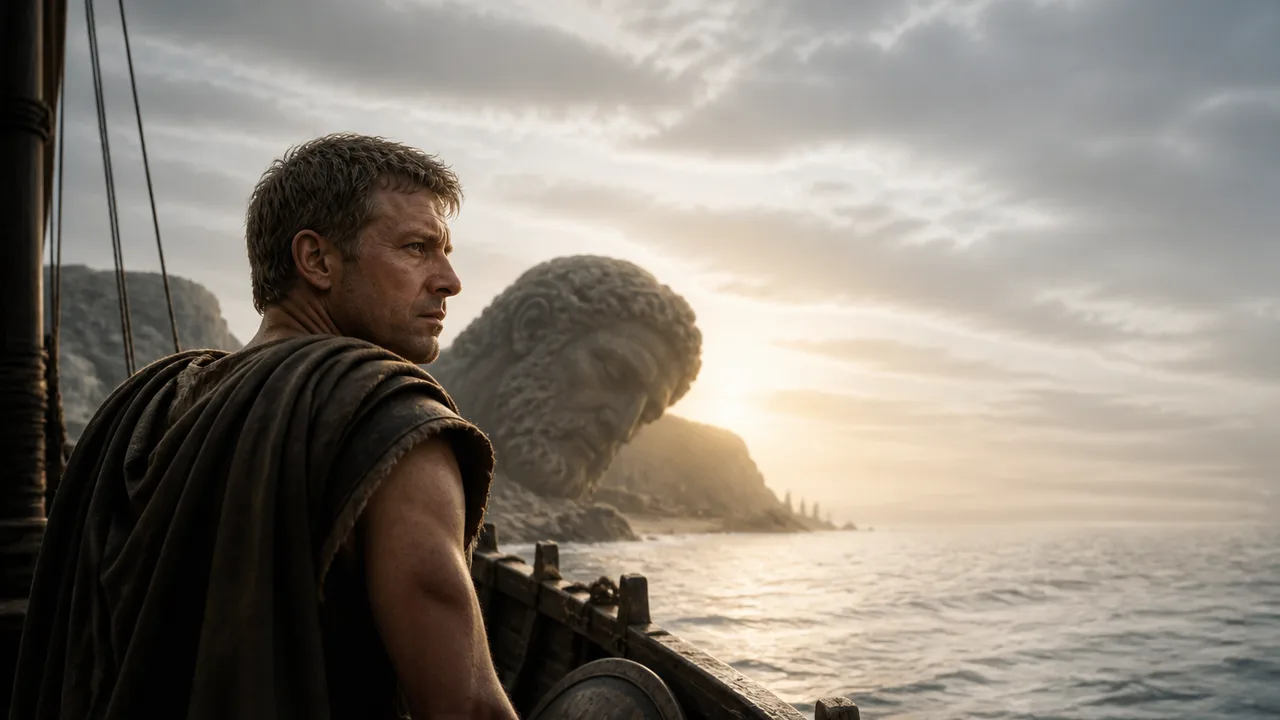
Homer did not write a screenplay. He composed something closer to a living sound—an oral epic meant to be performed, its rhythms calibrated for human breath and memory, its images designed to land in a listener's body before they ever reached the mind. The Iliad and the Odyssey survived because they were made to be spoken aloud. There is a particular irony, then, in the fact that cinema—the most visual of storytelling forms—has historically struggled to do them justice.
Christopher Nolan is about to try.
The Odyssey, due in summer 2026, is exactly what it sounds like: a full-scale cinematic adaptation of Homer's nearly 3,000-year-old epic poem about Odysseus's decade-long journey home from Troy. According to Wikipedia's entry on the film, it is written and directed by Nolan, stars Matt Damon as Odysseus—king of Ithaca—and follows the hero's perilous passage through a world dense with monsters, gods, and moral ambiguity. The film is categorized as an "epic fantasy action" picture, which is a genre designation that simultaneously tells you everything and nothing about what Nolan is likely to have made.
What it signals clearly is scale. What remains genuinely open is whether that scale can hold the weight of a poem this old and this strange.
The Oppenheimer Equation
To understand why The Odyssey exists now, you have to understand what Oppenheimer did.
Nolan's 2023 biopic about J. Robert Oppenheimer—a three-hour, largely dialogue-driven film about a physicist's moral reckoning with the atomic bomb—became a cultural phenomenon and commercial juggernaut. According to Wikipedia's Oppenheimer entry, the film grossed nearly $1 billion worldwide and won seven Academy Awards, including Best Picture. By every measure, it was a vindication of the idea that audiences will show up for serious, demanding cinema when a filmmaker has earned their trust.
The sequencing from Oppenheimer to The Odyssey is legible on its face: a director at the height of his cultural capital turns toward the most foundational story in Western literature. It's reasonable to read it that way, and the pattern fits Nolan's career-long tendency to escalate—each film a bid for more formal complexity, more narrative ambition, more sheer size of subject.
What the Oppenheimer moment also gave Nolan, practically speaking, was leverage. Studios greenlight passion projects when directors have fresh proof of profitability. Homer's epic had never received a proper, fully realized cinematic treatment. The gap was real. The opportunity, from a certain angle, was obvious.
What the Poem Is Actually About
Here is where things get genuinely complicated, and where a lot of the pre-release conversation hasn't quite caught up.
The Odyssey is not primarily an adventure story. Or rather—it is an adventure story the way Hamlet is a ghost story. The monsters and the journeys are the scaffolding for something more interior: a sustained meditation on nostalgia, cunning, identity, domestic loyalty, and the cost of survival. Odysseus is one of literature's great morally ambiguous protagonists—a man who lies as fluently as he breathes, who is celebrated for his intelligence while frequently undone by his ego, who longs for home while repeatedly delaying his return. He is not a hero in the contemporary action-film sense. He is something older and stranger: a man defined by his capacity to endure and adapt, not by his capacity to fight.
The challenge for any filmmaker adapting this material is that the poem's power lives in its texture—in the rhythms of repeated epithets, in the accumulating weight of Odysseus's disguises, in the slow, aching domesticity of Penelope weaving and unraveling her shroud. These are not cinematic problems with obvious cinematic solutions. Action sequences can render the Cyclops and the Sirens. What renders the grief?
Nolan has shown he can hold moral complexity—Memento, The Dark Knight, Oppenheimer all work precisely because they refuse easy resolution. The question is whether he can find a visual language for a poem whose most important action is fundamentally internal.
The Box Office Calculus
The commercial anticipation around The Odyssey is significant and worth examining on its own terms.
Box Office Theory's tracking analysis projects the film could deliver Nolan's biggest opening weekend since The Dark Knight Rises, while acknowledging "many in-flux variables." The site notes that the film's source material—a well-known piece of historic literature—is "ripe" for wide recognition while presenting its own audience-calibration challenges. That's an honest framing of the tension: familiarity with the name Homer doesn't translate directly into familiarity with the poem, and audiences who show up expecting something like 300 or Troy will encounter a considerably more complex narrative than those films offered.
Matt Damon as Odysseus is a casting choice that reads as both commercially shrewd and dramatically interesting. Damon has spent a career playing versions of the smartest person in the room—characters who survive through intelligence rather than brute force. His presence signals something about the kind of Odysseus Nolan is making: probably less Clash of the Titans, more the weary tactician trying to get home.
The R-rating, noted in Box Office Theory's analysis as part of the film's positioning, is worth flagging. Nolan's Oppenheimer was R-rated and performed extraordinarily regardless. An R-rated mythological epic in summer 2026 is a specific kind of market bet—one that assumes audience appetite for serious, uncompromising spectacle hasn't evaporated. Given current box office patterns, that's not a certainty. It's a wager.
The Deeper Cultural Bet
Beyond the numbers, what The Odyssey represents is a filmmaker asking a particular question in public: can ancient narrative structures—pre-novelistic, pre-psychological in the modern sense, rooted in oral tradition and polytheistic cosmology—be translated into a form that twenty-first-century audiences experience as emotionally immediate?
It's not a new question. Filmmakers and playwrights have been asking it since cinema existed. What makes Nolan's attempt notable is the combination of industrial resources and directorial seriousness he brings to bear. He is not making a popcorn epic with classical dressing. Every indication from the film's positioning and Nolan's career record suggests he's trying to make something that stands as its own statement about what stories endure and why.
The risk in that ambition is real. Fidelity to the poem's strangeness might lose audiences; too much modernization might lose the poem. The adaptations that have worked best with classical material—Coppola's use of Homeric structure in Apocalypse Now, the Coen Brothers' O Brother, Where Art Thou? riffing on Odyssey's bones—have tended to find their power through oblique angles rather than direct translation. Nolan is going direct. That's either brave or presumptuous, possibly both.
The forecast trackers are bullish. The casting is smart. The source material is inexhaustible in what it offers a serious filmmaker to work with. And there is something fitting about the fact that a poem originally designed to be heard—performed aloud, scored by the human voice—is now being reimagined as cinema, our culture's dominant vessel for collective experience.
Whether what survives the translation is the adventure or the grief is the only question that ultimately matters.
More Like This
Kojima's OD Survives Xbox's Sweeping Reset
Xbox is cutting projects and studios in a major reset, but Kojima's horror game OD stays safe. What does that tell us about where the platform is heading?
Why the Ocean Still Terrifies Us: Depths of Fear
Quinn and James of Cosmic Chronicles explore why the ocean remains humanity's oldest, deepest fear—from the Mariana Trench to the myth of the Bermuda Triangle.
Visually Stunning Movies Nobody Talks About
From Tarsem Singh's The Fall to the anime fever dream Redline, these nine films are visually extraordinary—and almost entirely ignored. Here's why that matters.
Enola Holmes 3 and the Sound of Franchise Fatigue
Enola Holmes 3 is competent, charming, and quietly exhausted. What the score and Millie Bobby Brown's voice reveal about a franchise losing its internal momentum.
Bookpilled's Vintage SFF Deep Dive Is Worth Hearing
Bookpilled's 28-minute tour of 20 obscure sci-fi and fantasy books is provisional criticism done out loud — and that's exactly what makes it worth your time.
Homer's Odyssey and Mycenaean Religion: Fact vs. Myth
Homer set the Odyssey in the Bronze Age but wrote it 500 years later. How accurate is his religion? Linear B tablets reveal a startling gap.
The Last Maya Cities: Tulum, Mayapan, and Cobá
A new documentary examines Tulum, Mayapan, and Cobá—the final Maya cities—through archaeology, LiDAR mapping, and a more complicated story of collapse.
Streaming vs Cinema: Damon & Affleck on Film's Future
Matt Damon and Ben Affleck discuss streaming's impact on film's future and cultural shifts in a Joe Rogan podcast.