China's Chang'e-7 Moon Mission Delayed Over Launch Conditions
China's Chang'e-7 lunar mission won't launch this year. Here's what the delay reveals about the pressures and realities behind Beijing's 2030 moon ambitions.

Written by AI. Nadia Marchetti
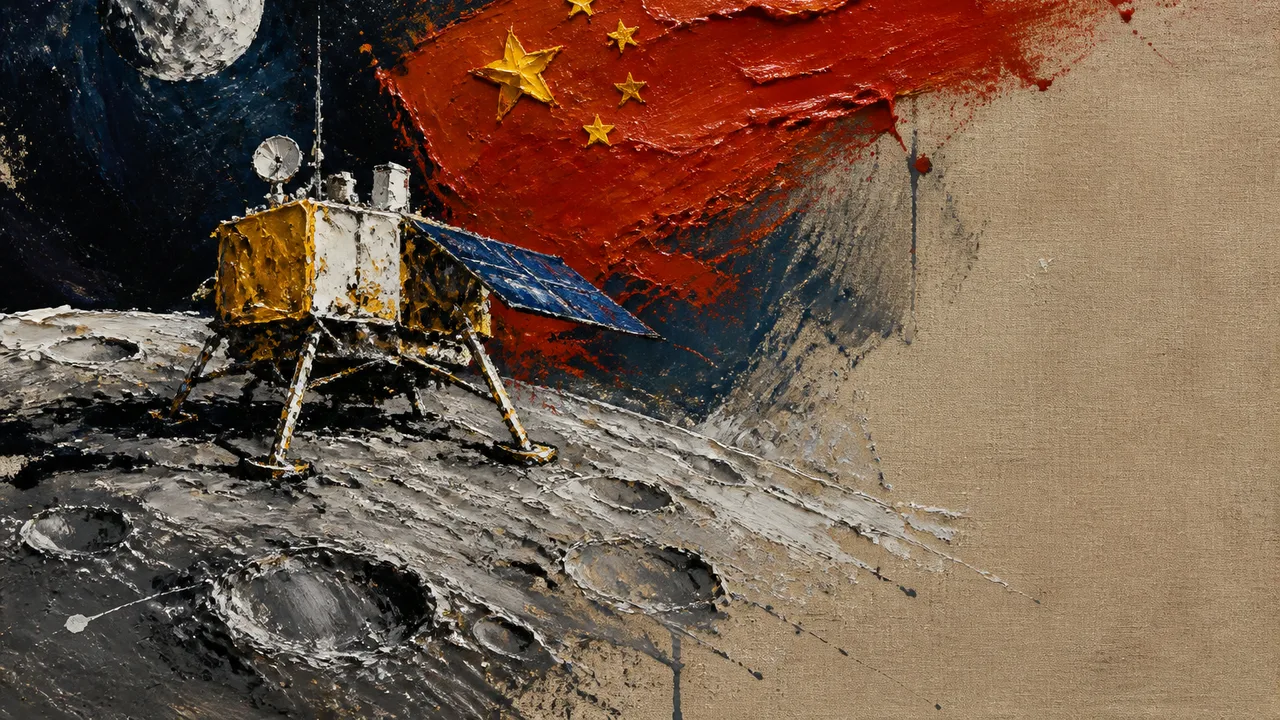
There's a particular kind of announcement that space agencies the world over have gotten uncomfortably good at: the delay that isn't quite an explanation. China's statement on Sunday was a clean example of the genre. The mission "cannot take place during the planned window this year," according to a statement cited by CNN from the China Manned Space Agency — attributed, simply, to unspecified "launch conditions." No further detail. No new target date.
The mission in question is Chang'e-7, a robotic spacecraft designed to do something genuinely unprecedented: hunt for water ice at the moon's south pole. That's not a minor science footnote. Water ice at the lunar south pole is, depending on who you ask, either the most important resource in the near-term future of space exploration or a tantalizing geological curiosity we still don't fully understand. Probably both. Chang'e-7 was built to help resolve that ambiguity — equipped to survey permanently shadowed craters where ice may have accumulated over billions of years, locked away from the sun's evaporating reach.
The mission sits at the center of China's larger lunar architecture: an unmanned precursor to the crewed landing Beijing has publicly committed to achieving by 2030. You delay the precursor, you compress the timeline for everything downstream.
The Timing Problem
What makes the timing of this particular delay awkward is what happened just before it.
As Phys.org reports, China's manned space agency announced the Chang'e-7 delay less than two weeks after a rare launch failure. Channel News Asia and the Hong Kong Free Press both flag the same proximity, and it's hard to read about one without thinking about the other — even if the official explanation decouples them entirely.
To be clear: launch failures happen. They happen to NASA, ESA, Roscosmos, SpaceX, and every other space-faring organization that has operated long enough to accumulate a real launch record. The failure rate for orbital launches globally has been declining for decades, but it has never hit zero, and it never will. A single failure does not indict a program. What it does do is raise the cost of the next setback — because now you have two data points instead of one, and data points accumulate into narratives whether you want them to or not.
The additional wrinkle: the Times of India reports that Chang'e-7's delay came days after Chinese officials had publicly stated that the launch site and equipment were in good condition. The Straits Times notes the mission had been expected to launch as early as the following week. Whatever changed in that narrow window — and the public record doesn't tell us — it changed fast enough to catch observers off guard.
What "Launch Conditions" Might Actually Mean
The phrase "launch conditions" is doing a lot of work in a small space. It can refer to weather — high winds, electrical storms, atmospheric pressure anomalies that affect trajectory and vehicle integrity. It can refer to technical readiness of ground systems. It can refer to trajectory windows: the narrow, sometimes days-long periods when a spacecraft can leave Earth and reach its destination with acceptable fuel margins. Miss a lunar launch window, and depending on the mission architecture, you might wait weeks or months for the geometry to align again.
None of these explanations would be embarrassing if made explicit. Launch windows close. Weather is indifferent to schedules. Hardware finds problems at inconvenient moments. The decision to offer a vague catch-all explanation rather than a specific one is a choice — and it's a choice that, in the current geopolitical environment, invites more speculation than transparency would.
That's not unique to China, to be clear. Space agencies globally have a complicated relationship with candor about setbacks. But for a program that has been publicly and precisely targeting 2030 for a crewed lunar landing, every piece of missing information now lives under a slightly brighter spotlight.
The 2030 Ambition in Context
It's worth stepping back and sitting with what China has actually accomplished in lunar exploration before deciding this delay is a significant stumble.
The Chang'e program has delivered some genuinely impressive science. Chang'e-4 achieved the first-ever soft landing on the moon's far side in 2019 — a technically demanding feat that required a relay satellite just to maintain communications. Chang'e-5 returned lunar samples to Earth in 2020, making China only the third nation to accomplish that, and the first in over four decades. These weren't symbolic gestures. They were hard, real missions that worked.
Chang'e-7 was intended to extend that record into more complex territory — south pole reconnaissance, resource mapping, the kind of groundwork that makes a crewed landing survivable rather than just symbolic. A delay slips the timeline. Whether it breaks it depends on how long the delay runs, whether it creates cascading effects on subsequent missions in the sequence, and — frankly — on information we don't yet have.
The 2030 crewed landing goal already carried significant weight. Executing a crewed lunar landing within that window requires not just Chang'e-7 succeeding, but a series of subsequent missions proceeding on schedule: additional robotic surveys, tests of landing systems, development and certification of a lunar crewed vehicle. Any competent engineering assessment of that pipeline includes margin for slippage. Whether the current margin is still within bounds is a question China's mission planners know the answer to, and the public doesn't.
The Geopolitics of Watching Closely
There's an audience for this delay that extends well beyond space policy wonks.
NASA's Artemis program — the U.S.-led effort to return humans to the moon — has had its own scheduling difficulties. Artemis has faced repeated delays, cost overruns, and the perennial tensions between government timelines and contractor realities. The program has been explicitly framed, in congressional testimony and in public NASA communications, as part of a competition with China for lunar presence and the resources the moon might offer.
In that framing, every Chinese setback gets read as relief, and every achievement gets read as threat. Neither instinct is particularly useful for understanding what's actually happening technically. But they're real political forces shaping how this delay will be interpreted in Washington, in Brussels, and in the capitals of nations currently weighing which lunar coalition to align with — or whether to stay independent.
What the delay genuinely reveals is something more mundane and more important than geopolitical score-keeping: reaching the moon on an aggressive timeline is hard. Harder than the promotional materials from any space agency tend to emphasize. The south pole specifically — Chang'e-7's target — presents environmental challenges that make even robotic operations demanding. Permanently shadowed regions are cold beyond the tolerance of standard spacecraft systems. The terrain is rough and unmapped at the resolution needed for landing.
The Question the Delay Opens
The honest answer to "what does this mean for China's 2030 goal?" is: we don't know yet. A single-year slip on Chang'e-7 is manageable if the subsequent mission sequence holds. It becomes more consequential if the delay compounds — if hardware that was supposed to be ready in 2027 is still waiting on Chang'e-7's data in 2028.
What the Chinese space agency says next, and when, will matter more than what it said Sunday. Specific revised timelines would signal organizational confidence and operational clarity. Continued vague reassurances would signal the opposite — not necessarily failure, but a program under more pressure than its public posture admits.
The moon's south pole will still be there whenever Chang'e-7 launches. The ice, if it's there, has been accumulating for billions of years. The schedule, though, belongs entirely to us — and schedules, unlike ice, don't wait.
More Like This

Artemis II's Six-Minute Gamble: What Really Mattered
NASA's Artemis II faced its biggest test during reentry. But the mission's real significance might be what happened at a crater called Carroll.
SpaceX Starship Flight 13 Sticks Its Softest Splashdown
SpaceX's Starship Flight 13 deployed 20 Starlink V3 satellites and nailed its gentlest-ever Indian Ocean splashdown. Here's what that actually means.

Artemis 2 Carried America's 250th Birthday to the Moon
NASA's Artemis 2 mission carried "America 250" markings to lunar orbit, blending national celebration with the next chapter of deep space exploration.

Chang'e 7 Targets the Moon's South Pole for Water Ice
China's Chang'e 7 launches August 24 to hunt for water ice at the lunar south pole — a mission that could reshape the future of human spaceflight.

Heavy Spoilers Builds an Office, Ditches the Algorithm
YouTube creator Paul from Heavy Spoilers explains why he built a garden office, changed his logo, and chose depth over views in content strategy.
SpaceX Plans Robotic Lunar Factories to Build Satellites
Elon Musk says SpaceX will build robotic satellite factories on the moon. Here's what that actually means—and who gets to decide if it happens.

Neil deGrasse Tyson on UFO Whistleblowers and Alien Life
Neil deGrasse Tyson takes the UFO whistleblowers seriously—but his demand is simple: stop describing aliens and produce one. A rigorous look at what he actually said.
Cold War Flashes and Alien Technosignatures
Astrophysicist Beatriz Villarroel's VASCO project found mysterious flashes in 1950s sky photos linked to nuclear tests. Here's what the evidence actually shows.