Paying Stay-at-Home Parents: What the Draft Plan Means
Trump officials drafted a plan to pay stay-at-home parents with working-family child care funds. What the draft says, who uses the subsidies, and what's still unknown.

Written by AI. Kira Yoshida
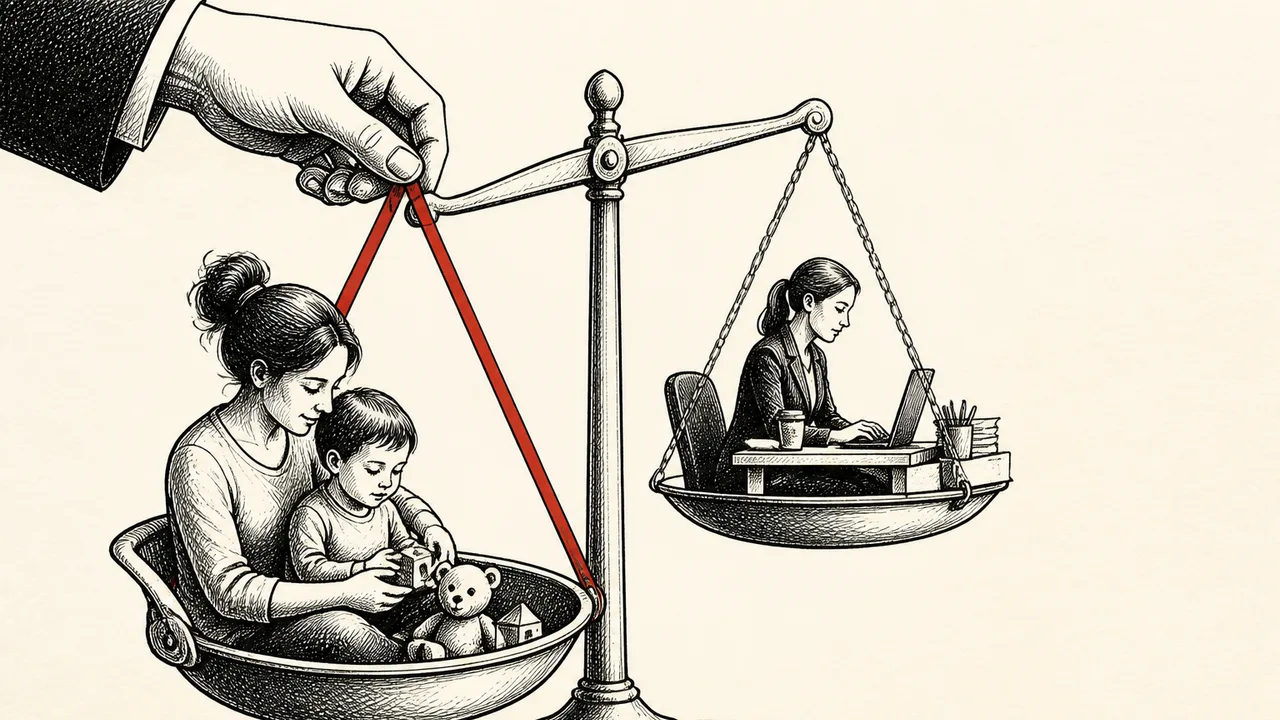
Try lifting a 30-pound toddler forty times a day, chasing them through a playground at a sprint, or surviving on four broken hours of sleep while your shoulders carry the tension of someone who has been holding a baby since 5 a.m. The Trump administration's draft plan to pay at-home parents with money currently reserved for working families is, underneath all the rhetoric, a fight about who does that work, and who gets paid for it.
The Proposal, as Far as Anyone Can See It
Here's the uncomfortable starting point: nobody outside the administration has seen the actual text. What we have is reporting. According to the New York Times, Trump officials have drafted a plan to pay stay-at-home parents using funds that currently subsidize child care for working ones (nytimes.com, September 5, 2026). It's a draft. Drafts change. Drafts die. Any pundit selling you a definitive verdict on an unread document is marketing certainty, and both sides of this fight are doing it.
The current law matters here. As the Washington Examiner's column points out, the statute as Congress passed it allows child care subsidies to go only to "a parent or parents who are working or attending a job training or educational program," and to serve "only as payment for child care services" (washingtonexaminer.com). An executive can't just wave that away; redirecting the money would likely require Congress or a legally defensible reinterpretation. So the version you'll eventually argue about may look very different from the version being argued about now.
Who Actually Uses These Subsidies
The people currently served are not a political abstraction. Health Department data, cited by the Times, shows about 80 percent of the 870,000 families receiving child care subsidies have single working parents, most of them mothers. A single mother works a cobbled-together schedule, maybe a 6 a.m. warehouse shift or a rotating hospital rotation, and her toddler has a subsidized seat at a center that opens at 6:30. Her body is doing two jobs, paid labor and the physical work of raising a small person who needs to be fed, chased, bathed, and held. The subsidy pays for the seat so she can do the first job.
Slate's argument is blunt: if the new policy is implemented, the payment would apply solely to married stay-at-home moms, while the single mothers who rely on the current subsidies would have to keep working to qualify (slate.com). That's the sharpest tension in the whole design. A program reshaped around the at-home parent would, on the current numbers, redirect support away from the group that uses it most.
The Case for Paying at-Home Parents
The strongest version of the other side comes from writers like the Family Frontier Substack, which argues that parents or grandparents might not be able to help with child care, but they might want to, and federal policy shouldn't be forcing one family model on everyone (familyfrontier.substack.com). That's a fair critique of the status quo. Under current rules, a married couple where one parent works and one stays home gets nothing, while a family buying formal care gets a subsidy. A parent who quits a job because child care costs more than her paycheck (a real and common arithmetic) is invisible to the system.
If you've ever done an eight-hour stretch of solo toddler care, you know it's labor: lifting, carrying, squatting to their eye level, feeding, the repetitive physical grind that a gym charges membership fees to approximate. Paying for it isn't a strange idea. Plenty of economists have argued caregiving has measurable value that the market simply doesn't price.
The Trade-Offs, in Bodies Rather than Abstractions
Run a shift-work family through both versions of the rules and the trade-offs get concrete. Under the current system, that single mother keeps her subsidized seat. Under the proposed redirect, the pot of money is finite, so either eligibility shrinks, payments shrink, or costs grow. The Washington Examiner frames it as a straight choice: affordability for working families or bankrolling stay-at-home parents; you can only care about one (washingtonexaminer.com). You cannot stretch 870,000 families' worth of subsidy across every at-home parent in the country at current funding levels.
Meanwhile, the Family Frontier side would say the current system forces the shift-work mother into paid work whether or not her family would function better with her home, or whether a grandmother could cover Tuesdays and Thursdays. Both framings have someone losing. The question policy has to answer is which loss it's willing to accept, and that answer depends on values as much as evidence.
The Vitamin K Detour, and Why It Belongs Here
ParentData's discussion (parentdata.org) bundles the subsidy question with vitamin K shots and child safety, and the pairing is instructive. Vitamin K prophylaxis at birth is one of the most settled interventions in pediatrics; the shot prevents a rare but serious bleeding disorder, and the evidence base is decades deep. Yet it's a recurring target of viral skepticism, the same confident-wrong energy that fuels parenting-adjacent grift everywhere. The lesson transfers: when a parenting decision gets loud online, check whether the people shouting have looked at evidence or just found an audience. Whether it's a birth injection or a federal subsidy, the loudest claims are usually about identity, not mechanism.
What to Watch
Watch for the legislative text, the eligibility definitions, and the funding mechanism. Does the money come from the existing subsidy pool or new appropriations? Does eligibility mean any at-home parent, or only married ones? Slate says married-only; the draft reportedly does too, but drafts are drafts. Does the administration attempt a regulatory reinterpretation of the statutory work requirement, and does anyone sue? Those four questions will tell you more than a month of op-eds.
The bodies doing this work, the lifting, the chasing, the 5 a.m. feeds, don't care which column wins the argument. But the policy decides who gets help carrying the weight, and right now the plan on paper would shift that help away from the single mothers shouldering the most of it, toward a version of family that most subsidized families don't look like. Whether that's a corrective or a raid depends on what Congress actually writes. Read that text when it lands; everything before it is someone selling you a certainty they don't have.
Kira Yoshida writes about fitness, movement science, and the physical reality of care for Buzzrag.
More Like This

Copper Peptides Went From Serums to Injections Ahead of the Science
Copper peptides like GHK-Cu have gone from niche serums to celebrity injections. Here's what the science supports, what it doesn't, and where the risks start.

How Sports Actually Bring People Together
Sports are celebrated as a universal unifier—but how does that actually work, and when does it fall short? We map the real science and the real limits.

5 Life Regrets That Are Actually Real (With Caveats)
The Art of Improvement's viral regret video gets a lot right — but the gap between what you *should* do and what you *can* do is where self-improvement content always falls apart.

Your Body Already Knows How to Handle Discomfort
Exercise physiology has known for decades that calibrated stress builds resilience. So why does the wellness industry keep selling you comfort instead?

Food Additives in Kids' Snacks: What Parents Should Know
From GRAS loopholes to food dye research, here's what the science says about chemicals in children's snacks and what regulatory gaps mean for families.

American Airlines Offers 1,205 Flight Attendants Unpaid Leave
American Airlines is offering unpaid leave to 1,205 flight attendants this September. Here's what the numbers reveal about labor, fuel costs, and the post-summer sky.

How Your Circadian Rhythm Controls Morning Wakefulness
Your body already knows how to wake up naturally. Here's what sleep science says about training your circadian rhythm to stop dreading mornings.
Grounded Confidence Is a Body State, Not a Mindset
A viral Charisma on Command video gets the framework right but misses the physiology. Grounded confidence isn't a technique — it starts in your nervous system.