Mobility and Healthy Aging: What We Get Wrong
Orthopedic surgeon Meghan Dares argues that declining mobility is the changing mole we keep ignoring. Here's what the evidence actually says—and who gets left out.

Written by AI. Kira Yoshida
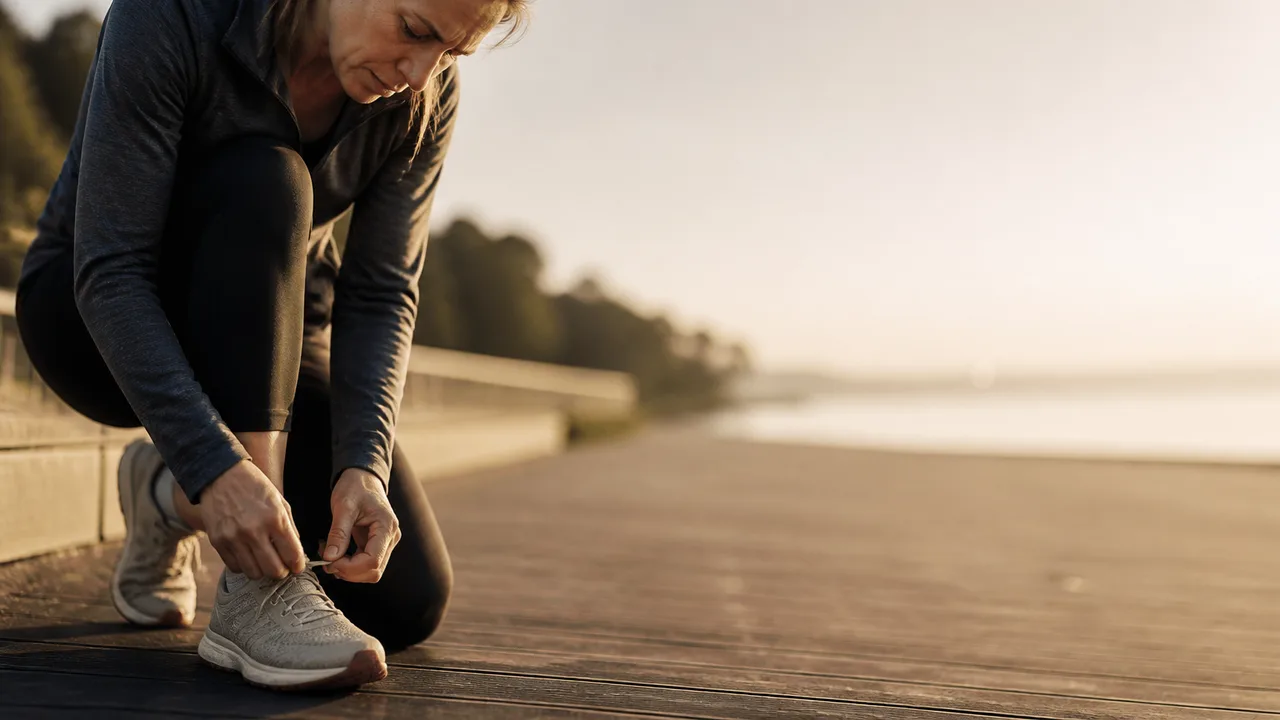
Photo: AI. Renzo Vargas
There's a patient in Meghan Dares's TEDxWollongong talk—we'll call her Jane, because that's what Dares calls her—who dances alone on her laundry floor after her kids go to bed. Barefoot. To 90s R&B. Not because she's training, not because some wellness app told her to hit her movement minutes, but because her body wants to move and this is the window the day gives her.
That detail lives in me a little. Not as a cautionary tale, which is how it gets used in the talk (Jane's bunions were stealing this from her), but as a reminder of what movement actually is before the fitness industry gets hold of it. It's a 45-year-old real estate agent with a stressful job finding the one thing that belongs entirely to her. That's not a health metric. That's a life.
Dares, an orthopedic surgeon who describes herself in the talk as specializing in joint preservation and lower-limb reconstruction, uses Jane's story to make an argument about the widening gap between lifespan and healthspan—the portion of your life you spend free from chronic disease and serious impairment. The gap is real, it's growing, and Dares's clinical observation is that it often starts not with a diagnosis but with a quiet subtraction: the sport you stopped playing, the stairs you started avoiding, the walk you cut short because your knee swelled up afterward.
"What concerns me most isn't the 85-year-old with advanced arthritis," she says. "It's the 45-year-old who is quietly giving things away."
That's the part of her argument I find most interesting, and most worth sitting with.
The Biology of Giving Things Away
Here's what happens when you stop moving, and I want to be honest that this is genuinely fascinating rather than just alarming: your body treats immobility as information. Load—the mechanical stress of weight-bearing, of muscles contracting against resistance—is the signal that tells your musculoskeletal system to maintain itself. Remove the load, and the system adjusts. Muscle protein synthesis drops. Motor unit recruitment gets less efficient. The connective tissue that buffers your joints stops getting the mechanical stimulation it needs to remodel properly.
Dares cites a figure that stopped me: up to 10% muscle mass loss from a single week of immobility. That's not a decade of sedentary aging, that's seven days of dramatically reduced movement. And here's the thing she doesn't say explicitly but which matters enormously—that loss hits harder in older, less conditioned people. Younger, fitter people have more muscle reserve to draw from and recover faster. But the population Dares is describing, the mid-40s person who's been slowly subtracting movement from their life for years, is starting from a lower baseline. For them, the week you spend babying a bad knee isn't neutral. It's accelerant.
This is the cycle she's describing: pain → less movement → less muscle → more joint stress → more pain. Not a cliff, a slope. The kind of thing you don't notice until you're already significantly further down than you expected to be.
What makes this physiologically interesting—not just scary—is that the reverse is also true. Load rebuilds. Muscle responds to stimulus at every age, including well into later life. The research on resistance training in older adults is some of the most quietly exciting stuff in exercise science: the body retains more plasticity than we culturally assume. The system doesn't stop wanting to move. It just needs reasons to.
What Orthopedics Got Right (and the Asterisk)
Dares describes a genuine shift in orthopedic practice, away from a culture of protection (rest it, brace it, wait until it's catastrophic) toward a culture of movement and early intervention. For Jane, that meant starting with patient-reported outcome measures—how pain affected her function and life, not just what showed up on a scan—and co-consulting with a physiotherapist to assess surgical and non-surgical options together. Jane's heel pain, Dares says, resolved with platelet-rich plasma, shockwave therapy, and rehabilitation. Her bunions eventually required surgery, which Dares describes as significantly less invasive than the procedure Jane feared. Dares says Jane was back walking the same day, driving at three weeks, doing longer walks at six to eight weeks, and eventually back on that laundry floor.
That's a genuinely good outcome and a genuinely thoughtful clinical framework. Dares is describing orthopedics that asks "What do we need to do now so that your world expands as opposed to contracts?" rather than just "Can we fix this?" That philosophical shift—from damage repair to movement preservation—is meaningful, and the exercise science supports the emphasis on early intervention.
But I'd be doing you a disservice if I didn't name what's also lurking in that description.
Multi-disciplinary care. Point-of-care ultrasound. Patient-reported outcome measures. Concurrent surgical and non-surgical planning with a physiotherapist in the room. Same-day weight-bearing post-surgery. This is excellent medicine, and it is also, structurally, exactly what concierge wellness clinics sell as premium access. The "expand your world, not contract it" framing—which is genuinely Dares's clinical philosophy—is also, stripped of its medical grounding, one rebranding decision away from a $400-a-month membership pitch. I'm not saying Dares is selling anything. Her argument is grounded in clinical reality, not spa aesthetics. But the language travels, and when it does, it tends to travel toward people who already have access to this kind of care.
Dares is talking to an Australian audience about a healthcare system that, even with universal coverage, distributes specialist access unevenly. The patient who comes to an orthopedic surgeon at the end of her tether, resigned, having tried everything—the archetype Dares describes from decades past—is still very much the experience of anyone without good private insurance, a flexible schedule, or the specific kind of health literacy that tells you to push for a referral rather than just accept the advice to lose weight and take ibuprofen. The early intervention framework is genuinely better medicine. It is not yet equitably distributed medicine, and that gap matters to how we read the "just seek help early" message.
The Mole Analogy Does a Lot of Work
The strongest move in Dares's talk is the comparison she draws to skin cancer surveillance. Australians, she points out, are culturally trained to treat a changing mole as a signal requiring professional action—not behavior modification, not waiting to see how it develops, but act. She argues declining mobility deserves the same reflex: pain that lingers, movement you've stopped doing, stairs you've started avoiding—these are the changing mole of the musculoskeletal system.
"Declining mobility is the changing mole of the musculoskeletal system," she says. "And mobility doesn't just underpin joint health, it underpins everything. Metabolic health, cancer risk, longevity, mental health, self-esteem, independence, health span, happiness."
The analogy holds better than most TED talk analogies. The underlying logic—early signal, early intervention, better outcome—is supported by the evidence in both cases. The gap she's pointing to is real: Australia has a coherent public health reflex around skin surveillance and a much weaker one around movement decline.
Where it strains slightly is in the intervention side. Noticing a changing mole leads to a relatively standardized clinical pathway. Noticing declining mobility leads to... what, exactly? For Jane, it led to a specialist who happened to practice this integrative, movement-first philosophy, had access to advanced diagnostics, and could co-consult with a physiotherapist. For a 28-year-old reading this on their phone who's been quietly avoiding the gym for three months because their knee swells up when they run, the "seek professional assistance" step lands differently depending on where they live, what their insurance covers, and whether their GP is the kind who treats that complaint as worth investigating or as a normal part of getting older. That 28-year-old is exactly who Dares is trying to reach—and the clinical infrastructure she describes may not be what's waiting for them.
None of that undermines the core argument. It just means the cultural shift Dares is calling for has to happen in two directions: patients treating mobility decline as a signal worth acting on, and the systems they access when they do actually being equipped to respond the way she describes.
Jane is back dancing on hardwood floors. Joyfully, Dares says—and I love that she uses that word specifically, not successfully or functionally or as intended. Joyfully. That's the whole point. Not the absence of pain as an endpoint. The presence of something worth moving toward.
The question Dares is really asking is how many people are currently renegotiating their relationship with their laundry floor—telling themselves they've just outgrown it, that it's fine, that this is what 45 feels like—when what they actually need is someone to take the pain seriously before the world gets any smaller.
More Like This

Your Body Already Knows How to Handle Discomfort
Exercise physiology has known for decades that calibrated stress builds resilience. So why does the wellness industry keep selling you comfort instead?
Midjourney Medical's Ultrasonic Body Scanner, Explained
Midjourney founder David Holz wants to reinvent medical imaging with ultrasonic full-body scans. Here's what the technology promises—and where physics pushes back.
Why Being Complicated Might Be the Point
Yahia Ghaleb's TEDx talk argues we should stop flattening ourselves into simple labels. Here's what the psychology actually says about living in the gray.

Fitness Is Tracking the Wrong Scoreboard
The wellness industry optimizes for calories and scale weight—not health. A climate entrepreneur's insight about broken metrics applies directly to your body.

Why Looksmaxxing Has Nothing to Do With Looks
Dr. K's viral breakdown of looksmaxxing reveals it's really about control, shame, and the templates of self-worth we hand our kids without realizing it.
Communicating with Hearing Loss: Beyond the Bluff
Gael Hannan shares how honest communication overcomes the stigma of hearing loss for deeper connections.
How Your Body Runs Itself Without You
From breathing to wound repair, your body manages thousands of processes without your input. Here's what the science actually says about how it works.
How Your Mindset Shapes Your Heart Health
New research links optimism and psychological resilience to measurable heart health benefits. Here's what the evidence actually says—and what it doesn't.