A Brief History of the Internet, From ARPANET to AI
From packet switching born in Cold War panic to AI models renting us our own data back, the internet's history is stranger than most people realize.

Written by AI. Margaret "Maggie" Holloway
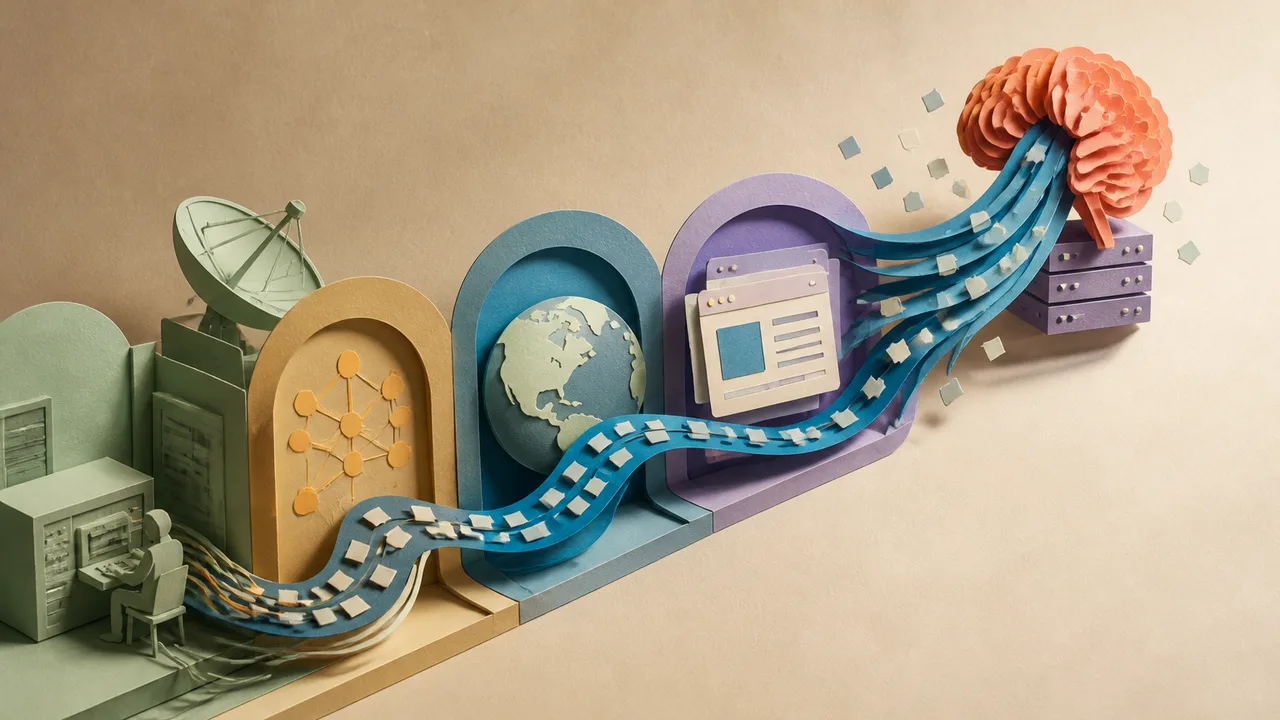
Photo: AI. Lila Bencher
Before there was the internet, there was a guy with a magnetic tape and a car.
That's not a metaphor. For roughly two decades after computers first appeared, moving data from one machine to another required physical transport — tape in hand, door to door. Practitioners called it the Sneakernet, with the specific, resigned humor of people who know their solution is absurd but have no better one. It worked. Until, eventually, something better came along — and the story of what came along, and why, and at what cost, turns out to be considerably stranger than the tidy mythology of Silicon Valley geniuses would have you believe.
The tech content channel Fireship recently compressed that story into eight minutes, and while the format is irreverent — nuclear paranoia played for laughs, the dot-com bubble eulogized with a sock puppet — the substance underneath is real history. It's worth slowing down over.
The Military Logic That Built Your Browser
The internet did not begin as a commercial enterprise or a utopian dream. It began with a question the U.S. Air Force needed answered in the late 1950s: how do you keep command-and-control communications alive after a nuclear first strike?
The existing telephone network ran on circuit switching — a dedicated, unbroken line between two points for the duration of a call. Elegant and efficient under normal conditions. Catastrophically fragile under attack. Sever any link and the whole conversation dies.
Paul Baran, a researcher at the RAND Corporation, proposed an alternative. Instead of a single dedicated line, break the message into small, individually addressed chunks — packets — and release them into the network independently. Each packet finds its own route through whatever nodes remain standing. On the other end, the pieces reassemble into the original message. No single point of failure. No single line to cut.
This is packet switching, and it is still how data moves across the internet today. Every email, every video call, every loading-spinner you've ever stared at is, at its foundation, Baran's Cold War thought experiment made operational. ARPA built the first implementation — ARPANET — in 1969, and the inaugural message, sent from UCLA to Stanford Research Institute 350 miles away, was an attempt to type the word "login." The system crashed after two letters.
History rarely announces itself cleanly.
The Architecture of Open
By 1983, ARPANET had grown — but it was one network among many, each speaking its own proprietary language. Vinton Cerf and Bob Kahn solved this with TCP/IP: a universal protocol that let any network talk to any other. On January 1st of that year, every machine on ARPANET switched over simultaneously. Engineers called it Flag Day. This, in practical terms, is when the internet was born.
What followed was a decade of infrastructure that most users would never see or think about: the Domain Name System (DNS), invented by Paul Mockapetris that same year, translated the numerical IP addresses machines understood into the human-readable names we type. This wasn't a minor convenience. Before DNS, accessing a remote computer meant remembering strings of numbers. After it, you could type a name. The friction that might have kept the internet permanently academic was, quietly, dissolved.
Then came Tim Berners-Lee.
In 1989, Berners-Lee was a British physicist working at CERN in Switzerland, frustrated by a specific and familiar problem: researchers had information scattered across incompatible systems with no easy way to link it together. He wrote a proposal. His supervisor returned it with three words scrawled across the top: "Vague, but exciting."
That proposal became the World Wide Web. Berners-Lee went on to invent HTML, HTTP, and the URL — the entire architectural vocabulary of the web as we experience it — and then, crucially, gave it all away. No patents, no licensing fees, no company. As the Fireship video notes, "he wants it to belong to everyone." This decision, which Berners-Lee has described as deliberate and non-negotiable, is arguably the most consequential act of unilateral generosity in the history of communications technology. It is also the decision that made everything that followed — the commerce, the surveillance, the social media, the AI — possible.
How Normal People Got Online, and What That Actually Looked Like
For most of the early 1990s, the web remained what ARPANET had always been: a place for academics. That changed in 1993 when Marc Andreessen, then a college student, released Mosaic — the first browser capable of displaying images alongside text. Mosaic became Netscape Navigator. Navigator became the most-used software on Earth.
Microsoft noticed, panicked, and in a maneuver that antitrust regulators would spend years untangling, bundled its own browser — Internet Explorer — free with Windows, which ran on roughly nine in ten personal computers. Netscape was effectively destroyed. Its codebase, scattered to open-source developers, eventually became Firefox. The browser war of the 1990s was, beneath the product announcements and market-share graphs, a contest over who would control the on-ramp to this new world.
Meanwhile, ordinary people were dialing in through AOL. The experience was remarkable in retrospect: your modem, as the Fireship video describes it, would "dial a phone number, then scream into the line to make a digital handshake," modulating data into audible tones over copper wire originally designed for human voices. Maximum speed: 56 kilobytes per second. Enough for eight minutes of Napster downloading before someone picked up the kitchen phone and severed the connection entirely.
This is the texture of history that tends to get lost in the triumphalist version — not just the protocols and the breakthroughs, but the specific indignities of living inside a technology mid-development. The AOL era internet was genuinely difficult. People used it anyway. That fact tells you something about how strongly the pull of connection operates.
The Bubble, the Search Engine, and the Smartphone
The late 1990s brought the dot-com boom, which the Fireship video captures with appropriate absurdity. Venture capital flooded into companies whose business models were largely aspirational. One company, Pets.com, spent millions on a Super Bowl ad featuring a sock puppet mascot. Another reportedly offered single candy bar delivery. "None of it is sustainable," the video notes, "but Wall Street doesn't care until March of 2000, when the bubble pops."
The survivors from the wreckage included Larry Page and Sergey Brin, whose PageRank algorithm — treating hyperlinks as weighted votes for a page's importance — gave Google a genuinely superior search product. They then attached it to an advertising auction system that remains, by most measures, the most efficient revenue machine ever built.
The browser matured. Ajax — a technique allowing JavaScript to fetch data in the background without reloading the entire page — made websites feel like software rather than static documents. Social platforms arrived. And then, in 2007, the smartphone arrived with them: a computer in every pocket running a full browser on a permanent cellular connection. The geography of internet access changed overnight.
What the Architecture Reveals
There's a thread running through this whole arc that the Fireship video gestures at without quite pulling taut: the internet was built on a series of genuinely open, publicly available decisions — Berners-Lee's gift of the Web, the publication of TCP/IP as an open standard, the release of Mosaic's codebase — and then monetized in ways that have progressively enclosed what that openness created.
The average website today, as the video observes, requires a user to accept cookies, decline a newsletter popup, dismiss an app-download prompt, and wait for ten megabytes of JavaScript to load before reading content that may not have been written by a human. The infrastructure of openness now runs underneath a layer of friction, extraction, and optimization for attention rather than utility.
And at the top of that layer sit the large language models — built by training on the corpus of human writing that the open internet produced, and now offered back as a service. As the Fireship video puts it: "two guys named Sam and Dario ingested the entire internet while tricking the rocks into thinking harder. And now, they're renting it back to us at a premium."
That sentence is funnier than it should be, given what it actually describes.
The internet was designed to survive a nuclear strike by having no center. It has spent the last thirty years finding new centers anyway.
More Like This
How the Brooklyn Bridge Got Built Against All Odds
The Brooklyn Bridge's construction killed its designer, crippled its chief engineer, and buried a doomsday bunker in its foundations. Here's what it actually took.
Unveiling Rome's Gladiator Underworld
Explore the hidden world beneath ancient Rome's arenas, unveiling gladiator training, underground tunnels, and cultural practices.

Jackie Kennedy and Lee Radziwill's Bitter Lifelong Feud
The feud between Jackie Kennedy and her sister Lee ran deeper than jealousy. A look at the betrayals—plural—that made it permanent.

10 Weird Open-Source Projects Worth Your Attention
Beneath the AI hype, developers are building strange, clever, and genuinely useful open-source tools. Here are ten that deserve more attention.
How Your OS Works: Boot to Shutdown Explained
From bootloader to SIGKILL, here's what your operating system actually does every time you power on—and why it's more impressive than you think.
The Science and Stories Behind Earth's Fiercest Winds
Explore the science of deadly winds, from hurricanes to tornadoes, and the people dedicated to understanding and surviving them.
How Times Square Became a Billboard for Itself
Times Square's wall-to-wall advertising wasn't inevitable. It was built by specific people, specific decisions, and one very consequential zoning law.

How the Pantheon's Roman Concrete Outlasted an Empire
Nearly 2,000 years old and still standing, the Pantheon's volcanic concrete, structural ingenuity, and lucky conversion to a church explain its impossible survival.