An Arctangent Integral Solved via Two Clever Lemmas
Michael Penn's latest integral builds two lemmas—a Fourier-style series and a Feynman ODE—then snaps them together into an arctanh surprise.

Written by AI. Nadia Marchetti

Photo: AI. Marcel Dubois
The question Michael Penn poses at the top of his latest video is deceptively casual: does this integral go "too far"? The integral in question runs from 0 to infinity, and its integrand stacks an inverse tangent of sin(x), multiplied by sin(2x), all divided by x² + 1. Written out, it looks like something a professor might put on an exam to separate the students who memorize from the ones who actually understand what integration is doing.
Penn's answer to his own question is, essentially: not if you know what tools to bring.
Building the scaffolding before you need it
The strategy Penn lays out isn't to attack the integral directly. It's to build two separate lemmas — he calls them "tools" — that will only reveal their purpose once the final assembly begins. This is a particular kind of mathematical patience that doesn't get talked about enough. The architecture has to exist before you can live in it.
The first lemma starts somewhere genuinely unexpected: a complex-valued expression involving arctan(2a·i·sin(x) / (1 + a²)). Penn notes that if you choose the right value of a — specifically a = 1 − √2·i — the expression collapses into something recognizable: arctan(sin(x)), which is exactly the left-hand portion of the original integrand. That's the hook. But to get there, Penn runs the expression through Euler's formula in reverse, breaking 2i·sin(x) into its exponential components, then reassembles the denominator 1 + a² in a form that lets the arctan addition formula split the whole thing into a difference of two arctangents. From there, the Taylor series for arctan takes over, the complex exponentials fold back into sines via Euler's formula again, and what emerges is a Fourier-style series representation:
arctan(sin(x)) = 2 · Σ (from n=1 to ∞) of [( √2 − 1)^(2n−1) / (2n−1)] · sin((2n−1)x)
That's lemma one: a clean infinite series for something that looked, sixty seconds ago, like it had no business being summable.
Feynman's trick builds the second tool
The second lemma starts with a function Penn defines as I(n) = ∫₀^∞ cos(nx) / (x² + 1) dx. The goal is a closed form, and the method is differentiation under the integral sign — what Penn calls "Feynman's trick," and what practitioners of the sinc function integral will recognize as one of the more quietly powerful moves in the analyst's toolkit.
Differentiating I(n) with respect to n pulls down a factor of −x from the cosine, giving −x·sin(nx) in the numerator. Penn then multiplies through by x/x to create x² in the numerator, writes x² as (x² + 1) − 1, and splits the fraction. One piece simplifies to −sin(nx)/x, whose integral from 0 to infinity is the well-known −π/2. The other piece sends the remaining integral back toward I(n)'s own structure. Differentiate again:
I″(n) = I(n)
Now: which functions satisfy f″ = f? Exponentials. So I(n) = C₁eⁿ + C₂e^{−n}. The C₁ term blows up as n → ∞ — the damping from x² + 1 in the denominator keeps the integral finite, which eliminates the growing exponential. Plugging in n = 0 pins the constant: ∫₀^∞ 1/(x²+1) dx = π/2, so C₂ = π/2. The second lemma lands cleanly:
∫₀^∞ cos(nx) / (x² + 1) dx = (π/2)e^{−n}
Penn notes the result and moves directly to the final evaluation. That flatness is part of his style — the drama lives in the construction, not the announcement.
The moment the two tools find each other
Here's where the piece genuinely surprised me, and I want to stay in that moment rather than skip past it.
Penn substitutes the series expansion for arctan(sin(x)) into the original integral. Suddenly the integrand is a sum, and the x² + 1 denominator is still waiting there. Each term in the sum involves sin((2n−1)x) · sin(2x), which Penn converts via a product-to-sum identity into a difference of cosines — specifically cos((2n−3)x) and cos((2n+1)x). And those cosine integrals, divided by x² + 1, are exactly the form of the second lemma.
Every single one of them resolves to (π/2)e^{−|something|}. The integral doesn't just simplify — it dissolves into a sum of exponentials, indexed cleanly over the same n that was running the Fourier series. When that happened, I felt the click. You have this sum of weighted exponentials with coefficients of the form (√2 − 1)^(2n−1) / (2n−1), and it starts to look familiar in the way a face looks familiar before you've remembered the name. The structure is a Taylor series — specifically, the Taylor series for the inverse hyperbolic tangent function. The sums collapse into arctanh(( √2 − 1)/e), scaled and combined with the leading exponential terms.
The final answer involves π, √2, e, and arctanh. The transcendental family tree is more interconnected than the initial presentation suggests, and the arctanh appearance, in particular, is the kind of answer that genuinely delights me — not because it's tidy, but because nothing in the original integral hinted that hyperbolic functions were anywhere nearby.
What the architecture reveals
Part of what makes this problem interesting beyond the calculation is what it demonstrates about mathematical strategy. Penn never tries to integrate arctan(sin(x)) directly. He never brute-forces the product sin((2n−1)x)·sin(2x). Each move is chosen to convert something hard into something whose form he already controls.
The two-lemma structure is, in this sense, a kind of prior knowledge made explicit. You build Lemma 1 because you suspect the integrand has hidden Fourier structure. You build Lemma 2 because you know the denominator x² + 1 will eat your cosine integrals if you give it the chance. Neither lemma is useful alone. The problem is precisely the intersection of the two.
This is what makes Penn's presentation more interesting than a textbook solution. He's not pretending the tools emerged spontaneously. He's naming them as tools, acknowledging that the strategy precedes the execution — that someone had to decide, before touching the integral, what shape the answer would probably take.
Penn frames the opening by asking whether the integral goes "too far." By the end, the answer is clearly no — but what's more interesting is that it doesn't go far enough to be messy. It stops exactly where it needs to, at a closed form that requires three distinct areas of analysis (Taylor series, ODEs, Fourier-style identities) to see simultaneously. Whether that feels like elegance or like an elaborate trap probably depends on how you feel about the fact that mathematics occasionally hides arctanh inside an arctangent problem and waits for you to find it.
More Like This

Seven Proofs That the Harmonic Series Diverges
Michael Penn's 31-minute video walks through seven distinct proofs that the harmonic series diverges—from a 1350 grouping trick to a prime-number infinite product.
Exploring the Enigma of the Sinc Function Integral
Delve into the complexity of the sinc function's integral and Feynman's unique approach.
Lebesgue's Integral and the Limits of Riemann
How Dirichlet's impossible function exposed the limits of Riemann's integral—and forced a 26-year-old to rebuild calculus from scratch in 1902.

The Feynman Trick That Stumped a Math Competition
Richard Behiel's competition integral uses the Feynman trick to reach a surprisingly clean answer. Here's what the footage reveals about math, pressure, and access.
How an Integral Conceals the Euler-Mascheroni Constant
Michael Penn's eight-minute walkthrough shows how a limit of an integral, carefully disassembled, quietly converges to gamma—one of mathematics' most elusive constants.
Solar Flares, Earth's Magnetosphere, and StormWall
Recent X-class solar flares and CMEs have prompted serious discussion about Earth's space weather vulnerability—and a theoretical plasma shield called StormWall.

Neil Turok's Case for Quantum Gravity Without Strings
Neil Turok argues quadratic gravity—a 1970s idea—may solve quantum gravity without strings or extra dimensions. Here's what that claim actually rests on.
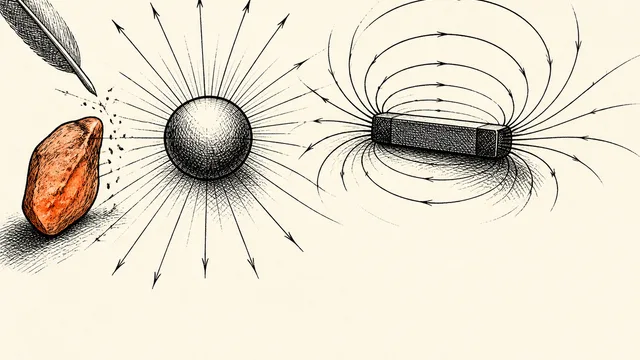
Electric and Magnetic Fields Explained From First Principles
From ancient amber to Gauss's law: how physicists replaced "action at a distance" with the field concept that underpins all of modern physics.