Airplane Windows Are Rounded; Digital Views May Replace Them
Rounded airplane windows limit stress in a pressurized fuselage. Digital displays could offer new views, but raise questions about comfort and safety.

Written by AI. Priya Chandrasekaran
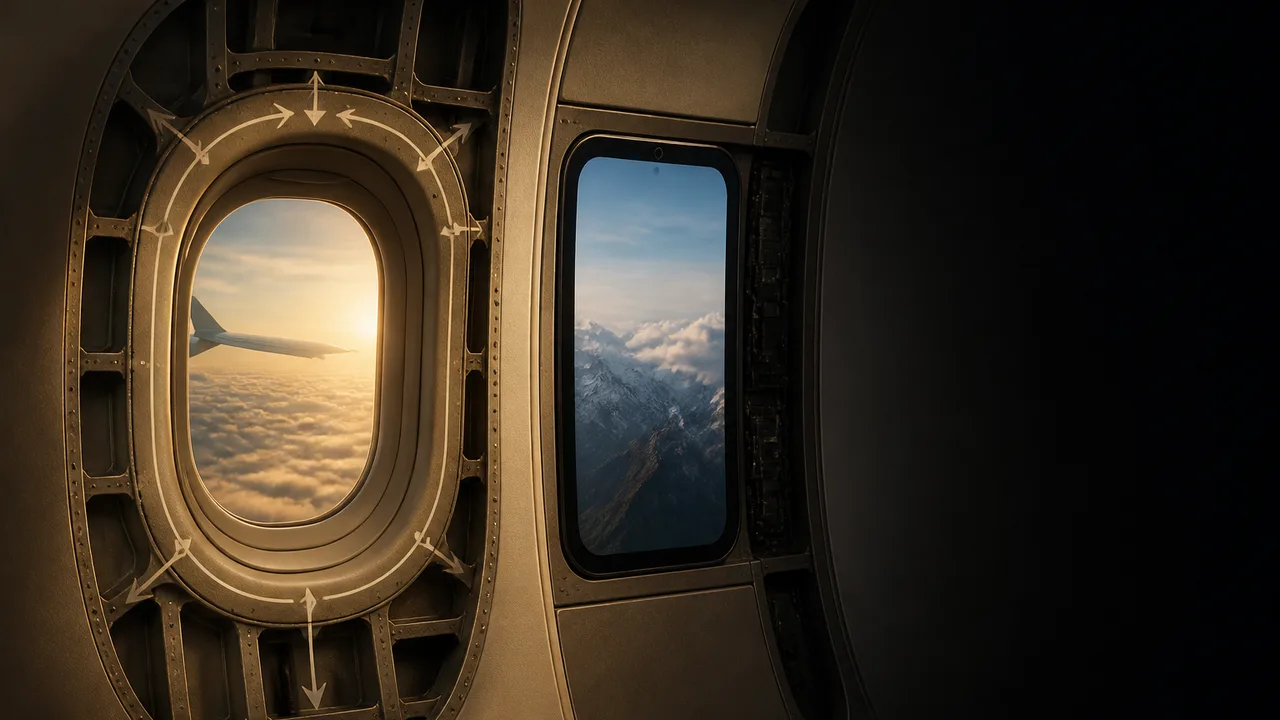
A Boeing 737's rounded passenger window offers a view of the ground while limiting stress concentrations around its pressurized fuselage opening. From the outside, it interrupts a structure that has to carry loads through every flight.
Those two views of the window, one human and one structural, explain the appeal and the difficulty of replacing it. Rounded window openings help avoid the stress concentrations associated with sharp corners. Designers have also explored digital displays that could show passengers what lies outside, or present other information in its place. One such proposal remains a design concept, rather than a confirmed industry-wide shift.
The question reaches beyond whether a screen can render a convincing sky. A window gives a passenger a direct view through the aircraft, while a display delivers an image assembled by a system. Each approach makes different demands on the aircraft and offers a different experience to the person in the seat.
Why the Corners Are Rounded
Pressurizing a cabin places a load on the surrounding fuselage. A window opening changes how that load travels through the structure. Sharp corners concentrate stress, so rounded or oval openings give engineers a more manageable shape around which to design the surrounding material. The curve does not make the opening disappear from an engineering standpoint. It reduces a problem that the structure must still accommodate.
Passengers see a familiar outline and perhaps a patch of rain on the outer surface. Engineers see a repeated interruption in the fuselage, one that must perform reliably through cycles of pressurization and depressurization. Even if someone preferred the wider panorama of a rectangular picture frame, the aircraft's structure would have a say.
Shape is only part of a window's design. Its size, position and surrounding structure also affect how an aircraft accommodates openings. A proposal for a larger view would therefore require more than redrawing the plastic trim inside the cabin. It would ask what loads the changed opening creates and how the aircraft would carry them. The passenger's field of vision begins with decisions made well behind the cabin wall.
What a Screen Could Offer
A display changes the design question. Instead of asking where each passenger can look through the fuselage, a cabin designer could ask where an image would be most useful. A live outside view might reach a seat that otherwise faces a wall or sits far from a window. A screen could also show a map, flight information or another view at different moments of the trip.
The strongest case for the idea is flexibility. A physical opening fixes the location of the view. A display could place imagery across a different area of the cabin or let a passenger choose what to see. For someone seated away from the sidewall, an outside view might be welcome even if it arrives through a camera. For a traveler who wants to rest, a controllable screen could make the view easier to set aside.
Flexibility also creates choices that a conventional window leaves to the person beside it. Who controls a display shared across several seats? Does it show a live view during approach, or does it switch to information the airline considers useful? Could one passenger turn it off while another wants to watch the landing? Cabin design would have to answer those questions in hardware and software, and passengers would encounter the answers on every flight.
There are structural questions, too. Adding a screen to an aircraft that already has windows would leave the existing openings in place; the display alone would not remove them from the fuselage. Designing an aircraft without those openings would be a different project, involving the airframe as well as the cabin. A digital image can move a view around a room. It cannot, by itself, change the structure behind the room's walls.
Looking Out and Seeing a Picture
During an unfamiliar approach, a real window can make geography legible in pieces: a bend in a river, a grid of roads, the point where land gives way to water. The view arrives as the aircraft moves. A screen showing a live camera feed could convey much of that information, but the result would depend on where the camera points, how the image is framed and how consistently the system works.
That difference might be negligible to one passenger and consequential to another. Someone checking the route may care chiefly that the image shows the correct side of the aircraft. Someone watching a city come into view may want to shift position and see a little farther along the horizon. A fixed camera frame offers whatever its designers chose to capture. Multiple cameras or interactive controls could expand that choice, while adding equipment and complexity.
Displays introduce their own sensory conditions. Brightness and contrast affect what a passenger can make out when the cabin lighting changes. A delayed or interrupted image could be frustrating at the moment a passenger most wants to look outside. The same screen that makes a view possible for an aisle-seat traveler might feel like an unwelcome source of light to someone trying to sleep. Passenger comfort would depend on the details, not simply on the presence of a view.
Calling these images windows also shapes expectations. A passenger can look through glass without waiting for software to start or a camera to supply a picture. A display might offer more information and more control, but it asks the viewer to trust a chain of components between the sky and the seat. That trade could prove attractive in some cabin layouts and less persuasive in others.
The Test Beyond the Cabin Rendering
Any proposed system would have to satisfy aircraft safety requirements. The questions would extend beyond whether the image looks good in a design drawing: What happens when a component fails? How would crews maintain the equipment? Would a passenger or crew member need a direct outside view at any point, and how would the design address that need? The answers would depend on the aircraft and the role the display was meant to serve.
Reliability has a different meaning when a screen provides an optional extra than when it replaces a passenger's only view. If an entertainment display fails, a traveler loses a convenience. If a cabin design promises a live view in place of a physical opening, an outage removes the promised connection to the outside. Designers would need to decide which functions should continue during a failure and what passengers would see instead.
Passenger response would also have to be measured in ordinary conditions, not just against a polished image of a proposed cabin. A display that impresses on a short demonstration might feel different during a long flight, in strong daylight or on an approach when people reach for the window shade. Travelers will judge the system from their seats, with their own reasons for looking out.
The oval opening has survived as a compromise between a view and the demands of a pressurized structure. Digital displays could rearrange that compromise, giving more passengers access to an outside image and giving cabin designers more control over what appears. The decisive question is whether the screen can earn its place through safety review, dependable operation and the simple test of a passenger wanting to watch the ground come into focus.
More Like This

When the Kitchen Was Already an Army
A French military doctrine is being proposed for hotel kitchens. But Escoffier already militarized the kitchen in 1900. What changes when the orders stop?

Istanbul's Layers: History, Faith, and Food
Rick Steves guides viewers through Istanbul's Byzantine ruins, Ottoman mosques, hammams, and tables. A food writer looks closer at what the camera catches and what it misses.

Small Group Italy Tours Are Reshaping Travel
Small group Italy tours promise authenticity over crowds. But do they deliver — and at what cost to the communities they claim to honor?

Hotel Loyalty Programs Court Gen Z With Concert Perks
Wyndham says Gen Z is nearly 10% of loyalty members. Concert perks may recruit young travelers, but cost, access and repeat stays will test the strategy.

GM’s CarPlay Return Offers a Split-Screen Compromise
GM’s split-screen CarPlay return solves a dashboard problem without settling its EV strategy, while safety rules revive the case for physical controls.

The Next Generation of Windows Is Already Here
From squid-inspired liquid panes to transparent wood, new window technologies promise dramatic energy savings—but how close are they to your wall?

Vodka and Pierogi: Poland's Food Identity Explained
Rick Steves and guide Tomasz Klepacki explore what Polish vodka and pierogi reveal about Polish identity, tradition, and the meaning of home-cooked food.

La Grande-Motte's Pyramid Architecture Finds New Admirers
La Grande-Motte's futurist pyramids, once mocked, are now drawing architourists to the Languedoc coast. Here's what's driving the revival—and what it costs.