Inside the Airbus A380: The $375M Gamble That Rewired Aviation
The Airbus A380 promised to solve airport congestion and cut fuel costs. What it actually delivered was more complicated—and more interesting.

Written by AI. Margaret "Maggie" Holloway
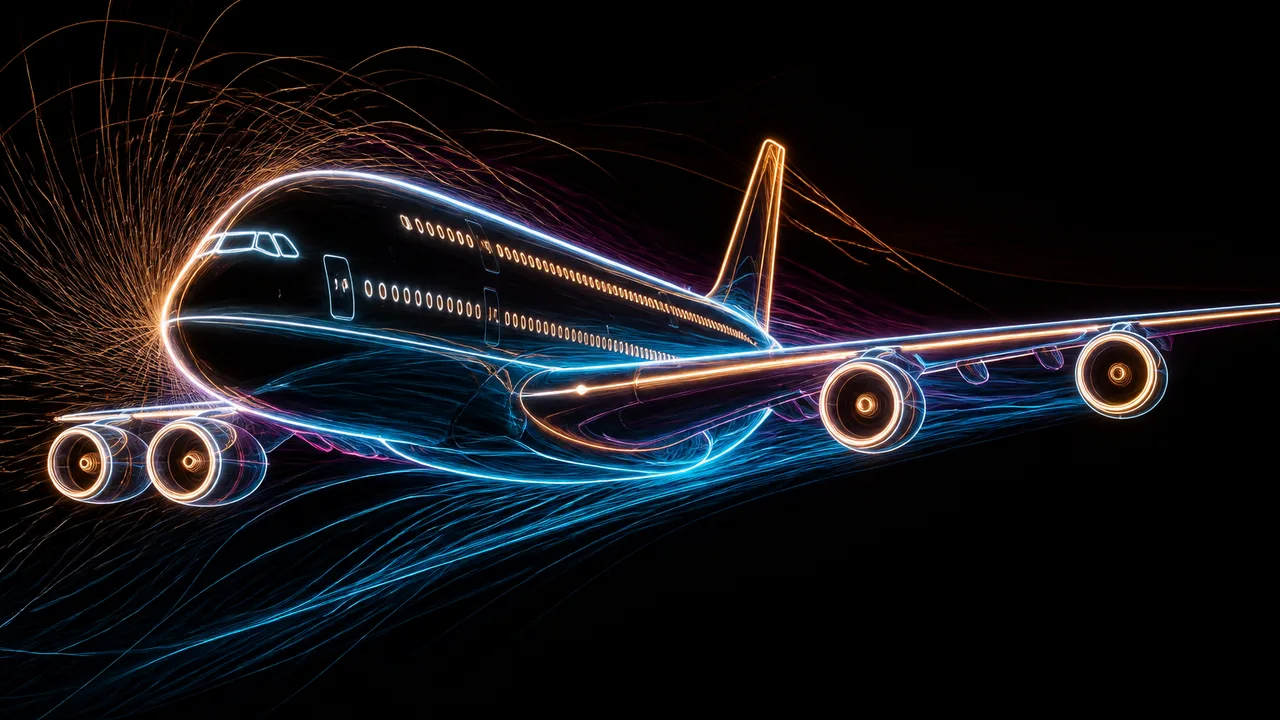
Photo: AI. Phaedra Lin
The document Heiner Kreymer is about to sign represents $375 million of Lufthansa's money. He pauses before putting pen to paper. "I would like a little bit heart beating to sign an aircraft," he admits, "especially to sign an A380 aircraft."
That is, when you think about it, a remarkable thing for a senior aviation executive to say out loud. But the A380 is a remarkable object, and the size of the bet it represents is genuinely staggering—not just for Lufthansa, which was targeting a fleet of 50 at $375 million each, but for every airport, every ground crew, every maintenance team, and every pilot who would need to rethink their assumptions about what a commercial aircraft could be.
The story of the A380 is not simply a story about a very large plane. It is a story about what happens when an engineering solution collides with a system that was never designed to accommodate it.
The Problem It Was Built to Solve
Start with the underlying logic, because it is genuinely compelling. By the mid-2000s, the major hub airports—Frankfurt, Heathrow, JFK—had run out of takeoff and landing slots. Demand for air travel was climbing, but you cannot conjure runway capacity from thin air. The physics of airport congestion are merciless: at some point, you simply cannot schedule more flights.
Airbus's answer was to make each flight carry more people. The A380 holds 100 more passengers than a 747 while burning 12 percent less fuel. Run the numbers and the pitch is almost irresistible: lower fuel cost per seat, more revenue per slot. Airlines like Lufthansa, squeezed at congested hubs, found the argument persuasive.
What the pitch required, though, was that virtually everything downstream of the aircraft itself would need to be rebuilt around it. That is a very large caveat.
Building It Is Hard Enough
The assembly process alone tells you something about the ambitions involved. The A380 is put together in Toulouse, France, but its major components are manufactured across Europe—fuselage sections from Germany and Spain, wings from the UK—then shipped to the Atlantic coast, floated up the Garonne River, and trucked to the final assembly facility. When they arrive, they have already been fitted with hydraulic lines, electrical harnesses, all of it. The work in Toulouse is largely a matter of joining pre-equipped sections together.
That joining requires precision that strains ordinary language. Christopher Stonehouse, the head of Airbus's A380 customer program, explains that the tolerance at the wing-to-center-section joint is roughly 40 microns. "That is basically about the thickness of a piece of paper," he says. A fuselage section weighing 70 tons must slot into place with a margin thinner than a page of text.
Nearly a quarter of the aircraft's structure is composite materials—carbon fiber, glass fiber, aramid fiber—chosen to keep weight down so the aircraft can carry both its 526-odd passengers and the amenities airlines want to offer them. Airbus tracks the weight of every optional feature: the cappuccino machines, the towel warmers, the beds in first class that extend to nearly two meters. A plane that is 20 kilograms too heavy in the wrong place is a plane that burns more fuel than the spreadsheet promised.
The Infrastructure Nobody Fully Anticipated
Here is where the story gets genuinely interesting. The A380 requires three jetways to board its passengers in a reasonable timeframe—two doors on the main deck, one on the upper. Most airports were built around one or two. The aircraft's 80-meter wingspan means ground crews operate inside an imaginary 80-by-80-meter box. Loading 600 pieces of luggage, fuel for a transoceanic crossing, and catering for 500 people is a choreography problem that takes on new dimensions when the vehicle in question is effectively a two-story building that needs to leave on time.
The emergency evacuation equipment alone illustrates the engineering creativity required. FAA regulations mandate that any commercial aircraft must be fully evacuated within 90 seconds. For the A380, with its upper deck sitting high above the tarmac, that meant inventing a new kind of evacuation slide. Goodrich's solution—220 square meters of high-strength urethane fabric, bonded by hand, packed into a slot at the base of each door—must inflate in seconds from an 82-kilogram bundle into a structure long enough to safely deliver passengers from the upper deck to the ground. Every slide is tested in simulated post-emergency conditions, including the freezing temperatures that result from a rapid descent from cruising altitude.
The landing gear presents its own set of contradictions. The A380 needs four main undercarriages to support its maximum takeoff weight of nearly 570 tons—body gear with six wheels each, wing gear with four—spread widely enough that the aircraft can use runways already rated for 747s. The steel forging for a single main gear strut arrives weighing 5,900 kilograms. By the time it is finished, it weighs 860 kilograms. "There's always a trade-off between weight and cost," one Goodrich engineer notes. "Whenever you're trying to reduce weight, it always happens to be more expensive."
The Human System
What a documentary like this captures that raw specifications cannot is the density of human coordination required to keep one of these aircraft flying. Consider a single overnight maintenance window in Frankfurt: Torsten Boxmann and his team have 10 hours to prepare an A380 for a Tokyo departure. The aircraft's self-monitoring systems transmit performance data every 15 minutes during flight, so the engineers arrive knowing what to look for. But technician Patrick Young still has to physically locate a hydraulic hose leak—"you cannot detect hydraulic leak via the electronics," he explains, "you would have to place sensors everywhere around the aircraft and that's impossible"—and replace it with a new Kevlar hose before pressure-testing the system from scratch.
Meanwhile, in San Francisco, operations agent Denise Stevens is preparing to turn the aircraft around in two hours and fifteen minutes. She has never done it before. Neither has most of her crew. The ground operation requires coordinating refueling, cargo loading, catering, a wheel change (inspection reveals damage on landing), a specialized high-reach catering truck that the driver has never operated, and the weight-and-balance calculations that determine how much of everything goes where. A nose-heavy aircraft with an uneven load cannot fly. Any missing passenger whose bag is already in the hold requires unpacking until that bag is found and removed.
San Francisco's Board of Supervisors President David Chiu, celebrating the inaugural arrival, announces that the route could bring 35,000 additional visitors per year and more than $100 million in new business revenue. Politicians at ribbon-cuttings always have numbers. What his numbers depend on is Denise Stevens getting the doors closed on time.
What the A380 Actually Revealed
The aircraft that Lufthansa's chief pilot Jürgen Raps flies from Frankfurt to San Francisco—deliberately slowing his approach to arrive on schedule rather than the 30 minutes early the calm North Atlantic winds would have delivered—is by any technical measure an extraordinary machine. Its fly-by-wire flight management system processes over a million lines of code. Its cockpit, the first genuinely paperless design in commercial aviation, communicates with pilots in ways that required 70 hours of simulator training before any of them were cleared to carry passengers. "In spite of its weight and its size, it's very responsive, extremely responsive to the control inputs by the pilot when it is flown manually," Raps says. "You wouldn't expect such a heavy aircraft to respond in such a fast way."
But the aircraft's success or failure ultimately had less to do with what the aircraft could do than with what the system around it could absorb. Every airport that wanted A380 service needed new ground equipment, retrained staff, reconfigured gates, and revised procedures for everything from catering to emergency response. The plane was, as one Lufthansa executive acknowledged during the early days of its commercial operation, "a white elephant on the world"—not because it was bad, but because the world it operated in had been built around different assumptions.
The A380 asked a genuinely difficult question of the aviation industry: is it more efficient to move more people on fewer, larger aircraft, or to move fewer people on more, smaller aircraft operating point-to-point? Airbus bet on the former. Boeing, with its 787 Dreamliner, bet on the latter. Both bets were internally coherent. They reflected genuinely different readings of where travel demand was heading and how airports would evolve.
What the A380's story makes clear is that an aircraft is never just a machine. It is an argument—about cities, about infrastructure, about how people want to move through the world. Whether that argument was right is a question the industry spent the better part of two decades answering, one sold ticket and one missed departure at a time.
More Like This
Inside the $65M Car Carrier Crossing the North Atlantic
The Faust carries $65M in luxury cars across a winter North Atlantic. What the documentary reveals about the people and systems keeping it all afloat.

How to Build Git Version Control Into Your Apps
LibGit2 lets developers embed Git functionality directly into applications. Here's what that actually looks like in practice, and why it matters.

When Agents Generate Their Own UI: The Three Flavors Explained
CopilotKit's Tyler Slaton maps the spectrum of generative UI—from pixel-perfect control to agents writing raw HTML. Each approach makes different tradeoffs.
Dulles Airport's Mobile Lounges Were Never Built for You
Dulles Airport's 1960s mobile lounges were designed for jet-age elites. When flying democratized, regular people inherited a system built for someone else.

Unitree's Mech Robot and the Regulation Nobody Wrote
Unitree's GD01 manned mecha is commercially available and already deploying abroad. The regulatory framework to govern it doesn't exist yet.
Berlin's Tegel Airport: Built in 90 Days, Abandoned at Last
Berlin's Tegel Airport was built in 90 days during the Cold War. Now abandoned, its layered history—from airlift to hexagonal icon—raises urgent questions about memory and renewal.

The Invisible Inventions That Built Modern Life
From flush toilets to undersea fiber cables, the inventions that most shaped modern civilization are the ones we've stopped noticing entirely.
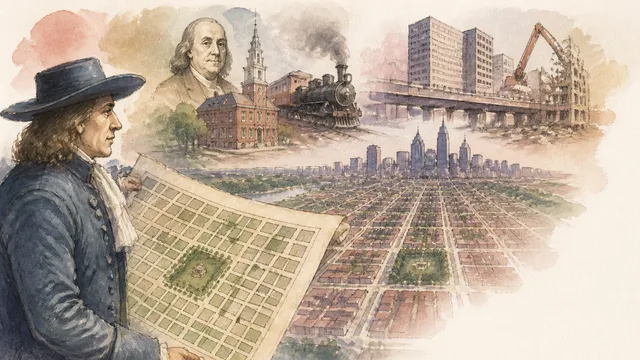
How William Penn's 1682 Grid Still Shapes Philadelphia
From Penn's Quaker grid to Ed Bacon's urban renewal, Daniel Steiner's video traces how Philadelphia's original plan survived — and who it cost along the way.