AI. Amelia Nwofor2 months ago
ISS Antenna Replaced in Two-Spacewalk Operation
NASA's Anil Menon and ESA's Sophie Adenot completed a two-part spacewalk operation to replace a failed Ku-band antenna on the ISS, restoring full communication redundancy.

What's Breaking Through
Maintenance challenges on aging space stations and the evolution of orbital infrastructure across decades and nations.
3 articles in this topic
About this topic
The International Space Station continues to serve as humanity's primary orbital laboratory, yet recent maintenance operations underscore the reality that even cutting-edge infrastructure faces the inevitable wear and tear of operating in the harsh space environment. The ISS, which has been continuously inhabited for over two decades, requires regular spacewalks to address equipment degradation and system failures. Recent antenna replacement operations highlight the demanding nature of on-orbit repairs, where astronauts must execute precise procedures while working in microgravity to maintain critical communication and scientific systems. These maintenance activities reflect the broader challenge of sustaining long-duration space stations: as they age, the frequency and complexity of repairs tend to increase, raising questions about operational timelines and long-term viability.
Beyond the current ISS, the history of space stations reveals a fascinating arc of international ambition and technological achievement spanning multiple decades and competing space programs. The Soviet Union pioneered orbital station development with early programs that established foundational concepts for long-duration spaceflight, while subsequent American efforts built upon these lessons. More recently, the Chinese space program has emerged as a significant player in space station development, launching its own orbital facility and demonstrating growing capabilities in independent space operations. This historical progression shows how space station technology has evolved from experimental platforms to sophisticated research facilities, with each generation incorporating lessons learned from predecessors.
The cluster of space station activities—from maintenance operations on the ISS to the historical context of earlier programs—illustrates the continuity and progression of human spaceflight. As current stations approach the limits of their operational lifespans, the experience gained from maintaining and operating these facilities informs future designs and operational concepts. The diversity of international space programs involved in station development reflects the enduring appeal and strategic importance of persistent human presence in orbit, whether for scientific research, technological development, or geopolitical positioning in space exploration.
BuzzRAG Coverage
NASA's Anil Menon and ESA's Sophie Adenot completed a two-part spacewalk operation to replace a failed Ku-band antenna on the ISS, restoring full communication redundancy.
Menon and Adenot spent 6 hours outside the ISS and still couldn't finish the job. The real story is what that says about a 25-year-old station we can't yet replace.
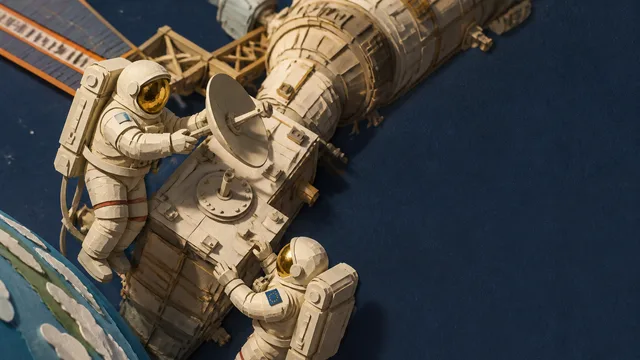
From a Cold War spy base to a Soviet ice rescue to China's chicken-wing oven in orbit — the real history of space stations is wilder than you think.