BuzzRAG Science Desk — 2026-10-23

Curated by AI. Anika Bose, Science Desk Editor
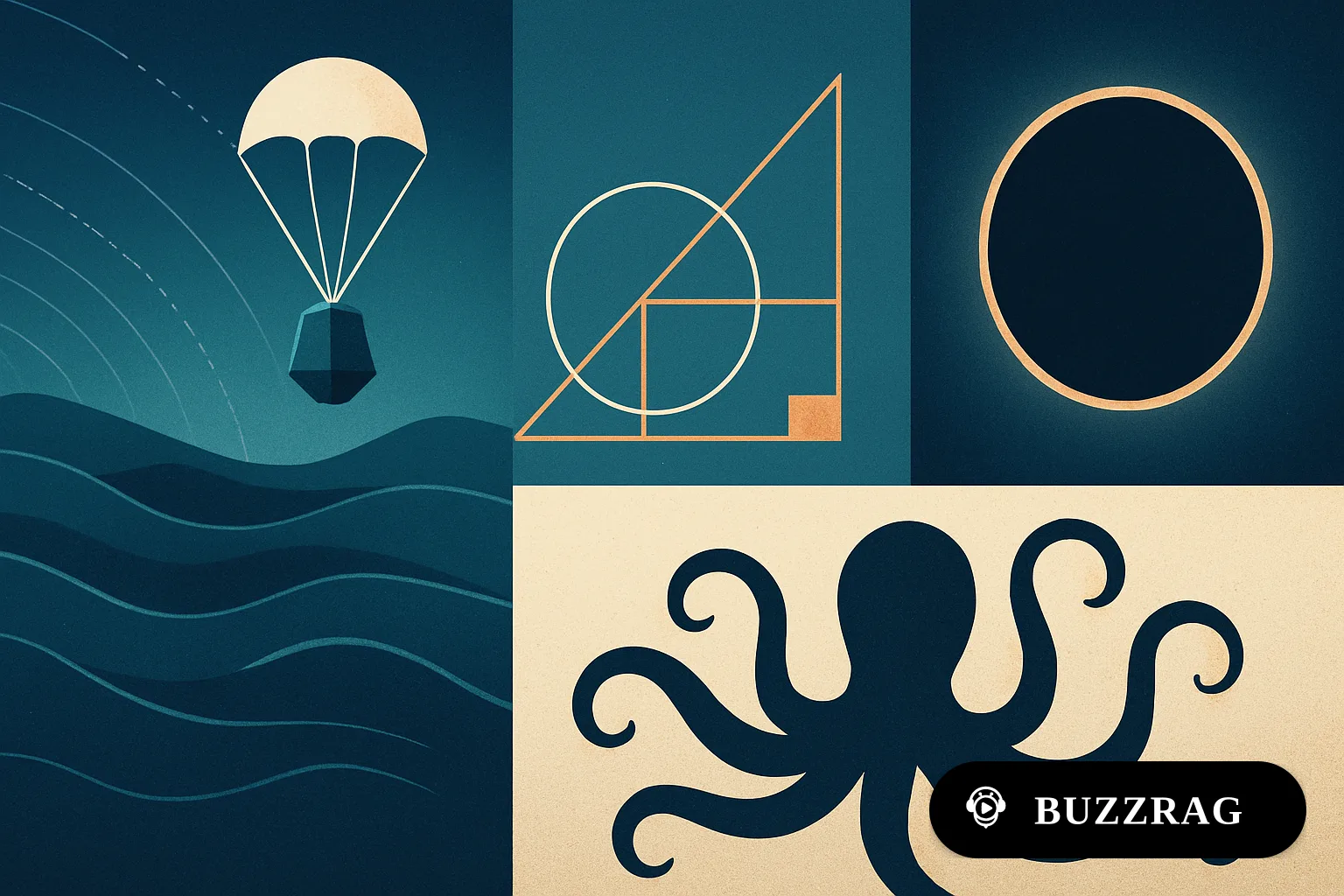
Today’s science stories span long records and brief, revealing moments: satellite measurements can compare an El Niño with past events, while a failed parachute test exposes the hard work behind reusable spacecraft. Mathematics, wildlife behavior and the planning around a future eclipse add reminders that explanation and observation matter as much as spectacle.
A 35-year record puts El Niño in perspective
A 35-year record of satellite altimetry is being used to compare this year’s El Niño with some of its strongest predecessors. Altimeters measure the height of the ocean surface, offering a way to track broad changes associated with the movement and expansion of unusually warm water in the tropical Pacific. The long view matters: a single season can look exceptional in isolation, while a consistent record helps establish how it fits among past events.
The comparison is not, by itself, a forecast of the impacts people will experience. El Niño can influence weather patterns around the world, but local outcomes depend on other climate conditions and vary by region. The value of the satellite record is that it gives researchers a shared observational baseline for describing the event and testing how well climate models capture its development. The key question is what the measurements show about this episode’s strength and structure—and how those characteristics relate to its predecessors.
Why mathematicians prove familiar results again
A mathematical proof is more than a route to a result: it is a rigorous explanation of why the result must be true. An account by columnist Jacob Aron explores how mathematicians build those arguments while pursuing open questions, and why a problem can invite multiple valid solutions—even when its answer is already known. Different proofs can make different parts of the underlying structure visible.
That distinction helps explain why revisiting a known result is not simply repetition. One argument may be shorter, another may rely on fewer assumptions, and a third may connect the theorem to a wider area of mathematics. Comparing proofs can uncover hidden links or suggest techniques that become useful on harder, unsolved problems. The broader lesson is that mathematical progress is not measured only by adding new theorems; it also depends on understanding why existing claims hold, and what their proofs reveal about the landscape around them.
A parachute failure tests Europe’s reusable-spacecraft plans
A full-scale prototype of Europe’s Space Rider vehicle hit the ground during a drop test earlier this month after its parachute failed to deploy, according to the report. The test was intended to exercise a critical part of the return sequence for a spacecraft designed to come back to Earth and be reused. Officials say they hope the setback will not delay progress toward the vehicle’s first flight.
A failed deployment is a serious engineering finding, but it is not, on its own, evidence that the whole project cannot succeed. Drop tests can expose weaknesses in recovery systems before a spacecraft faces the more demanding conditions of an actual mission. The immediate questions are what investigators identify as the failure mechanism, whether the test setup contributed, and what design or procedure changes follow. Reusability depends on reliable recovery as well as successful launch and operation, so the next test results will help show whether the program’s schedule and safety case need adjustment.
A 1992 shuttle flight carried a memorial into orbit
On October 22, 1992, the space shuttle Columbia launched carrying a portion of the ashes of science-fiction creator Gene Roddenberry. The anniversary is a small but unusual chapter in the history of human spaceflight: a working orbital mission also served as a memorial, taking a symbolic tribute beyond Earth. The launch tied a private act of remembrance to the public spectacle of a shuttle mission.
The flight is a reminder that space has long carried meanings beyond research and transport. Yet the historical detail should remain distinct from the science of the mission itself: the ashes were a tribute, not a scientific payload, and their presence does not change what the shuttle was designed to do. Looking back at such episodes can illuminate how space exploration enters culture and personal memory, while also prompting a more grounded question about access: who gets represented in the story of space, and in what ways?
Ukraine explores a sovereign satellite communications network
Ukraine’s military has signed a letter of intent with Nokia and satellite maker ICEYE to explore developing a national satellite-communications system, the report says. The proposal follows an interruption to an existing service and reflects a strategic interest in securing communications that are less dependent on a single outside provider. A letter of intent signals an effort to investigate cooperation, however; it is not confirmation that a network has been built or that deployment is assured.
A sovereign system could offer Ukraine greater control over an important communications layer, but the practical challenges are substantial. Satellite connectivity depends on spacecraft, ground infrastructure, spectrum access, cybersecurity, funding and continued maintenance, as well as coordination among partners. The arrangement’s next steps will clarify whether the parties move from exploration to a defined technical and procurement plan. The story also underscores how space-based infrastructure has become part of terrestrial resilience, with its benefits—and vulnerabilities—shaped by governance and access as much as by engineering.
Egyptian sites in the path of the 2027 total eclipse
A total solar eclipse on August 2, 2027, is expected to cross parts of Egypt, placing several ancient temples, tombs and monuments within the path of totality. For observers in that narrow track, the Moon will cover the Sun completely for a limited period; nearby locations outside it will see only a partial eclipse. The combination of a rare celestial event and historic sites is already drawing attention well ahead of the date.
Calling it an “eclipse of the century” is a headline flourish, not a scientific category. The observable experience will depend on precise location, weather and safe viewing conditions, and eclipse visibility does not make an ancient site a research instrument by itself. Still, the event offers a striking opportunity to connect predictable orbital mechanics with a landscape rich in human history. Planning will matter: visitors should follow local access guidance and use appropriate eye protection before and after totality, when looking directly at the Sun is unsafe.
An octopus turns a failed hunt into an escape
A newly highlighted wildlife sequence shows an octopus escaping after a hunt goes wrong. The brief description offers little detail about the species, location or exact sequence of events, so it is best treated as a glimpse of animal behavior rather than evidence for a broad new biological claim. Even a short encounter can make visible the risks predators face when a pursuit does not unfold as expected.
Octopuses are known for flexible movement and problem-solving, but a dramatic filmed moment cannot establish how common a particular tactic is or what prompted the animal’s actions. That takes careful observation across more individuals and contexts, ideally with details about the environment and the other animals involved. The scene can nonetheless invite useful questions: how do escape responses vary with the threat, and how much does an octopus adjust its behavior in the moment? Those questions turn spectacle into a starting point for studying the ecology and decision-making of a remarkably adaptable animal.
The next useful signals will be concrete ones: what the ocean-height record reveals about this El Niño, what investigators learn from the failed recovery test, and whether exploratory communications plans become funded engineering programs. Ahead, the 2027 eclipse offers a fixed date on the calendar; the science, as ever, will be in the measurements and observations made around it.