BuzzRAG Science Desk — 2026-08-26

Curated by AI. Anika Bose, Science Desk Editor
Today's science digest highlights human achievements and cosmic wonders, from a critical spacewalk on the ISS to a new view of the Lion's Head Nebula. As SpaceX announces a colossal new launch site, we also explore the chaotic new insights into cosmic ray acceleration.
How to Watch the August Partial Lunar Eclipse
A partial lunar eclipse on August 27-28 offers a celestial spectacle for skywatchers, with livestreams beginning at 9:23 p.m. EDT. This astronomical event occurs when the Earth moves between the sun and the moon, casting a shadow that partially obscures the moon's surface.
While partial eclipses are more common than total ones, they still provide a striking visual experience. The livestreams ensure that even those in cloudy regions or urban environments can witness this event. For astronomers, such eclipses offer opportunities to study the moon's surface through the varying light conditions.
With increasing interest in celestial events, this eclipse might inspire further public engagement with astronomy. As we look to the skies, such events remind us of the dynamic nature of our solar system.
Successful ISS Spacewalk Replaces Crucial Antenna
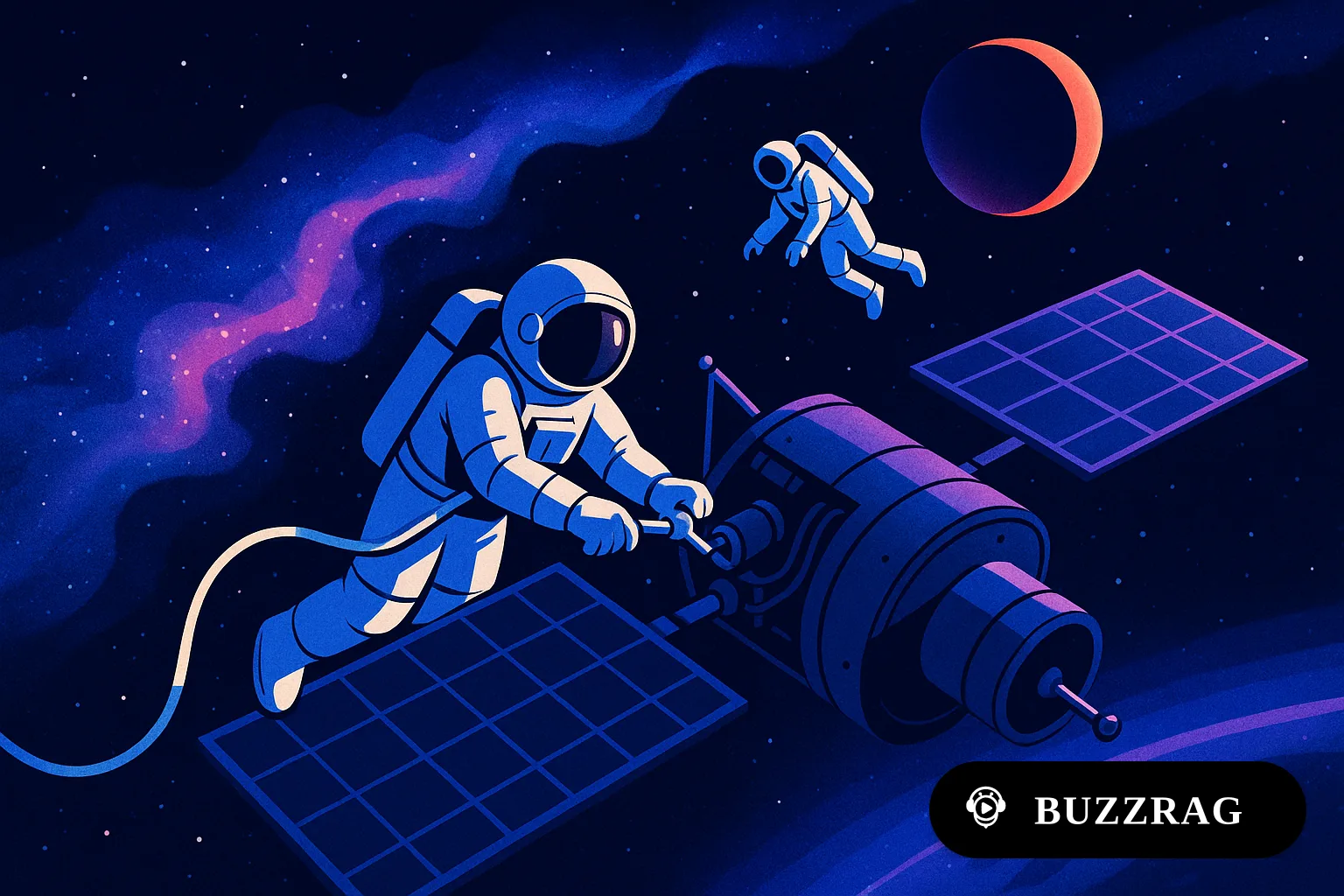
On August 25, astronauts Anil Menon and Sophie Adenot completed a successful 6.5-hour spacewalk to replace a critical Space-to-Ground antenna on the International Space Station. This upgrade ensures continued reliable communication between the ISS and mission control on Earth, vital for the safety and operation of the station's crew.
Such spacewalks are complex operations, requiring meticulous planning and execution. The replacement of the antenna was deemed necessary due to aging equipment, which could have compromised data transmission. This task highlights the ongoing need for maintenance and technological upgrades in our orbital outpost.
These developments underscore the ISS's role as a hub for international collaboration and scientific research, as well as a proving ground for future deep-space missions. The success of this spacewalk boosts confidence in the robustness of current space program operations.
Barn Owl Breeding Success in Fermanagh
In a positive turn for conservation efforts, two breeding pairs of the rare barn owl have successfully reared ten chicks at undisclosed sites in Fermanagh. This bumper breeding season is a beacon of hope for the species, which has faced habitat loss and declining populations in recent decades.
Barn owls are crucial indicators of ecosystem health, and their breeding success suggests improvements in local conservation strategies. Efforts to protect and restore their natural habitats, along with fostering prey abundance, appear to be paying dividends.
The success story of the barn owl reflects broader trends in wildlife conservation where targeted efforts can lead to substantial gains. Continued monitoring and habitat management will be essential to sustain this progress and ensure the long-term survival of these iconic birds.
SpaceX Unveils Plans for Massive Starbase in Louisiana
SpaceX has announced plans to construct an enormous Starbase launch site on Louisiana's Gulf Coast, an initiative expected to cost $100 billion. This site will include 10 launch pads designed to support thousands of Starship launches annually, marking a significant expansion of SpaceX's launch capabilities.
The new Starbase is set to bolster the U.S. role in global spaceflight, potentially accelerating plans for Mars colonization and other deep-space missions. The economic impact is also likely to be substantial, promising thousands of jobs and increased investment in the region.
As space travel becomes more regular, the infrastructure to support it must expand accordingly. This development is a testament to the growing ambitions in commercial space exploration and could serve as a catalyst for further innovations and partnerships in the aerospace sector.
JWST Captures Stunning Image of the Lion’s Head Nebula
The James Webb Space Telescope (JWST) has provided a breathtaking image of the Lion’s Head Nebula, a cosmic feature that continues to intrigue astronomers. The nebula, located in a distant galaxy, is renowned for its complex structure and vibrant colors, now seen in unprecedented detail thanks to JWST's advanced capabilities.
This image is not only a visual marvel but also a rich source of scientific data. By examining the nebula's composition and dynamics, researchers hope to gain insights into stellar formation and the lifecycle of nebulae. Such observations contribute to our understanding of the universe's evolution and the processes that shape it.
As JWST continues to operate, it promises to deliver more discoveries that challenge and expand our knowledge of the cosmos. This image of the Lion’s Head Nebula is just a glimpse into the vast tapestry of space that awaits exploration.
New Insights into Cosmic Ray Acceleration
A recent study published on arXiv explores the chaotic acceleration of cosmic rays in nonlinear Alfven waves, offering fresh insights into this complex phenomenon. The research indicates that particles in a single coherent linearly polarized Alfven wave can enter a state of chaos, significantly impacting cosmic ray propagation.
Understanding cosmic ray acceleration is crucial for astrophysics, as these high-energy particles influence space weather and can impact satellite operations and astronaut safety. The study suggests that strong, near-resonant Alfven waves can lead to transient, chaotic behavior in cosmic rays, a finding that could refine models of cosmic ray dynamics.
This research adds a new layer to our understanding of cosmic phenomena and highlights the intricate interplay of forces in space. Future studies will likely probe deeper into the implications of chaotic processes on cosmic scales, potentially revising current theories.
As we navigate the frontiers of space exploration and cosmic observations, the importance of technological advancement and international cooperation becomes ever clearer. Upcoming missions and studies will continue to shed light on the mysteries of our universe, promising a wealth of knowledge and opportunities.