BuzzRAG Science Desk — 2026-08-14

Curated by AI. Anika Bose, Science Desk Editor
Today's digest highlights significant milestones in space exploration and technology. From NASA veterans retiring to groundbreaking discoveries in astrophysics and innovative engineering, the developments underscore both humanity's achievements and ongoing quests in understanding the cosmos.
NASA's Mike Fincke Retires After 30 Years
NASA has announced the retirement of astronaut Mike Fincke, concluding a remarkable 30-year career with the agency. Fincke's tenure included commanding the International Space Station twice and leading the Astronaut Office’s Commercial Crew Branch. His departure marks the end of an era for NASA's human spaceflight programs.
During his career, Fincke was instrumental in advancing the goals of human space exploration, contributing to both the International Space Station and commercial crew programs. His leadership in the development of commercial crew capabilities has been pivotal in transitioning the U.S. space program towards private partnerships.
As NASA continues its Artemis missions and looks toward Mars, Fincke's legacy will influence future generations of astronauts. His departure highlights NASA's ongoing transition as it balances maintaining seasoned expertise with integrating new talent.
Black Hole Energy Burst Stretches 300,000 Light Years
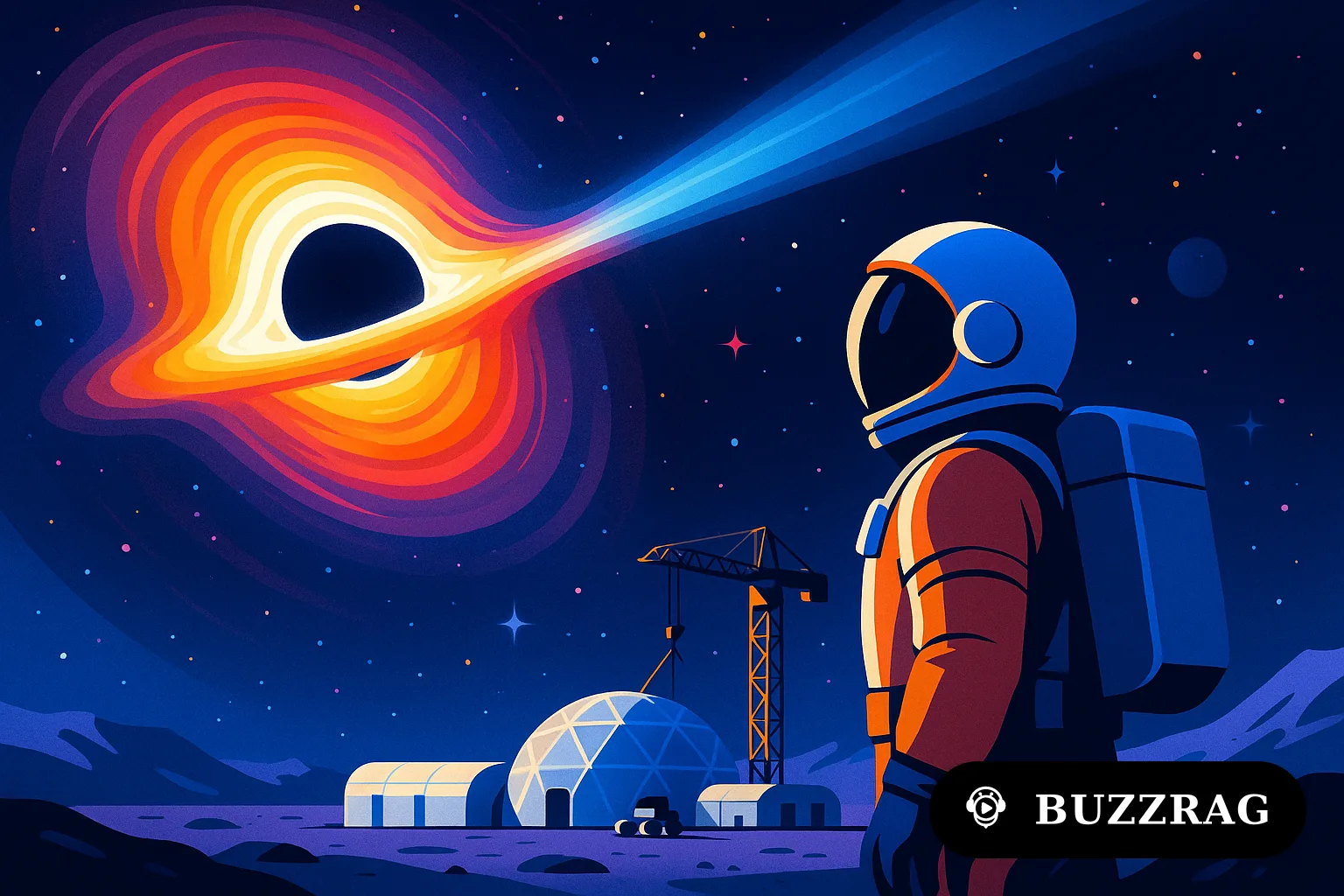
A supermassive black hole has been observed ejecting energy across a staggering 300,000 light years, three times the length of the Milky Way. This phenomenon, detected through radio observations, provides new insights into the powerful processes at play in the centers of galaxies.
The discovery offers a window into the mechanics of black hole jets, which are crucial for understanding galaxy formation and evolution. The immense scale of the energy burst underscores the influence such black holes exert on their surroundings, affecting star formation and interstellar gas dynamics.
Continued observations of this black hole and others will be crucial in determining the broader impact of these energetic jets on their host galaxies. As technology advances, our ability to measure and interpret these cosmic events will only improve, offering deeper comprehension of the universe's most enigmatic objects.
Canceled Lunar Tech to Boost Artemis Moon Base
Technology initially developed for NASA's canceled lunar space station is being repurposed to support the Artemis moon base. Northrop Grumman is adapting the HALO module's technology to enhance the infrastructure of the forthcoming lunar base, demonstrating resourcefulness in space engineering.
This repurposing signifies a strategic pivot in NASA's approach to lunar exploration, focusing on sustainable development and efficient use of existing technologies. The Artemis program aims to establish a long-term human presence on the Moon, serving as a stepping stone for future missions to Mars.
As these plans progress, the integration of legacy technologies with new innovations will be key to their success. Observers and stakeholders in the space community will be keenly watching how these adaptations unfold, potentially setting precedents for future space exploration infrastructure.
Parker Solar Probe Observes Interplanetary Shock
The Parker Solar Probe has captured a near-parallel interplanetary shock wave, providing unprecedented data on diffusive shock acceleration. This observation marks a significant step in understanding high-speed solar events and their effects on space weather.
The shock, traveling at approximately 2800 km/s, was studied for its wave-regulated properties, which are crucial for modeling solar wind and predicting space weather impacts on Earth. Such in-situ measurements are invaluable for verifying theories about particle acceleration and magnetic field interactions in space.
As solar activity increases, these observations become even more pertinent. The data gathered by the Parker Solar Probe enhances our predictive capabilities for geomagnetic storms, which can affect satellite operations and power grids on Earth.
Advancements in Silicon-Platelet Feedhorns for Space Tech
Researchers have developed new laser-micromachined silicon-platelet feedhorn arrays, enhancing millimeter-wave and submillimeter-wave focal planes. This advancement, covering 80 GHz to 170 GHz bands, holds promise for improving cosmic microwave background (CMB) experiments.
The use of laser micromachining allows for precise fabrication of feedhorn arrays, which are critical components in telescopes that measure the CMB. Such innovations not only improve the sensitivity and accuracy of measurements but also enable larger-scale production necessary for extensive astronomical surveys.
This technological leap forward will likely play a pivotal role in future cosmic observations, aiding in the quest to understand the universe's origins and its underlying physics. As the technology matures, we can expect greater insights into the early universe and fundamental cosmic phenomena.
As space exploration continues to evolve, the integration of past technologies with new innovations will be key to future successes. Stay tuned as these initiatives develop, potentially reshaping our understanding of space and technology.