Zodiacal Light: Why September's New Moon Is the Best Week to See the False Dawn
September's new moon opens a dark-sky window for the zodiacal light, the faint 'false dawn' glow from interplanetary dust. How to see it, and why it's visible at all.

Written by AI. Mei Zhang
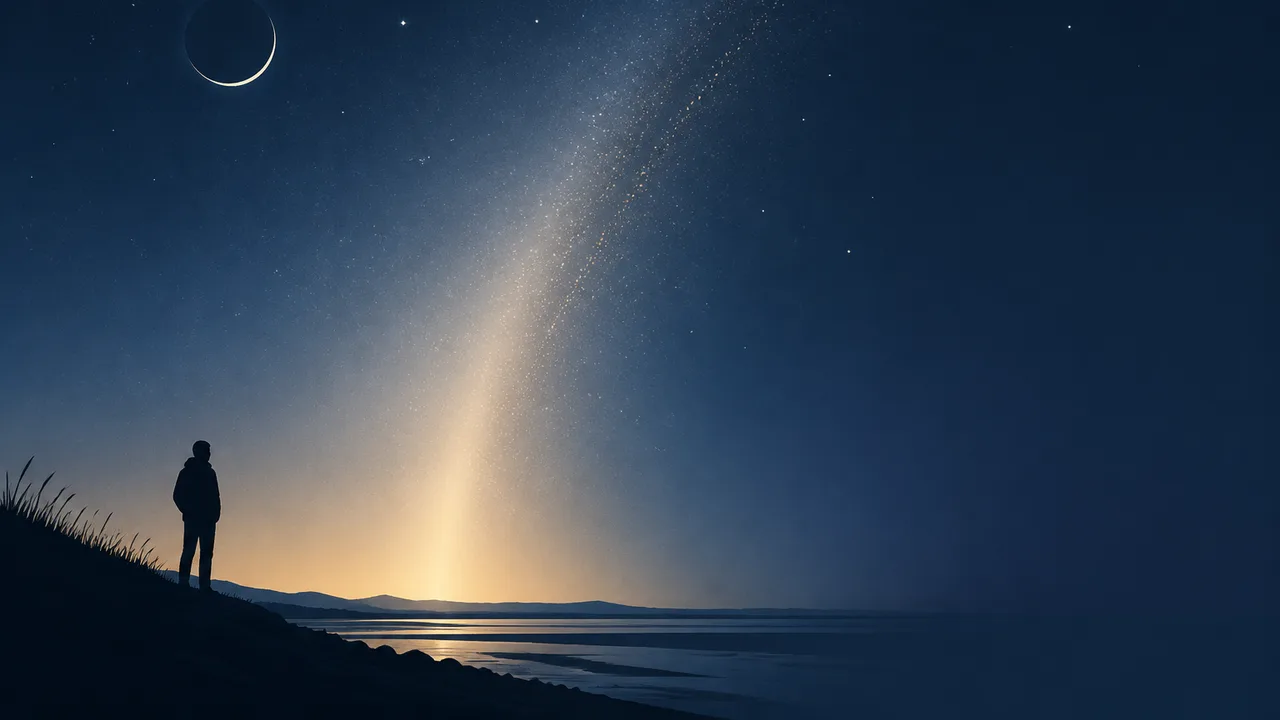
Between September 9 and 24, 2026, a two-hour pre-dawn look east could land you a view of something most people have never seen and most people who see it misidentify. The zodiacal light, a faint pyramid of glow leaning up from the eastern horizon, is the target, and this week's new moon is what makes it possible. According to Forbes, the window runs from September 9 through September 24 for observers with access to a dark location, with the glow appearing roughly two hours before sunrise.
The Falsest Dawn There Is
The nickname earns itself. Travel + Leisure places the glow about 80 to 120 minutes before sunrise, a broad, softly tilted cone of light rising from the eastern horizon. If you walk out of a tent at 4:30 a.m. and see a pale wedge above the horizon, your brain says: sunrise soon. Your brain is early by an hour and a half.
What you're actually looking at is sunlight bouncing off dust. EarthSky catalogues the phenomenon in detail: the glow comes from interplanetary dust scattered through the inner solar system, concentrated along the plane where the planets orbit. Forbes attributes that dust to comets shedding material and to collisions between asteroids, which is the current mainstream picture: a slow, constant snowfall of debris left over from the solar system's construction, ground down over billions of years and lit up by the Sun like dust motes in a sunbeam.
This dust is the closest thing the solar system has to leftover recipe scraps. The planets formed from a disk of gas and dust; most of that disk was swept up or blown out. The zodiacal cloud is what remains, still floating, still catching light. You are looking at the crumbs of creation, poorly lit, which is why almost nobody notices them.
Why This Week, and Not Next Month
The zodiacal light exists year-round. What changes is whether anything is competing with it, and whether its geometry cooperates.
The competition part is the new moon. A bright moon washes out anything fainter than itself, and zodiacal light is fainter than almost everything. Forbes pegs the favorable stretch at September 9 to 24; Astronomy Magazine flags the same window in its weekly sky guide for September 11 to 18.
The geometry part is latitude-dependent, and this is where calendar advice falls apart if you copy it blindly. In September, from the Northern Hemisphere's mid-latitudes, the ecliptic (the apparent path of the Sun and planets, and the plane the dust is concentrated in) stands nearly vertical against the eastern pre-dawn horizon. That steep angle lifts the glow high above the horizon haze, where it's easiest to see. From the Southern Hemisphere, the geometry inverts: the evening sky after sunset is the prime slot, and spring is their season. EarthSky's guide is the best single reference here, because it explains the latitude and seasonal logic rather than just naming a date.
The practical summary: the dates you see online are a starting point, and your actual odds depend on latitude, weather, and how dark your eastern horizon is. All three sources agree on that, though none of them can tell you whether your local forecast will cooperate.
How to Actually Find It
The instructions are short and forgiving:
- Find a dark site with an unobstructed eastern horizon. Urban and suburban light pollution will erase the contrast; this is a phenomenon that lives or dies by how dark the sky floor around it is.
- Get out 80 to 120 minutes before sunrise, per Travel + Leisure, and give your eyes 20 to 30 minutes to dark-adapt. The glow is faint, and the process of seeing it is partly a process of your retinas becoming capable of seeing it.
- Look for a broad, tilted pyramid of light leaning along the ecliptic. Free Independent News describes it as enormous under a dark sky, a softly glowing pyramid rising from the horizon, fainter than the Milky Way and with no hard edges.
- Binoculars can help you orient on the stars along the ecliptic, but the glow itself is diffuse. Sweeping binoculars across it won't make a boundary appear, because there is no boundary.
If you photograph it, long exposure changes the experience: Free Independent News notes that the cone shape becomes obvious in a long-exposure image even when it's marginal to the eye. That's also the source of a modern problem worth naming. A phone camera or DSLR on a tripod will happily pull the zodiacal light out of a sky where the human eye barely registers it, and posted photos routinely overstate what a naked-eye observer sees. The dust is real; the photograph's version of it is a collaborator, not a document.
What the Record Doesn't Settle
A few honest gaps in the source material deserve flagging rather than papering over.
The sources differ slightly on timing. Forbes says about two hours before sunrise; Travel + Leisure says 80 to 120 minutes. These aren't contradictions so much as a reflection of the real situation: the glow's visibility window stretches and compresses depending on how dark your sky is and how sharp your eyes are. Neither number is wrong; neither is universally right.
Nor do the sources give a precise brightness figure for zodiacal light in 2026, or say whether this year's dust environment differs from last year's. The long-term picture from research literature is that the cloud is fed by comet and asteroid debris and slowly evolves, but week-to-week forecasts of its brightness don't exist the way weather forecasts do. If you go out and it's invisible, the likeliest culprits are local: light pollution, haze, or moonlight from a moon that's already fattening again.
There's also the question of what the dust actually is. Forbes summarizes the standard answer, comets plus asteroid collisions, and that's a fair one-paragraph version. The fuller picture has more moving parts, including contributions from short-period comets and ongoing debate about relative shares. The one-paragraph version will get you oriented; it won't get you published in a planetary science journal.
Why a Dust Cloud Deserves Your Alarm Clock
Aurora is air. Stars are light-years. The zodiacal light is the solar system itself, faintly glowing at you. That in-between status is why it's so easy to misread as dawn and so rarely on anyone's list of things to see.
It's also under threat. Dark skies keep shrinking, and a phenomenon that depends entirely on contrast is among the first casualties of a growing suburb. The window from September 9 to 24 exists this year and will exist next year, but whether you can use it from where you live is a question with a moving answer.
Set the alarm, drive east, and check whether your sky can still show you the solar system's oldest leftovers. The false dawn will be there either way; the question is whether you can see it from home.
More Like This
Unraveling the Golden Ratio's Mathematical Magic
Explore how the golden ratio's unique irrationality connects math, nature, and fractals.
Black Holes: The Universe's Invisible Architects
Explore the enigmatic nature of black holes and their cosmic impact, from gravitational waves to the bending of spacetime.
Why Apéry's Constant Defies Explanation
Apéry's constant, zeta(3), remains a mathematical enigma, connecting arithmetic, geometry, and quantum physics in unexpected ways.
Tabby's Star Mystery: A Super-Jupiter May Be the Culprit
Ten years after its discovery, Tabby's Star may finally have an explanation—a massive hidden planet flinging comets toward the star. Here's what the evidence actually shows.

Shungite: Ancient Rock with Modern Potential
Explore the ancient origins and modern applications of Shungite, a unique carbon-rich rock with potential in tech and construction.
Moon Hides Jupiter in Daylight: Today's Occultation Explained
On September 8 the Moon passes in front of Jupiter in a rare daytime occultation. How the geometry works, who can see it, and how to actually try.

DC Is Releasing 600,000 Mosquitoes to Fight Mosquitoes
Washington DC is deploying 600,000 Wolbachia-infected male mosquitoes this summer to crash local populations. Here's the biology, the stakes, and the bigger picture.
Calculus Indeterminate Forms Explained With Limits
DIBEOS unpacks the seven indeterminate forms in calculus—0/0, ∞/∞, and more—and why mastering limits matters far beyond the classroom.