Wonder's $9B Bet on Robots, Drones, and AI Food
Marc Lore wants to automate fast-casual food with robots, drones, and AI restaurant creation. Here's what his $9B Wonder pitch actually claims—and what it leaves open.

Written by AI. Alex Volkov
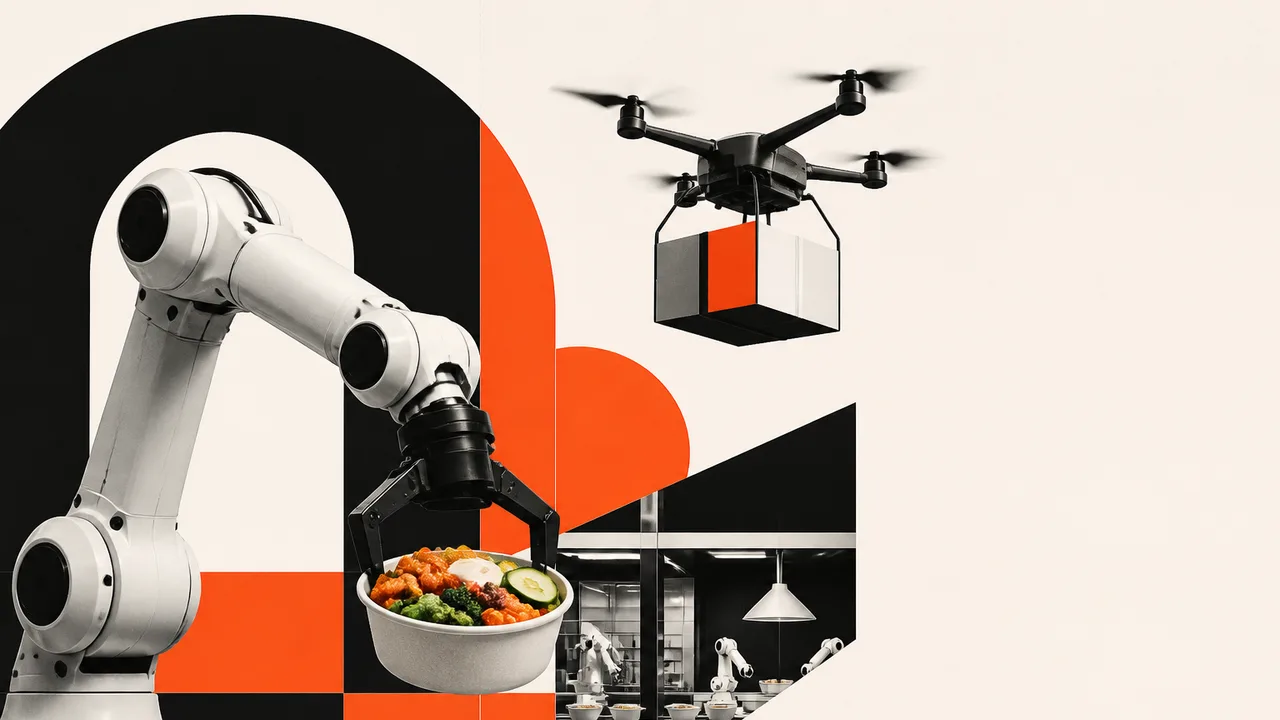
Photo: AI. Ondine Ferretti
Marc Lore has built and sold companies before most people finish their first startup. Diapers.com, to Amazon. Jet.com, to Walmart for $3.3 billion. He co-owns the Minnesota Timberwolves. He once tried to build a utopian city from scratch. He qualified for the US National Bobsled team. At this point, the biographical preamble almost gets in the way of the actual question: what is Wonder, and does the $9 billion valuation hold together?
In a recent interview with Fortune's Allie Garfinkle on the Term Sheet podcast, Lore laid out the full architecture of the bet. It's worth working through carefully, because it's either a genuine platform play or a very expensive collection of adjacent moonshots. Maybe both.
The Machine Underneath
Start with what Wonder actually does today. It operates physical food-hall-style locations where customers can order from multiple restaurant concepts in a single delivery. The kitchens are being systematically automated. The flagship piece of hardware is what Lore calls the "infinite bowl machine" — already in production — which can assemble 500 customized bowls per hour across 90 ingredients, rotating the bowl to plate each component precisely. The "infinite sauce machine," which produces made-to-order sauces from a library of 152 ingredients using high-shear blending and heat, is slated for production in Q1.
The pitch on automation is straightforward: take out labor costs, roll the savings back into lower prices, and close the gap between fast food and fast casual. Lore told Garfinkle he believes that gap can converge almost entirely — that a high-quality fast-casual meal could eventually cost roughly the same as a fast-food order. That's a real consumer unlock if it happens. The ghost kitchen graveyard exists largely because the unit economics never worked; food-tech companies discovered too late that fresh ingredients, cold chains, and perishable inventory are categorically harder than shipping a box of diapers. Lore acknowledges this directly: "Food is a completely different beast because the product itself could be different. And the product expires."
The automation angle is the most credible part of the thesis, because it's the most testable. Either the machines produce consistent food at projected throughput, or they don't. Either labor savings translate to lower menu prices, or they get absorbed by other costs. Lore is claiming the bowl machine is already working. The sauce machine timeline is a near-term claim. These things can be verified.
The AI Restaurant Layer
Here's where the vision gets genuinely strange, in a way that could be brilliant or could be category confusion dressed up in compelling language.
Lore described a product called Wonder Create: you type a prompt — "fast-casual Mexican concept for Gen Z cyclists, higher carbs, lower protein" — and AI generates the restaurant name, logo, imagery, full menu, recipes, nutritional information, and pricing. You can publish that restaurant to all Wonder locations for $10 a month. "A restaurant in our world," Lore said, "is just recipes and a brand."
The democratization framing is seductive. Lore predicts that "millions of restaurateurs will exist in five to ten years" — influencers, personal trainers, high school students, anyone with a concept and a following. The restaurant scales like software because the physical infrastructure — sourcing, cooking, delivery — is handled entirely by Wonder. The creator just markets.
There are real questions embedded here that the interview doesn't resolve. If anyone can create a restaurant for $10/month, what does the quality bar look like? AI-generated recipes produced from a shared ingredient library might end up being surprisingly similar to each other. The infinite bowl machine can assemble 90 ingredients, but 90 ingredients constrain the creative space considerably. And if the differentiation between thousands of AI-generated restaurant concepts is primarily brand and marketing, the user who "owns" that restaurant owns something fragile — a relationship with Wonder's platform, not a restaurant. What happens to those millions of restaurateurs if Wonder's terms change, or the company goes public and optimizes for margin?
Lore would probably say that's a feature, not a bug — the asset-lightness is the point. But for the person who builds a following around their Wonder restaurant, the dependency structure is worth understanding clearly.
The Drone Question
Wonder has partnered with Zipline for drone delivery. Lore described the mechanics: the drone flies at 300 feet, high enough to be inaudible, then lowers a small package via a wire that deposits the order and retracts in seconds. No tip required. Currently operating in Texas, with expansion planned.
Asked to predict scale by 2030, Lore said: closing in on a million drone deliveries per week across the US, across multiple drone companies. By 2040, he sees drone delivery as standard in suburban, exurban, and rural areas — though he was careful to note that FAA regulation over densely populated urban areas remains a genuine bottleneck.
A million drone deliveries per week sounds large. It's also worth noting that DoorDash alone processes millions of deliveries per day. Drone delivery at scale faces real infrastructure constraints — each delivery requires airspace management, landing coordinates, weather tolerance — and regulatory movement has historically been slower than startup timelines assume. Lore's 2040 caveat about dense urban areas is probably the more honest framing. The suburb-first, rural-first rollout makes physical and regulatory sense; the question is whether that geography maps onto Wonder's customer base.
The Management System Nobody Asked About (But Should Think About)
Something Lore describes at Wonder that rarely comes up in food-tech coverage is the internal operating system. Wonder runs a performance management framework called VCP — Vision, Capital, People — anchored by a physical room with color-coded whiteboards representing org structure using taekwondo belt levels. Black belt, brown belt, yellow belt, white belt. The visual is immediately legible: you can see at a glance where the company is talent-rich and where it's thin.
On top of that, there's a semi-annual 360-degree review process where at least a dozen colleagues rate each employee on company values, performance, and leadership qualities. An AI synthesizes those inputs into a written report. A separate metric called VAR — Value Above Replacement, borrowed from baseball analytics — rates employees on a minus-three to plus-three scale based on how hard they'd be to replace at their level. The AI combines VAR with review scores to generate promotion recommendations. Compensation is fully transparent across the company, including Lore's own pay.
Lore is enthusiastic about the bias-correction properties of this system — that removing managerial personality conflicts and unconscious bias from promotion decisions is inherently more equitable. There's a legitimate argument there. There's also a separate literature on how algorithmic performance systems can encode existing biases in the training data, amplify small score differentials into large outcome differences, and create legibility problems for employees who don't understand how the model weights inputs. Lore acknowledged that exceptions exist and that disagreements sometimes update the model. How often, and whether the exception process is itself equitable, is something you'd want to see data on before taking the system entirely at face value.
The M&A Barbell
One of the more practically useful frameworks Lore offered was his "barbell strategy" for acquisitions. Most M&A fails, he argued, because companies end up in the middle — buying something that's partly an asset play and partly a business play, and getting neither right. His rule: decide which end of the barbell you're on before you buy.
Pure asset acquisition: the asset alone must justify the price, independent of the business. He cited Wonder's Grubhub acquisition — $650 million for 250,000 delivery couriers, 200 million annual deliveries, 400,000 restaurant relationships, and an exclusive college campus program covering 400 schools. Those assets would cost more to build than to buy. The Grubhub business itself, famously struggling, was beside the point.
Pure business acquisition: the business must be the best in its category. He cited Blue Ribbon Fried Chicken — $6.5 million for a beloved New York City brand, which Lore projects will generate around $100 million in revenue next year. The brand IP was the asset; the business model already worked.
Lore also mentioned Wonder's acquisition of Sweetgreen's robotic kitchen technology as part of its automation buildout — an asset acquisition in the same mold.
What the $9 Billion Is Actually Betting On
The valuation isn't a claim about what Wonder is today. It's a bet that the platform logic holds: that automated kitchens plus AI-generated restaurant concepts plus drone delivery plus 340 locations next year produces a business that looks less like a restaurant company and more like infrastructure. The margin structure of infrastructure — scalable, defensible, capital-efficient over time — is what justifies software-style multiples on a food business.
Whether that platform logic holds depends on execution across at least three separate hard problems simultaneously: physical automation at scale, AI product quality, and regulatory logistics in the sky. Lore is not naive about the difficulty. "You're going to need to raise a lot of capital," he told Garfinkle. "You're going to make mistakes." He has put substantial personal capital into Wonder, which is at least a signal that the conviction is real.
Wonder has also told Fortune it may go public early next year. If that timeline holds, the S-1 will be the document that forces specificity on all of the above — unit economics per location, customer acquisition costs, automation capex, gross margins with and without labor. The pitch is coherent. The proof will be in the filing.
More Like This

Supreme Court Blocks Trump's Bid to Fire Fed's Lisa Cook
The Supreme Court's 5-4 ruling blocking Trump's firing of Fed Governor Lisa Cook is a win for central bank independence—but a narrow, provisional one.

Zeta Global's AI Growth and the Work It Replaces
Zeta Global's AI platform is automating marketing workflows at scale. The financial results look strong. The labor story underneath them is harder to read.

They Turned Down $550K. Here's What That Actually Cost.
GigaML's Varun Vummadi turned down a $550K job to build an AI startup. The real story isn't the money — it's what the pivot taught him about finding what customers actually pay for.
How to Hire for Roles You've Never Done
Ryan Deiss paid a $200K CFO who was really a bookkeeper. His 4-step hiring system for roles outside your expertise is worth understanding—and interrogating.
Neros Plans to Build One Million Drones a Year
Neros CTO Olaf Hichwa on scaling drone production to 1M units annually, building for operators not bureaucrats, and why the US is losing the manufacturing race.
How Ramp Built Its GTM Orchestration Engine
Ramp's Arman Vaziri explains how an internal CDP, durable Temporal threads, and a skill library turn a one-line campaign idea into a live GTM motion.

Tech Workers Choose Early Retirement Over AI Adaptation
A wave of veteran tech workers is choosing early retirement over AI-driven workplace change. What their exit reveals about the industry's talent calculus.
How AI-Native Companies Ship Faster Than Everyone Else
Nate B Jones argues the speed gap between AI-native teams and everyone else isn't about better models—it's about what they've moved into code.