Which Study Techniques Actually Work, Ranked
Dr. Justin Sung ranks 8 popular study techniques from F to S tier. Here's what the research says—and where his framework gets genuinely interesting.

Written by AI. Ellis Redmond
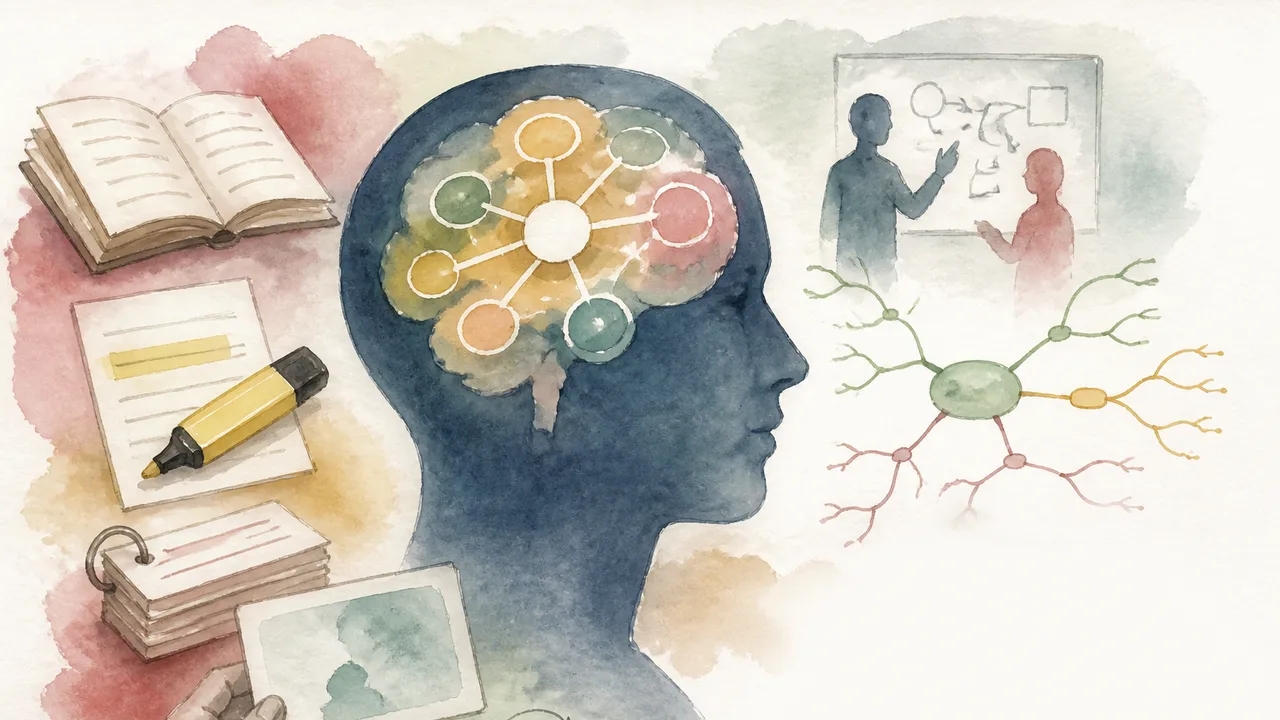
Photo: AI. Júlia Almeida
There's a particular kind of exhaustion that comes from studying hard and still failing. Not because you were lazy—but because the techniques you trusted turned out to be mostly theater.
Dr. Justin Sung, a former medical doctor turned learning coach, recently released an 18-minute video ranking eight popular study techniques from F to S tier. It's the kind of content that could easily veer into self-help hokum, but Sung's framework is grounded enough in actual learning science that it's worth unpacking—not as gospel, but as a useful map of terrain a lot of people are navigating blind.
The core argument he makes, which research broadly supports, is this: effectiveness and ease are inversely correlated. The techniques that feel most natural—the ones that make you feel like you're learning—are often the ones doing the least work on your memory. The techniques that feel effortful and slightly uncomfortable are doing the most. That's not a motivational observation. It's a structural feature of how memory consolidation works.
The bottom of the pile
Sung gives both highlighting and rereading an F, and he's not wrong. Decades of cognitive psychology research—most comprehensively synthesized in Dunlosky et al.'s 2013 review in Psychological Science in the Public Interest—rates both techniques as low utility. The familiarity you build through rereading is real, but it's not the same thing as memory. You recognize the words. You don't own the ideas.
What's interesting about Sung's framing here is the mechanism he points to: these techniques are popular because they're effortless, and they're effortless because they don't actually engage your brain very hard. The feedback loop is broken. As he puts it, "learning is a cognitive skill, which means that most of it is invisible. So even if it's really bad, you don't see the impact of that until weeks or months later." You highlight your way through a chapter feeling productive, close the book, and only discover the problem when you're staring at an exam question.
Blurting—the social media trend where you read something and then write out everything you can remember from scratch—gets a B. It's essentially a brain dump, a well-established form of free recall, and free recall is genuinely useful. The limitation Sung identifies is real too: blurting tests whether you remember things, not whether you understand how they connect. For simple memorization tasks, fine. For anything requiring applied thinking, it runs out of road quickly.
Flashcards, particularly digital ones with spaced repetition algorithms like Anki, also land at B. The spacing effect—reviewing material at increasing intervals to strengthen retention—is one of the most replicated findings in memory research. Sung's critique isn't that flashcards don't work. It's that they work for a specific, narrow type of knowledge: isolated facts. Drug dosages, vocabulary, historical dates. He draws on his medical training here: when he needed to memorize medication doses, flashcards were the right tool. But for building the kind of interconnected understanding that lets you reason through a problem you've never seen before, they fall short.
Where it gets interesting
The video's most substantive territory is the middle range—the techniques that work, but only if you use them correctly, and where "correctly" turns out to be harder than it sounds.
Mind mapping gets the widest possible range: D to S tier, depending on execution. Most people's mind maps are, in Sung's view, just linear notes drawn in a circle. The technique has the shape of connected thinking without the substance. What makes mind mapping genuinely powerful—when it works—is that it forces you to externalize confusion. You're not transcribing organized knowledge; you're making visible the mess of half-understood relationships so you can actively reorganize them. "Instead of just feeling like things are confusing and disorganized, you can express that confusion and disorganization on paper, look at it, and clean it. Much like how it's easier to clean your house with the lights on rather than with your eyes closed."
That's a good analogy, and it points to something the learning science literature sometimes underemphasizes: the value of making cognitive struggle legible to yourself. The messiness isn't a bug in good mind mapping. It's the signal that real learning is happening.
The Feynman technique—explaining what you've learned to a complete beginner—gets an A, held back from S tier by what Sung calls the expertise limitation. If you're a beginner explaining something to a beginner, you don't have the calibration to know whether your explanation is accurate or just confident-sounding. He suggests AI can close this gap: explain a concept out loud, feed it to an AI, ask it to probe your understanding at whatever level you want. It's one of the more genuinely practical AI-for-learning suggestions going around, and it sidesteps the hype. This isn't AI replacing thinking. It's AI as a sparring partner that can pretend to be a PhD or a ten-year-old, depending on what you need.
The interleaving wrinkle
Interleaving is where Sung's video gets a little epistemologically spicy, and I mean that as a compliment.
The classical definition—mixing different subjects within a single study session rather than blocking them—is one of the most robustly supported strategies in learning science. The research on this goes back decades and the effect is consistent. Sung gives this version a B, not because it doesn't work, but because he argues his own interpretation of interleaving is more effective: rather than switching between subjects, you challenge the same concept from multiple angles, force comparisons between similar ideas, test yourself in unfamiliar combinations.
He's upfront that he's noticed other educators starting to describe interleaving the way he does, which he finds "suspicious." It's a telling moment. The distinction he's drawing—between topic-switching and perspective-challenging within a topic—is conceptually meaningful. But it also nudges close to proprietary territory, framing a general principle as a personal methodology. The underlying idea (that forcing your brain to discriminate between similar concepts strengthens individual representations of each) does have research support. Whether his framing is genuinely novel or a refinement of existing ideas is harder to assess from the outside.
Cornell notes get a C—a "great starter method for a beginner learner," with structural limitations that most users don't know to work around. The left-column questions that are supposed to prime deeper thinking typically end up being surface-level recall prompts. The summaries at the bottom tend toward compression rather than reorganization. And because the format looks tidy when you're done with it, there's no visual feedback to tell you your thinking was shallow. This is the contrast Sung draws with mind mapping: a bad mind map looks chaotic. A bad set of Cornell notes looks fine.
What the framework is actually about
Step back from the tier list and there's a consistent principle running through all of Sung's rankings: schema building. The term refers to the process of connecting new information into existing networks of knowledge—the mental architecture that lets you retrieve and use information flexibly, rather than retrieving it only when prompted in exactly the right way.
The techniques at the top of his rankings are all, in different ways, forcing your brain to do this structural work explicitly. The techniques at the bottom are letting you bypass it while feeling productive.
This isn't a radical idea in learning science. Schema theory has been central to cognitive psychology since the 1970s. What Sung is doing—and doing fairly well—is translating that research tradition into practical technique evaluation for people who never encountered it in school. The criticism you could levy is that tier lists flatten nuance: the "right" technique depends on what you're learning, at what stage, for what purpose. Flashcards at F tier for a PhD student might be S tier for someone preparing for a driving theory test.
But the deeper question his framework raises is harder to dismiss. If we've had solid research on effective learning strategies for decades, why are the least effective techniques still the most widely used? That's not a question about individual discipline. That's a question about what schools actually teach—and whether "how to learn" has ever really been on the curriculum.
Ellis Redmond is Buzzrag's Personal Development & Productivity Correspondent.
More Like This
The Power of Starting Conversations with 'What'
Discover how asking 'what' instead of 'why' can transform communication and influence.
Mastering Memory: The Ladder to Lasting Knowledge
Explore Dr. Justin Sung's Memory Ladder framework to learn effectively and retain knowledge forever with neuroscience-backed strategies.
Unlocking Muscle Strength Post-40: The Urolithin A Debate
Explore how urolithin A might combat muscle decline after 40. Evidence-based insights.

Active Recall: The Study Method Worth Knowing
Active recall means testing yourself instead of re-reading. Here's what the science actually says — and what the tidy frameworks leave out.
Building Claude Skills With NotebookLM: A Technical Autopsy
Julian Goldie shows how to build custom Claude AI skills using Google's NotebookLM. We examine what works, what's overhyped, and what you should know.
Boost Your Memory: Strategies That Actually Work
Discover six evidence-based strategies to improve memory by actively engaging with information. It's all about handling, not capacity.

Surrender as a Leadership Strategy, Not a Weakness
Dr. Jessica Kriegel argues that letting go of control makes leaders more effective. The research behind the claim is worth taking seriously.

How Geography Traps Russia and China in Old Thinking
Military historian Sarah Paine explains how Russia and China are prisoners of continental-power logic — and what that means for the rest of us.