What Your Linux Distro Actually Says About You
From Ubuntu to NixOS, your Linux distro choice reveals more than a technical preference—it maps an entire engineering philosophy and value system.

Written by AI. Dev Kapoor
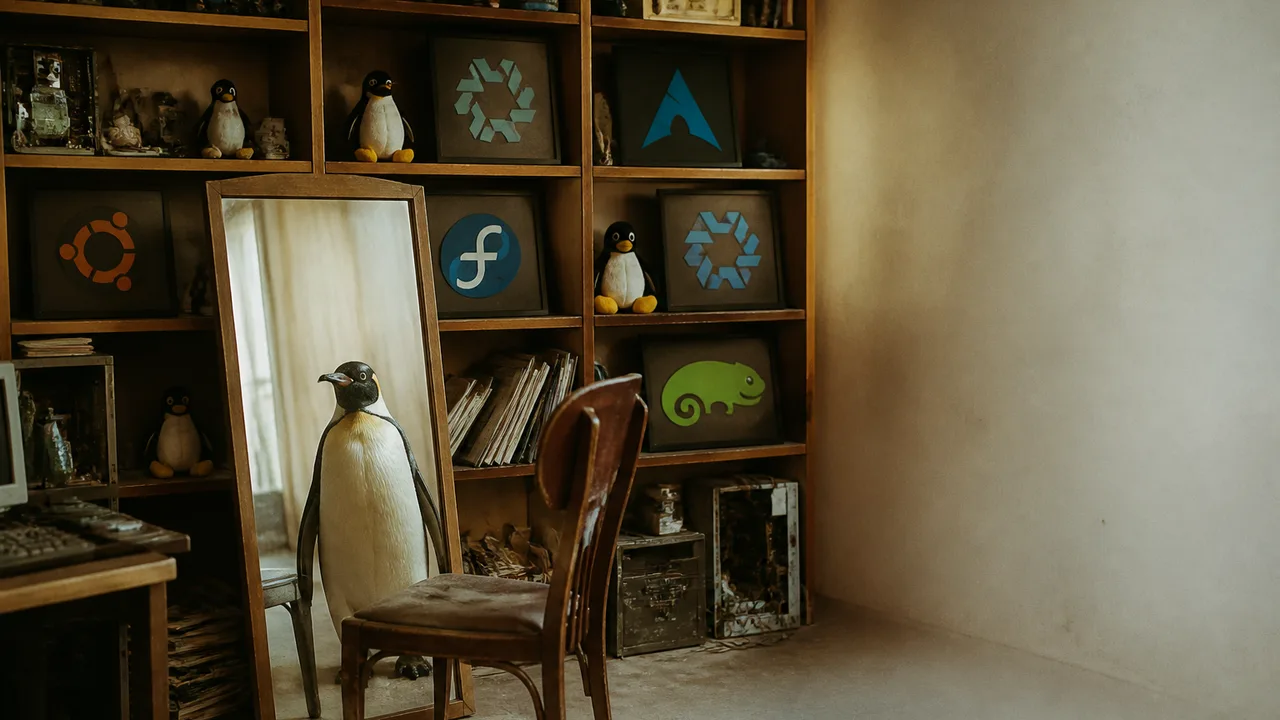
Photo: AI. Marcel Dubois
There's a genre of tech content that runs on personality quiz energy — "what does your [blank] say about you?" — and it usually produces something disposable. The Coding Gopher's recent video What Your Linux Distro Says About You is nominally in that genre. It's also, underneath the jokes about Arch users evangelizing in public, making a genuinely interesting argument: that in a world where everyone technically has access to the same kernel, the choices layered on top of it are a kind of self-portrait.
That argument is worth sitting with for a moment, because it depends on something that isn't obvious to people outside the Linux world.
The kernel is just the beginning
Most operating systems are vertical — you get what the company gives you. Linux is horizontal. The kernel, as The Coding Gopher explains, is "just a kernel, the core piece of low-level software that bridges the gap between your computer's physical hardware and the applications you run, managing things like CPU scheduling, memory allocation, and hardware device drivers." Everything above that layer — the package manager, the release model, the desktop environment, the default applications — is a choice made by whoever assembled the distribution. And then, at the user level, the choice of distribution is another layer of decision-making entirely.
This is what makes the "psychological profile" framing land better than it might in, say, a "what your browser says about you" piece. Browser choice is constrained. Distro choice is genuinely expressive — you're selecting a particular philosophy of how software should be assembled, delivered, and updated. The Coding Gopher's profiles are rooted in those real technical differences, which is what lifts the video above pure comedy.
The spectrum, from pragmatist to ascetic
The video maps a rough spectrum from "just let me work" to "compiling is the work."
At the pragmatist end sits Ubuntu. Canonical's flagship is where most people start, and The Coding Gopher is notably unsnobby about it: "you value your time. You like things that just work out of the box with proprietary drivers and codecs ready to go. And you don't feel the need to suffer to prove you're a real tech enthusiast." The implied critique from more experimental corners of the Linux community — that Ubuntu users are basic — is addressed directly and dismissed. "While they are spending their evening debugging a broken display server after a minor upstream kernel upgrade, you are actually getting your work done."
Linux Mint occupies adjacent territory, but with a distinct flavor: intense conservatism about UI. The Cinnamon desktop is a deliberate rejection of the flat-design era, and Mint strips away what it considers unnecessary interface experimentation. Whether that makes Mint users thoughtful or just nostalgic is genuinely ambiguous — both can be true, and the video mostly plays it for affectionate comedy.
Fedora is where the spectrum starts getting interesting. Red Hat's community distro gets you bleeding-edge kernel versions and advanced filesystem choices like Btrfs, plus early access to display server and audio stack improvements that the rest of the ecosystem eventually adopts. The corporate backing from Red Hat matters here — you get innovation without the full risk of running something nobody's accountable for. The profile: "a professional software engineer or a DevOps architect who wants the absolute bleeding edge of open-source technology, but with corporate backing from Red Hat, so it doesn't blow up your workflow." Strong opinions about containerization and systemd apparently come included.
Debian is the philosophical opposite of Fedora on the velocity axis. Packages in Debian stable go through testing cycles long enough that, as The Coding Gopher puts it, "the software versions are practically fossilized by the time they reach your machine." The video frames this as a moral stance — "stability is a moral virtue" — which feels about right. Debian users are the people whose home servers haven't rebooted since the previous administration.
Arch is where the video's comedy sharpens. "Running Arch means you possess a unique mix of technical curiosity and mild masochism. You didn't just want an operating system, you wanted a construction project." The technical description is accurate: Arch's installation is deliberately manual, requiring you to partition drives, mount filesystems, and configure your display server from a command line. The rolling release model means you're always on the latest upstream packages, which is powerful and occasionally catastrophic. The cultural observation — "we already know because you've likely told three people about it today" — is a well-worn joke that lands because it points at something real about the community's relationship with its own identity.
Gentoo occupies the far extreme before you reach NixOS territory. The Portage package manager doesn't deliver pre-compiled binaries — it downloads source code and compiles everything locally, optimized for your specific processor architecture. The video's description of the tradeoff is pointed: "you firmly believe that a 2% performance increase in your text editor justifies your computer running at 90°C for 12 hours straight." Whether that tradeoff makes sense depends on what you're running and what you value. For high-performance computing workloads, local compilation with architecture-specific optimizations can matter. For most users, it's philosophical rather than practical — and the video knows this.
NixOS: the interesting hard case
The most technically substantive profile in the video is NixOS, and it's worth unpacking carefully because The Coding Gopher's framing — "peak overengineering" — undersells what's actually novel about it.
NixOS treats system configuration as a pure functional programming problem. Your entire machine state — kernel, packages, services, configuration files, even desktop themes — is defined in a single declarative configuration.nix file. This isn't just organizational tidiness. It means that system state is reproducible and auditable in a way that traditional package management can't match. If an update breaks something, you roll back atomically to a previous generation. Nothing about the system exists outside that file's scope.
The Coding Gopher highlights what he frames as the key selling point: configuration reproducibility. According to an analysis published on Medium, NixOS: A Paradigm Shift in System Stability and Reproducibility, the guarantee NixOS actually delivers is configuration reproducibility — you can reliably recreate the same software environment from the same .nix file. Real-world hardware variation (firmware, drivers, physical devices) still introduces differences between machines, which is worth understanding before you make decisions based on overstated claims about hardware-agnostic portability.
That nuance doesn't undercut the core value proposition. For developers maintaining consistent environments across multiple machines, or system administrators who need to audit exactly what's running and why, the NixOS model is genuinely compelling. The video's "peak overengineering" framing is affectionate, but it risks obscuring why the model exists — it's a real answer to real problems in system reproducibility that traditional Linux administration doesn't solve cleanly.
What the video is actually doing
Step back from the individual profiles and there's a more interesting question lurking: why does distro identity carry this much social weight?
Part of the answer is in the technical architecture. Because Linux distributions are genuinely differentiated — not just cosmetically but in fundamental package management, release philosophy, and system design — choosing one is a real commitment to a set of tradeoffs. You're not just picking a color scheme. You're deciding how you want software to arrive on your machine, how stable you want your kernel, how much you're willing to invest in configuration and maintenance, and what you believe about the relationship between control and convenience.
The Coding Gopher's video treats those choices as personality-revealing because, at some level, they are. The Debian user who hasn't rebooted since 2018 and the Arch user who broke their display server this week have made different bets about what a computer is for. Neither is obviously wrong. They just have different priors about reliability, cutting-edge software, and how much of their time they want to spend managing infrastructure versus using it.
That's a real philosophical split that goes well beyond Linux — you can find the same tension in almost any domain where someone has to choose between stability and velocity, control and convenience, optimization and practicality.
The video makes it funny. But the underlying question it's asking — what do your technical choices reveal about your values? — is one the open source community has always taken seriously, even when it pretends to be just messing around.
More Like This

How the Nest Thermostat Launched the Smart Home Era
Tony Fadell's Nest Learning Thermostat didn't just fix an ugly device—it sparked the smart home era. A look at what it got right, wrong, and what Google killed.

Windows Under the Hood: malloc, BitLocker & OS Secrets
Dave and Glenn's Shop Talk #82 breaks down malloc, BitLocker's PIN vulnerability, OS handles, and why Windows backwards compatibility is weirder than you think.

Fragnesia, KDE's €1.2M, and Linux's Container Future
Fragnesia vulnerability explained, KDE gets €1.2M from Sovereign Tech Fund, and Fedora Hummingbird points to a container-native Linux future.
30 Self-Hosted GitHub Projects Trending Right Now
From media automation to AI chat apps, here are 30 trending self-hosted GitHub projects that put you back in control of your data and infrastructure.
Bridging the Gap: C++ Workshop Tackles Industry Reality
Amir Kirsh's workshop addresses the persistent divide between academic C++ and production code—and questions whether one-day training can solve it.

Why ChatGPT Won't Teach You Linux (And What Will)
A DevOps engineer with 10+ years experience argues that AI tools are failing Linux learners—and explains what actually works for mastering the command line.

How APIs Work and Why They Matter for AI
APIs are the connective tissue of modern software—and AI is making that architecture more consequential than ever. Here's what you need to know.

JavaScript Date Handling: From Broken Basics to Temporal
A deep dive into JavaScript's notoriously broken Date object, the underrated Intl API, and why TC39's Temporal proposal took nearly a decade to arrive.