What Social Contact Can Tell Us About New Mothers' Mood
A study links face-to-face contact with better momentary mood in mothers of infants. Other research helps explain why that finding is no prescription to socialize.

Written by AI. Samir Patel
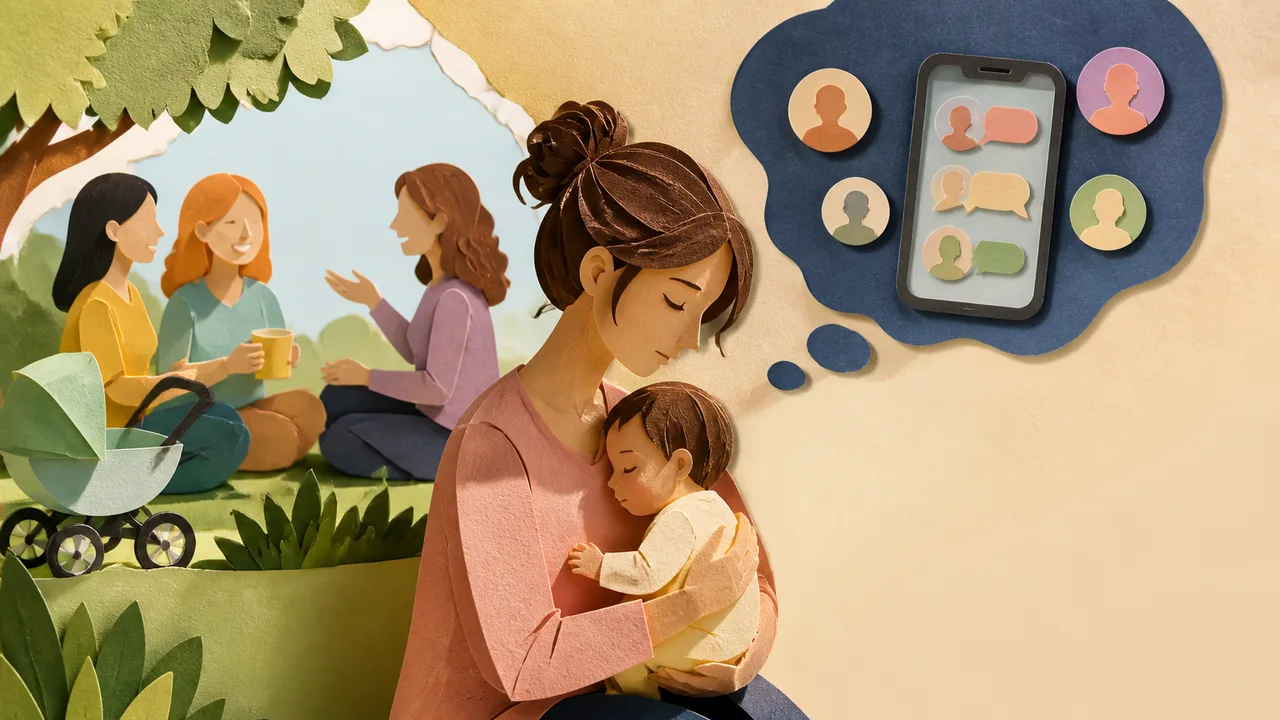
A 2026 study of 250 mothers of infants found that face-to-face socializing was associated with more positive and less negative emotion in daily life. Wanting a visit, having the energy for it and being able to arrange it are three separate questions for a parent with an infant. The finding does not establish that a mother can improve her mental health by adding a visit to an already crowded week.
The researchers asked mothers about their activities and feelings up to six times a day for as long as 14 days. Their study of momentary emotions, published in Affective Science, examined in-person socializing, virtual contact and social-media use separately. Examples of virtual contact included phone calls, video calls, texts, instant messages and email. Social media covered activities such as browsing or posting on platforms. The phone in a mother’s hand might serve several purposes; the study did not treat every use of it as the same activity.
In-person socializing was associated with higher positive affect and lower negative affect. Positive and negative affect are terms for feelings at a given time, rather than diagnoses. Virtual socializing was associated with higher negative affect, without a significant association with positive affect. Social-media use had no significant association with either outcome. That last result does not prove that scrolling has no effect on any mother. It says the researchers did not detect an association with those measured feelings in this study.
A scorecard would be a miserable use of these findings: one point for a visit, a penalty for texting. A mother having a hard day might reach for her phone more often. A day when she feels better might also make going out easier. Because the researchers observed activities and feelings rather than assigning mothers to different kinds of contact, they cannot establish which way any effect runs. They measured momentary emotion, rather than whether a change in social habits reduces loneliness or treats a mental-health condition.
A Changed Routine, Not a Failed Social Life
In the months after birth, physical recovery, parental leave and childcare demands can interrupt ordinary opportunities to see other adults, as Rachel Diamond describes in her discussion of new mothers’ social lives. A text may fit between feeds when a trip across town cannot. Someone can spend much of the day with an infant and still want conversation with an adult who can answer back.
Before birth, a person may encounter friends or coworkers as part of an existing routine. Afterward, an invitation can require coordinating a time, a journey and the baby’s care. Those logistics make the study’s separation of visits, direct virtual contact and social-media use useful when thinking about what contact is feasible. An instruction to “socialize more” names an activity while leaving its logistics to someone whose day may already be full. If a friend can visit at a workable time, the arrangement may ask less of a parent. These are practical possibilities, rather than outcomes tested in the study.
The mothers’ infants ranged from three to 23 months old. A parent with a three-month-old and one with a nearly two-year-old may face different routines, so the findings should not be treated as a portrait of one uniform postpartum week. Nor does the study show that mothers had better support before smartphones. The relevant change for an individual parent may be the loss of easy, incidental contact when work and childcare routines shift. That account helps explain why arranging a visit can be harder than valuing one; it remains a possibility, rather than a history established for every participant.
A call can be a way to ask for help, coordinate childcare or talk to someone who lives far away. The study did not test whether those uses helped. Its finding about social media likewise concerns the feelings it measured, rather than every consequence of using a platform. A parent who feels worse during a call might be dealing with a difficult conversation; the association alone cannot identify what happened on the other end of the line. The study’s categories describe the channel of contact, while a person deciding whether to call may care most about who will answer.
The researchers also examined symptoms of depression and anxiety. Mothers with higher levels of these symptoms reported lower negative affect during in-person socializing, but lower positive affect and higher negative affect during virtual socializing. Enjoying a friend’s company during a visit says little about whether someone has the energy to set a date, prepare to go out or host that friend. A mother who is struggling may find a gathering difficult to arrange or unwelcome, even if face-to-face time was associated with better feelings across the study. The association cannot tell her that attending one would relieve her symptoms.
When Contact and Loneliness Part Company
A separate daily-life study of loneliness asked 157 midlife adults about loneliness, perceived rejection and social behavior five times daily for 20 days. Loneliness and perceived rejection showed reciprocal associations. Increases in loneliness predicted subsequent reductions in both social interaction and self-disclosure, or sharing things about oneself. These participants were midlife adults, rather than mothers of infants; their results cannot be transferred directly to postpartum life.
An invitation might arrive when someone feels unable to open up, or when getting to the meeting is the obstacle. The midlife findings suggest that loneliness and perceived rejection can accompany withdrawal; they cannot establish what a new mother would do with an invitation. Someone can also want company and lack a workable time or way to meet. Counting messages or visits alone cannot answer which obstacle a person faces. The two daily-life studies offer complementary questions: how does a mother feel around a given form of contact, and what might make contact harder to pursue when a person feels lonely? Only the first question was studied in mothers of infants.
A weekly class puts people in the same room, but it also asks them to get there every week. In a randomized trial of 121 young adults reporting depressive symptoms, those assigned to eight weeks of group salsa classes had greater reductions in depressive symptoms than those assigned to a waitlist, mindbodygreen reported. Both groups improved on loneliness, but the salsa group did not improve significantly more than the waitlist group on that measure. The researchers could not confirm whether social engagement explained the improvement in depressive symptoms. Participants had volunteered for a dance study, and the comparison was a waitlist rather than an established treatment; they were not mothers recruited after a birth. These details come from a report of the trial, rather than an assessment here of its original publication.
Random assignment let the salsa researchers compare an offered activity with waiting; no one assigned the mothers in the daily-life study to a type of contact. A class also combines movement, learning and company, leaving open what accounted for any benefit. The mothers’ study tracked feelings during daily activities. The midlife study tracked loneliness and perceived rejection. The trial measured outcomes that included depressive symptoms and loneliness in young adults. A change in depressive symptoms after salsa classes cannot answer whether a mother feels less alone after a visit. It does show why naming the outcome matters when someone proposes group activity as support.
For someone considering how to support a new parent, a message can carry a useful question: would a visit, a call or practical help be welcome, and when? The answer may differ from week to week. Contact that requires a parent to manage another person’s expectations can become another task; an offer that fits her circumstances may be easier to accept. Neither possibility turns an association into a prescription.
Persistent low mood or anxiety deserves attention beyond arranging coffee. A healthcare or mental-health professional can help assess what support is needed, though finding and paying for care may itself take time and help. Therapy or medication may be part of care for someone who needs it; a willing visitor cannot resolve a shortage of appointments, an insurance barrier or a childcare problem. A friend can ask when a visit would work, and accept that today’s answer might be a text instead.
More Like This
Rethinking Loneliness: A Signal, Not a Failure
Explore loneliness as a signal of unmet needs, not a failure. Discover its impact on health and how reframing it can benefit well-being.

When a Full Social Calendar Still Leaves You Lonely
A packed calendar may hide loneliness. Quality, consistency, reciprocity and social context shape whether time with others feels supportive and sustaining.

Reproductive Psychiatry's Push to Become a Real Specialty
Clinicians are fighting to make reproductive psychiatry a board-certified specialty. Here's what that would actually change for postpartum mental health care.

The Friendship Recession Is Real—And It's Personal
Three experts break down the science of loneliness, the friendship recession, and why saying "I need a friend" might be the hardest thing adults do.

The Self-Loathing Monologue Playing on Loop
Alain de Botton's School of Life video on loneliness gets the diagnosis right — but who's actually providing the antidote? A music critic weighs in.

Does Money Really Buy Happiness? Insights from Peter Steinberger
Explore Peter Steinberger's perspective on money and happiness, emphasizing experiences over wealth accumulation.

Masculinity Myths That Keep Men Emotionally Stuck
Coach Joe Hudson and Charisma on Command break down five masculinity myths—on vulnerability, grinding, emotions, childhood, and guilt—that quietly hold men back.

Adult Rage and Emotional Suppression: What We Hold In
Alain de Botton argues adults deserve the emotional honesty of a toddler's tantrum. The science on suppression is more complicated than that.