War, Visas, and the 2026 World Cup's Political Storm
Iran plays in the US while at war with it. Haiti fans can't get visas. ICE will be at stadiums. The 2026 World Cup's politics are already extraordinary.

Written by AI. Fatima Al-Hassan
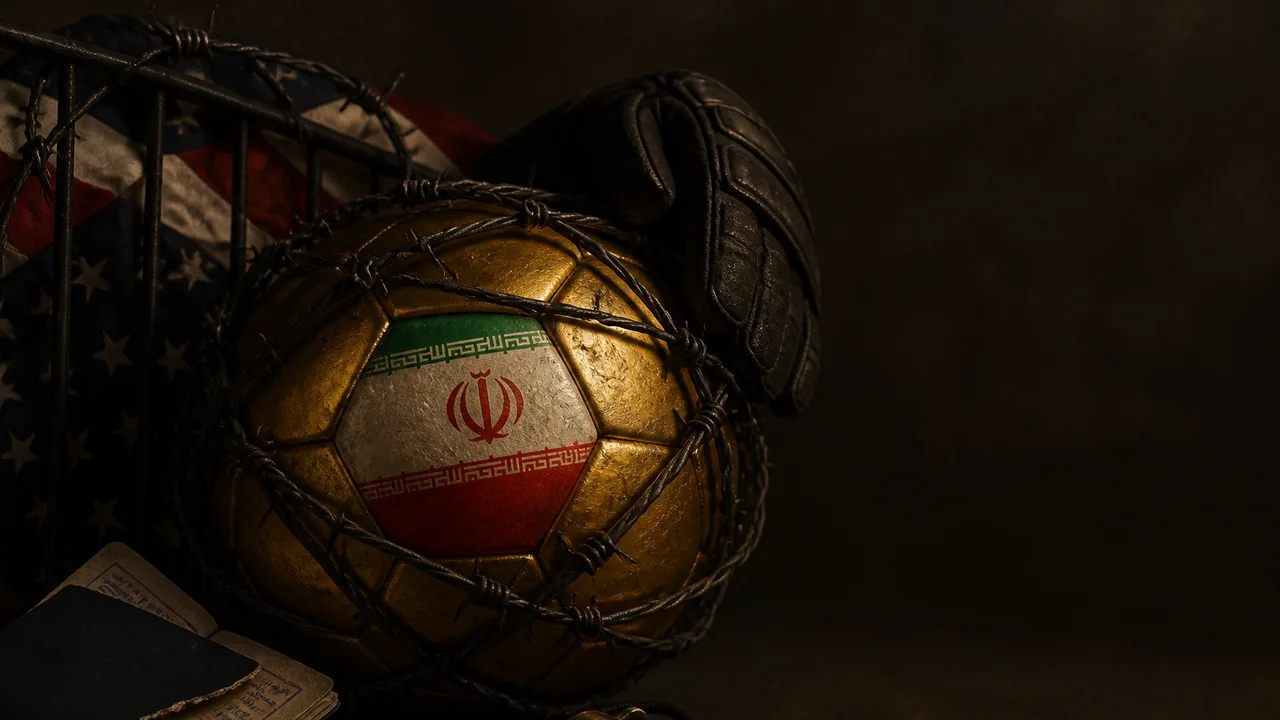
Photo: AI. Soraya Hadid
Iran qualified for the 2026 World Cup months before the United States and Iran entered active hostilities. That timing — the team locking in their berth before the geopolitical situation collapsed around them — is either a remarkable quirk of fate or a useful illustration of how sport keeps moving while the world burns. Probably both.
The BBC Newscast team, joined by Americast's Anthony Zurcher and Marianna Spring alongside 5 Live commentator John Murray, spent a recent episode mapping what may be the most politically loaded World Cup in the tournament's history. It's a dense brief. Iran playing on American soil during an active conflict. Visa bans cutting off fans from countries that qualified. ICE agents embedded in the tournament's security apparatus. The question the discussion keeps circling without quite landing on: at what point does hosting a World Cup become an act of foreign policy?
The Iranian team's peculiar logistical situation
As of early June, the working arrangement is this: Iran's players will fly into the United States for their matches, play, and fly back out to Mexico — where Mexican President Claudia Sheinbaum has offered to host the squad between fixtures. No overnight stays on American soil. Their group-stage schedule takes them to Los Angeles for matches against New Zealand and Belgium, then Seattle for their final group game against Egypt.
The arrangement exists because the Trump administration stated it was not "safe" for the Iranian team to stay overnight in the US. Donald Trump's March post on Truth Social — welcoming Iran to the World Cup while simultaneously suggesting it wasn't "appropriate" for them to be there for their "own life and safety" — reads, charitably, as confused. Less charitably, as a message. Anthony Zurcher, who spoke with Andrew Giuliani, the official Trump appointed to oversee World Cup security, reports that officials subsequently walked back the language: Iran is welcome, they can play their matches. The overnight restriction remains, though its precise rationale has not been clearly stated on the public record.
There's a separate and more concrete complication: reports that some squad members may have served in the IRGC — the Iranian Revolutionary Guard Corps, which is designated a terrorist organization under US law. Whether and how that affects individual visa applications is unresolved at the time of recording. As Zurcher notes, visas for the Iranian team had not yet been confirmed.
Murray frames the human dimension of this with some care. A World Cup squad is 26 players plus support staff — coaches, medics, analysts — and within that group there will be "a whole range of opinions and feelings." The logistical strain of being based in Tijuana, commuting across the border for matches, then making the long journey to Seattle, is not trivial. "I know there are much more important things than what is happening in the sport," Murray says, "but if they're able to get a point at this World Cup, I would be amazed."
The scenario no one quite wants to say out loud
With 48 teams and a reformed knockout structure that advances some third-placed group finishers, a United States versus Iran round-of-16 fixture is mathematically possible. Unlikely — but possible.
The 1998 World Cup gave us the last US-Iran match, played against a backdrop of the 1979 revolution and decades of accumulated tension. That was tense enough when both countries were merely hostile rather than actively at war. Murray reaches for Diego Maradona's autobiography to illustrate what geopolitics actually does inside a dressing room. Argentina versus England, 1986, four years after the Falklands War. The official line from the Argentina players was that football had nothing to do with the conflict. Maradona's private account was different: "Of course before the match we said that football had nothing to do with the Malvinas war, but we knew a lot of Argentinian kids had died there, shot down like little birds. This was revenge."
If Iran and the US meet in the knockout stage, no amount of pre-match diplomacy is going to paper over what that fixture means to the people playing in it.
Who can't get to the stadium
The Iran situation is extreme, but it's not the only country whose World Cup is being complicated by US immigration policy. Anthony Zurcher names Senegal, Côte d'Ivoire, and Haiti as countries covered by Trump administration visa bans — and in each case, the working assumption is that players will probably be admitted (the diplomatic cost of blocking a World Cup squad's entry is high), while fans face a substantially harder road.
The Trump administration has created a streamlined visa process for ticket-holders from World Cup countries. Whether that process works for nationals of specifically banned countries remains unclear. Secretary of State Marco Rubio's statement from November — "your FIFA ticket is not a US visa" — sets the tone. Haiti is the case that Murray and Zurcher return to: a country that very rarely qualifies for a World Cup, playing in one hosted practically next door, and yet whose supporters face significant structural barriers to attending. The gap between the tournament's promotional promise and the visa reality is not subtle.
Marianna Spring raises the social media screening question that has generated anxiety among potential visitors: will posting criticism of the Trump administration get you turned away at the border? The honest answer from Zurcher is that active, systematic social media vetting of every incoming fan is probably not happening at scale — the logistics alone would make it impractical. But the uncertainty itself does something. "It has a chilling effect," Zurcher says, "for people who are looking at coming into the United States for what was presented back when they announced this as a huge event that would showcase the United States and be able to turbocharge American tourism for years to come."
That framing — a tournament sold as a showcase that is now generating anxiety rather than enthusiasm — runs through the whole discussion.
ICE at the stadium gates
ICE — US Immigration and Customs Enforcement — has described itself as "a key part of the overall security apparatus" for the World Cup. The agency's role is officially framed as security support rather than immigration enforcement. The Trump administration has stated there will be no raids or crackdowns around stadiums.
The credibility problem is that ICE's documented history includes targeting immigrant communities and gathering spaces — not just border crossings. Spring notes that high-profile incidents involving ICE in recent months, including killings of American citizens, have raised public concern about the agency's use of force and its operational scope. For an Iranian fan, a Haitian fan, or any undocumented person from a World Cup country watching a match at a bar far from any stadium, the question isn't whether they trust the administration's assurance — it's whether that assurance, given prior conduct, is a reasonable basis for risk calculation.
The country hosting all of this
Mexico City, in John Murray's assessment, is where the tournament's atmosphere will feel most like itself. Mexico's domestic fan base is enormous, the country is football-obsessed, and hosting the World Cup on home soil after years of supporting the team abroad is significant. Murray notes a particular irony: supporters who would have spent money traveling to matches in other continents now find those matches in their own country — but tickets are priced at a level many of them cannot reach.
The security picture in Mexico is mixed. Murray's team has received additional safety briefings. BBC correspondent Will Grant in Mexico City has given reassuring advice about the capital specifically. The cartel situation is real but unevenly distributed; tourist areas have historically been insulated from the worst of it. That may hold. It may not.
As for the US itself, soccer's standing is genuinely growing. Zurcher reports that roughly 10% of Americans name it as their favorite sport — a steadily rising number, driven in part by immigration from football-dominant countries. Youth participation is higher for soccer than any other American sport. MLS draws tens of thousands regularly. The honest caveat is also his: if the US team exits early, the country's attention will mostly move on. The structural growth is real; the fair-weather ceiling is also real.
What the BBC Newscast discussion captures, without quite stating it, is something structural about this particular tournament: the politics aren't a backdrop. Iran playing in the US while at war with it. Fans from qualifying nations unable to reach the host country. Immigration enforcement embedded in tournament security. FIFA's Gianni Infantino has reportedly been "unswerving" in insisting Iran will participate — a position that looks less like principle and more like a test of how much geopolitical weather a sporting institution can claim to be above.
The 1998 US-Iran match in Lyon is remembered partly because the Iranian players gave flowers to their American counterparts before kick-off. A gesture that meant something, even then, because the politics were already on the pitch.
Nobody's handing out flowers this time.
More Like This

Ted Turner, PWHL Detroit, and a Turbulent Sports Media Day
Ted Turner's death, PWHL's Detroit expansion, FanDuel's CEO ouster, and ESPN's NFL rights silence made May 7 a defining day in sports business.
The Giants' Walk Rate Is Historically Bad in 2026
The SF Giants have a 5.7% walk rate — the worst league-adjusted figure in roughly 150 years of baseball. Here's what the numbers actually mean.
1938: The Year the World Chose Not to See
From Munich to the Yellow River, 1938 was the year crisis became catastrophe. What the decisions of that year still ask us to reckon with.
World Cup 2026 Economics: Who Pays, Who Profits
FIFA will make billions from World Cup 2026. Host cities will foot the bill. Dynamic pricing and immigration fears are leaving ordinary fans—and Main Street—behind.
Who Really Profits From the 2026 FIFA World Cup
FIFA projects $11B in revenue and $80B in global economic activity for 2026. But host cities are quietly getting cold feet. Here's where the money actually flows.

Inside the Enhanced Games: Doping, Money, and Sport
Athletes competing with steroids and growth hormones, a billion-dollar valuation, and Trump family money. The Enhanced Games are stranger than they sound.
MLS Bets on a Post-World Cup Surge
MLS commissioner Don Garber says the World Cup was always the plan. Now comes the harder part: turning a soccer moment into a soccer market.
Inside FIFA World Cup 2026's Massive Logistics Machine
Over 50,000 shipments, three countries, 16 cities. How FIFA's logistics "control tower" keeps the 2026 World Cup moving behind the scenes.