Voicebox: Open-Source Local Voice AI for Developers
Voicebox is a free, local-first AI voice studio with voice cloning, TTS, and agent integration. Here's what it actually does well—and where it still falls short.

Written by AI. Marcus Chen-Ramirez

Photo: AI. Kasper Winter
The pitch is almost too clean: what if you could do everything ElevenLabs does, except locally, for free, with no subscription, no API keys, and no cloud company holding your voice samples? That's the promise Voicebox is making, and it's earning attention—around 30,000 GitHub stars at last count, which is not a trivial number for a desktop app that dropped earlier this year.
The Better Stack team recently ran Voicebox through a practical demo, and the results are worth examining carefully—not because the tool is obviously great or obviously half-baked, but because it sits at the intersection of a few genuinely interesting tensions in how developers relate to AI infrastructure.
The Ollama Framing Is Smart (and Loaded)
Voicebox's own positioning leans heavily on a single analogy: "Ollama is for local text models. Voicebox is trying to be that for voice." It's an effective frame because Ollama has become shorthand in developer circles for a specific kind of promise—sophisticated AI capability that lives on your machine, costs nothing at runtime, and doesn't require you to route your data through someone else's servers.
That framing carries weight because Ollama actually delivered. So the question isn't whether the analogy is flattering—it obviously is—but whether Voicebox has the substance to back it up.
What the Better Stack demo shows is a tool that genuinely consolidates what was previously a fragmented stack. Before Voicebox, a developer wanting local voice capabilities would typically stitch together Piper for TTS, Whisper for transcription, some separate cloning library, and a DIY UI layer. As the presenter put it: "We have one tool for transcription, one for cloning, one for TTS, one for UI, all this stuff that we're really just smooshing together. Voicebox packages the whole workflow into one studio app."
That consolidation argument is real. Friction compounds. A four-tool workflow that each requires separate configuration, separate updates, and separate troubleshooting is genuinely worse than a unified app, even if the underlying models are identical. This is the same logic that made Ollama successful—not that it introduced new models, but that it made existing ones dramatically easier to use.
What the Demo Actually Shows
Running on an Apple M4, the Better Stack presenter walked through three core functions: voice cloning, text-to-speech generation, and system-wide dictation. The setup path is straightforward—download the desktop app, launch it, pull the local models you need—though the Docker alternative apparently took nearly 30 minutes to spin up containers, which is the kind of friction that can kill early adoption.
Voice cloning involves recording yourself or uploading a short audio file, adding a transcription of that audio, and letting the model build a voice profile. Generation is then as simple as typing text, selecting your profile and model, and hitting generate. The output the presenter demonstrated sounded, by their assessment, "really decent"—not ElevenLabs-tier polish, but functional and clearly recognizable as the cloned voice.
The dictation feature might be the most immediately practical piece. A global hotkey triggers Whisper-powered transcription that drops text directly into whatever application has focus—your code editor, a notes app, a document. For developers who spend most of their day in a text environment, this kind of ambient voice input has obvious utility. The moments where talking is faster than typing are frequent enough that system-wide dictation is a meaningful productivity surface, not a novelty.
Then there's the agent integration, which is where things get more speculative but also more interesting. Through MCP (Model Context Protocol) support and a local REST API, tools like Claude Code or Cursor can call Voicebox as a speech layer. Your coding agent doesn't just dump output to the terminal—it speaks. The presenter framed it this way: "Claude code, cursor, or your own local agent can trigger speech through Voicebox instead of only just dumping it into your terminal. We're already getting feedback from our AIs. Why not have it speak to us?"
Whether you find that compelling or mildly unsettling probably depends on how you feel about your development environment acquiring a voice. But the technical architecture is legitimate—this is an MCP tool call, not a gimmick, and the pattern of giving AI agents more expressive output channels is already gaining traction across the ecosystem.
The ElevenLabs Comparison Deserves More Nuance
Better Stack's presenter is fair to ElevenLabs: "11 Labs is great. Bravo... the quality is amazing." The concession matters because ElevenLabs has genuinely invested in voice quality research, and the gap between a well-tuned cloud model and a local open-source equivalent is real, particularly for long-form content where consistency and emotional range matter.
The Chatterbox Turbo model—one of the options available within Voicebox—has been making noise as an open-source TTS engine with built-in emotion control, and it's worth noting that Voicebox's quality ceiling is partly determined by which underlying models you pull. This isn't one model; it's a studio that can run several.
The local voice cloning space has been filling in quickly from multiple directions—Vox CPM, VibeVoice, and now Voicebox all represent different attempts at the same fundamental problem: making high-quality voice AI that doesn't require a cloud subscription. What Voicebox's approach adds is the unified interface layer, which none of the others have prioritized to the same degree.
But the quality gaps the presenter acknowledges are worth taking seriously. Long-form consistency—maintaining natural-sounding speech across paragraphs, not just sentences—is still a known weakness of local models compared to ElevenLabs' hosted infrastructure. For internal tooling, developer audio notes, or agent output, that gap probably doesn't matter. For a podcast or a product demo with paying customers, it likely does.
The Real Argument Is About Control
The presenter eventually lands on what is probably the most honest framing: "For us devs, the best tool is not always the one with the prettiest output. We don't actually care about that a lot of the time. Sometimes it's the one you can actually control."
That's not a rationalization for inferior quality—it's a genuine articulation of what developers are actually optimizing for when they choose local-first tools. The value proposition here isn't primarily acoustic. It's structural. When you run Voicebox locally, you control where voice samples go, you control how many generations you run, and you control how the tool integrates with everything else in your stack. You never open a billing dashboard to find out that testing ate through your monthly credits.
This matters more for some use cases than others. Internal content, sensitive audio, voice samples tied to personal or client data—these are contexts where "we put your stuff in the cloud" is a genuine concern, not a theoretical one. For a solo developer building a side project with their own voice profile, the privacy argument is almost the entire argument.
The limitations the presenter surfaces are real and shouldn't be glossed over. Windows users in particular are likely to hit GPU detection issues and model setup friction—problems that require app restarts to resolve, and that reflect the early-stage reality of a tool that launched this year. Emotion control is still model-dependent. Long-form audio quality lags behind ElevenLabs. These aren't fatal flaws, but they're genuine constraints that should inform how you deploy this, not just whether you install it.
The Question Worth Sitting With
The Ollama analogy Voicebox invokes is instructive in another way. When Ollama launched, the question wasn't whether local LLMs could match GPT-4—they obviously couldn't. The question was whether the control and cost advantages of running models locally were worth the quality tradeoff for specific use cases. Developers answered that question affirmatively, loudly and quickly, and the ecosystem around local models exploded accordingly.
Voicebox is making the same bet in the voice space. Whether the open-source voice ecosystem has the same momentum behind it—and whether voice quality closes the gap with cloud providers at the same pace that LLMs have—is genuinely uncertain. Thirty thousand GitHub stars suggests developers are at least curious. What they do with it after installation is the part nobody can predict yet.
Marcus Chen-Ramirez is a senior technology correspondent for Buzzrag covering AI, software development, and the intersection of technology and society.
More Like This
ASI:One Brings AI Agents to the Command Line—No UI Required
ASI:One's new CLI tool lets developers run agentic AI from the terminal. No dashboard, no playground—just HTTP calls and Python. Does it hold up?
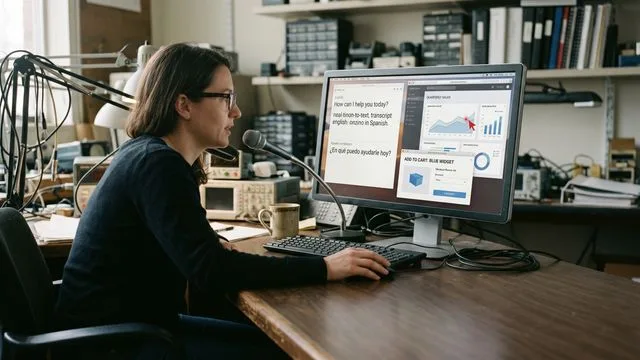
GPT-Realtime-2: Voice AI That Actually Does Things
OpenAI's GPT-Realtime-2 can operate UIs, call parallel tools, and translate live speech. Here's what that actually looks like in production.
Google Just Made Running LLMs on Your Phone Actually Simple
Google's AI Edge Gallery lets anyone run large language models locally on their phone—no developer account, no cloud, no data sharing. Here's what that means.

ElevenLabs and the Voice AI Bet Nobody Wanted
ElevenLabs CEO Mati Staniszewski explains how a two-person team from Warsaw suburbs built a $400M voice AI business by betting on the domain nobody wanted.

OpenAI's Codex Is Growing Up Fast—And Getting Weird
OpenAI's latest Codex updates add browser control, AI-reviewed approvals, and... animated pets? A look at where AI coding tools are actually heading.
Google's Gemini CLI Brings AI Agents to Your Terminal
Google quietly launched Gemini CLI, a command-line AI agent that reads files, searches the web, and edits code. Here's what it actually does.

Claude Code Nested Subagents: Power and Cost Explained
Anthropic's nested subagents let Claude Code spawn agents five levels deep. Here's what that actually means for your workflow—and your token bill.

35 Open-Source Tools Shaping AI Dev in 2025
GitHub's latest trending repos show developers wrestling with token costs, agent reliability, and AI tooling fragmentation—here's what's actually worth your attention.