Ukraine's Starlink Dispute Tests Sovereign Communications
Ukraine still reports satellite speed limits as it explores alternatives to Starlink. The dispute exposes the gap between controlling a network and needing one today.

Written by AI. Samira Barnes
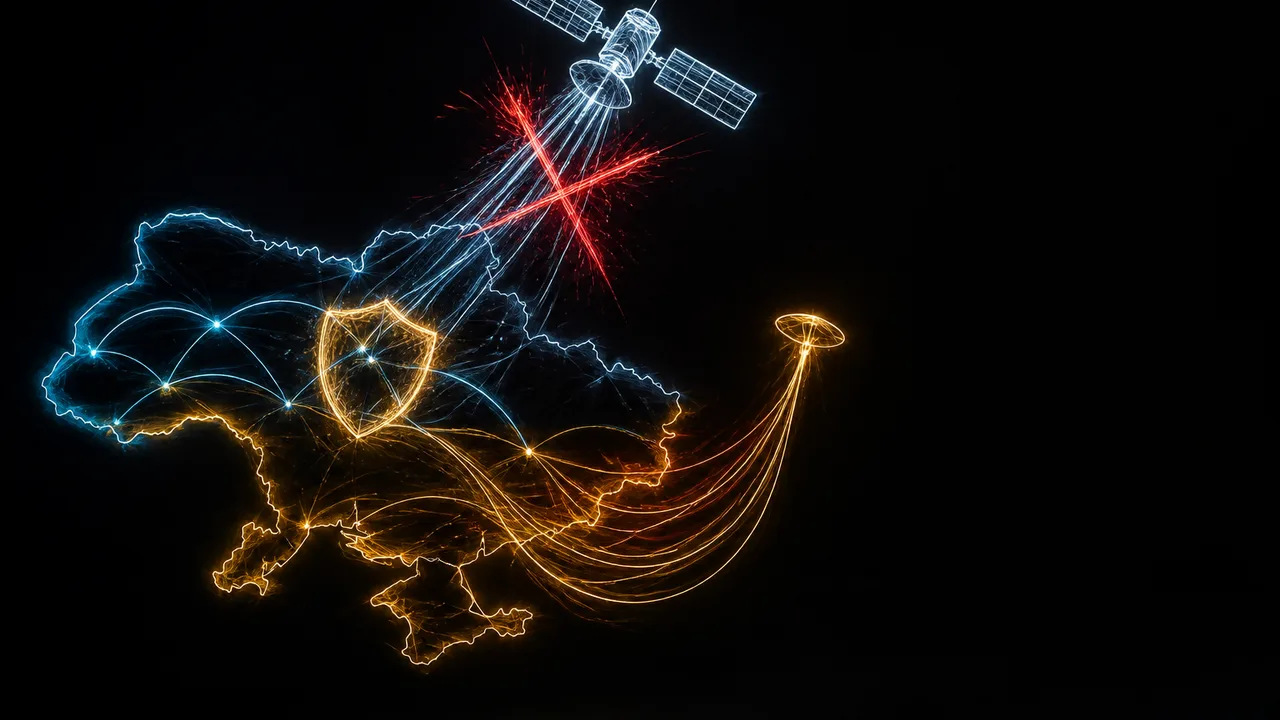
Ukraine’s defense ministry said Friday that aircraft using SpaceX’s satellite service were still losing connectivity at speeds of 100 miles per hour, despite President Donald Trump’s claim that Elon Musk had restored the service. The ministry said it had no confirmation that the restrictions had been lifted. Ukraine’s complaint concerns a speed limit affecting some military uses of Starlink and its military-grade offering, Starshield, rather than a nationwide loss of internet access.
President Volodymyr Zelenskyy said Friday that the restrictions on Starlink and Starshield remained. Ukrainian officials say drones traveling above the reported threshold have lost their connections, disrupting missions. Dmitri Alperovitch, chairman of the Silverado Policy Accelerator, said Ukraine was losing drones and had a reduced ability to strike Russian logistics. Those are accounts of operational effects, not a public measurement of every terminal’s performance. But they identify the immediate problem: a communications service Ukraine uses in combat may remain usable for some tasks while failing during others.
Kyiv has begun looking beyond that service. On Thursday, its defense ministry signed a letter of intent with Nokia and satellite maker ICEYE to develop defense and satellite communications capabilities. Zelenskyy put the objective plainly: “We must all rely on capabilities that we can control.” The agreement begins an exploration of cooperation; it does not put a replacement connection aboard a drone today.
The Live Network and the Proposed One
Russia’s full-scale invasion began in February 2022. Ukrainian forces rely on Starshield for military operations, so a restriction on how they can use the service affects an established wartime dependency. That history explains why the Nokia–ICEYE announcement is consequential without making it an immediate remedy. A force organized around a working network cannot obtain the same capability merely by signing an agreement to pursue another.
The comparison has two dimensions. Starlink and Starshield are services already in use, with a reported constraint at high speed. The Nokia–ICEYE cooperation is a plan to explore new capabilities, including what the companies describe as sovereign satellite communications. A sovereign system could, in principle, give Ukraine greater say over service conditions. Its usefulness would still depend on whether it could support the missions now served by the existing network. The announced cooperation sets out no public timetable, performance target or operational design that would answer that question.
Virginia Burger, a senior defense policy analyst at the Project on Government Oversight, said there is currently no drop-in replacement for Starlink, as combat increasingly uses unmanned systems requiring high-speed internet. That assessment puts a practical boundary around the word alternative. A second provider could reduce dependence for some communications without matching every use of Starshield. For a fast-moving drone, the relevant test is whether the connection works throughout the mission, including at the speeds at which Ukrainian officials report losses. For other users, the test may look different. The reported speed threshold should not be treated as a universal measure of the network’s reliability.
Europe offers another comparison, on a longer clock. The EU is developing IRIS², a constellation intended to support sovereign satellite communications, but its first launches are not expected until 2029. Both projects express a desire for greater control over connectivity. Neither an EU constellation awaiting launch nor Ukraine’s new letter of intent resolves Friday’s reported restrictions. Their scale and proposed uses also differ, so IRIS² is a comparison of timelines and policy aims, not a promised substitute for Ukrainian military terminals.
Who Can Change the Terms?
The speed limit has exposed a separate question from whether Ukraine can build an alternative: who had authority to impose this one? Musk has said limits on speed or usage are decided by the US military and ultimately the president. Defense Secretary Pete Hegseth gave a different account, saying the Pentagon had issued no directive and that Starlink had the option to make decisions under its terms of service. Neither statement identifies the decision-maker behind the reported restriction.
Trump said Thursday that Musk had “put it back.” On Friday, he said he had not spoken with Musk about Ukraine’s service and had heard it was fixed; he said he would speak to Musk if it was not. Ukraine’s ministry, meanwhile, reported continuing high-speed connectivity losses. The presidential assurance and the Ukrainian observations answer different questions: one describes what Trump believed had happened, while the other describes failures Ukraine said it was still seeing. The disagreement leaves restoration unresolved for the affected uses.
The political response has begun to focus on the records behind those claims. In a letter shared exclusively with CNBC, Democratic Representatives Sam Liccardo, Ro Khanna and Jimmy Panetta asked White House chief of staff Susie Wiles for a government-wide investigation. They asked who authorized, directed, approved or was consulted about the restrictions, how they were implemented, whether federal contracts were breached and whether similar vulnerabilities exist elsewhere. Those are investigative questions, not findings that SpaceX or the White House broke a contract.
Contract terms could help establish which party had the right to set usage conditions; an account of who actually directed a change would establish whether that right was exercised. A government could have contractual authority while a company operates the system, or a company could retain discretion under agreed terms. The public dispute does not settle which arrangement governed this decision. It does show why restoring connectivity alone would leave an accountability question unanswered.
There is a strong case for seeking other suppliers even if the current service returns to normal: operational dependence leaves Ukraine exposed whenever its needs and a provider’s terms diverge. Preserving access to a service that Ukrainian forces already use while alternatives take shape also has a strong case. Those positions can coexist. The hard policy work lies between them, in defining who can change service conditions, how a customer learns of a change, and what capability must be ready before a second network can serve as a fallback.
Ukraine can pursue greater control through Nokia and ICEYE while still needing SpaceX’s network now. The first measurable change will be a connection that works for the missions at issue, under terms Ukraine can understand and plan around.
More Like This
Starship Flight 14 Tests the Leap From Rocket to Utility
Starship Flight 14 aims for orbit, 26 working satellites and controlled deorbit, testing whether SpaceX's prototype can begin functioning as infrastructure.

SpaceX Hits 600 Falcon 9 Booster Reuses
SpaceX reached 600 flight-proven Falcon 9 booster launches on July 13-14, 2026. Here's what that number actually means for spaceflight economics.
Could Space be the Future for AI Deployment?
Elon Musk predicts AI deployment in space within 36 months, but is this vision realistic?
NASA's Crew-12 Mission: A Leap Towards Mars
Crew-12 mission advances space exploration, featuring ISS experiments and spacecraft upgrades for future Mars missions.

AI Chip Smuggling and the US-China Tech Divide
FT's Eleanor Olcott investigates the black market for Nvidia AI chips reaching China despite US export controls — and what it reveals about the tech race.

Promptware: When AI Agents Become Attack Vectors
Prompt injection attacks on AI agents follow a structured kill chain — and existing legal frameworks have almost nothing to say about who's liable when it works.