UK Plug-In Solar Panels and the Democratization of Home Energy
The UK government is backing plug-in solar panels that homeowners can install themselves. Here's what that shift means—and what it doesn't solve.

Written by AI. Raj Mehta
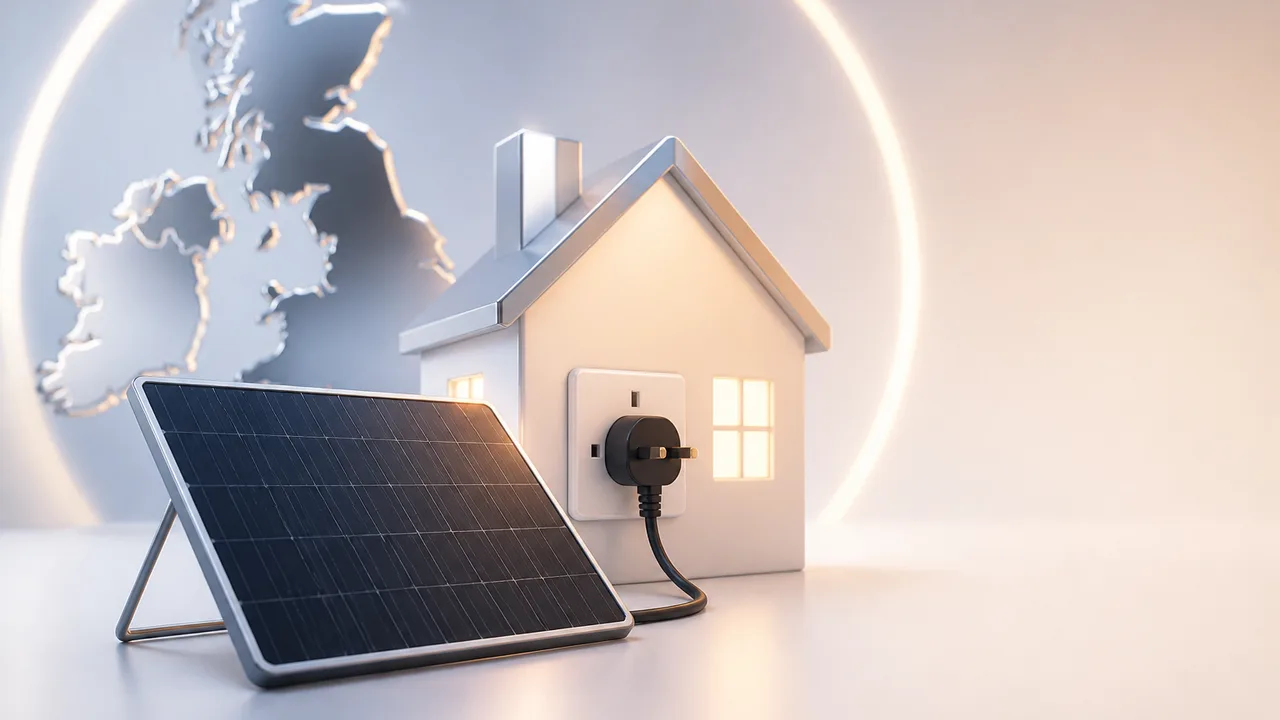
There is something quietly radical about the idea that a homeowner could unbox a solar panel, attach it to a south-facing wall, plug it into a standard socket, and start generating their own electricity before lunch. No scaffolding. No certified installer. No planning permission. No five-figure outlay and a decade-long payback calculation.
The UK government is now actively promoting exactly this model, according to BBC News, positioning plug-in solar panels as an accessible, cost-effective route for households to cut their energy bills. The pitch is simple: traditional rooftop solar has always been a product for people who already own their home outright, have capital to invest, and can wait years to break even. Plug-in panels, by contrast, lower almost every one of those barriers.
Whether the reality lives up to the pitch is a more complicated question.
What "Plug-In Solar" Actually Means
Before getting into the economics or the politics, it is worth being precise about the technology. Plug-in solar panels—sometimes called "balcony solar" or "solar starters" in European markets where they have been more widely adopted—are typically small-scale photovoltaic units, often in the 300W to 800W range per panel, designed to feed electricity directly into a home's grid via a standard outlet. They don't require a battery storage system, and they don't need a full inverter installation. The panels generate DC power, a microinverter converts it to AC, and it flows into the home's circuit, reducing what the household draws from the grid in real time.
Germany has been the most prominent adopter of this model in Europe—by some estimates, hundreds of thousands of "Balkonkraftwerk" (balcony power plant) units have been registered there, and German regulators have progressively simplified the administrative requirements to own one. The Netherlands, Austria, and France have followed with their own frameworks. The UK has been notably slower to move, and this government push represents a meaningful change in posture.
The specific contours of the UK initiative—which products are approved, what grid-connection standards apply, whether there are subsidies or VAT reliefs involved—are not fully detailed in the source material available at time of writing. The BBC's reporting confirms the government's promotional intent and the consumer-facing framing around bill reduction, but the full regulatory and financial architecture is worth tracking as it develops.
The Strongest Case For This
Let's map the argument at its most compelling, because it deserves that treatment.
Energy poverty in the UK is not a fringe concern. Following the energy price shocks of 2021-2023—driven in no small part by exposure to volatile global gas markets—millions of households found themselves rationing heating and making genuinely difficult choices. The structural response to that crisis has largely been a story of government bill support (expensive, temporary) and a push toward heat pumps and rooftop solar (slower, costly, inaccessible to renters). Plug-in solar fits a gap that the bigger solutions don't.
Renters are the most significant part of that gap. In a country where roughly one-third of households rent, the traditional solar market has almost nothing to offer. Landlords have little incentive to install rooftop panels, and tenants can't modify the property. A panel that attaches to a balcony railing or a garden fence and plugs into an indoor socket is the first solar product that is genuinely portable—you take it when you move. That reframes plug-in solar not just as a consumer product but as a renter's energy tool.
The democratization argument extends to capital access, too. A plug-in panel might cost a few hundred pounds rather than several thousand. The payback period, while still a genuine variable depending on usage patterns and tariff structures, is measured in years rather than the decade-or-more timeline that can make traditional solar a difficult sell. For households that are energy-anxious but asset-light, that math is different in a meaningful way.
And the collective arithmetic is not nothing. Millions of small generation sources, each shaving a modest amount from peak grid demand, represent a distributed energy asset that is—to use a term the energy industry has become very fond of—resilient. It doesn't require new transmission infrastructure. It doesn't require planning permission cycles. It scales at the speed of consumer adoption.
The Tensions Worth Naming
None of which means the framing should go unchallenged.
The first tension is between the bill-saving narrative and the actual numbers. A single 400W panel in the UK, running in a country not exactly famous for its solar irradiance, will generate a limited and variable amount of electricity annually. On a typical UK electricity tariff, the annual savings are real but modest. For a household in genuine fuel poverty—spending a significant share of its income on energy—modest savings matter; but the gap between the government's promotional language and the lived financial relief for the most stretched households deserves scrutiny. This technology is unlikely to be transformative for the households who need the most help; it is more likely to be genuinely useful for the squeezed middle.
The second tension is around grid standards and safety. The reason the UK moved more slowly than Germany on this is partly regulatory caution—there are legitimate questions about how large volumes of microinverter-fed power interact with domestic wiring, how installers (or non-installers, in this case) manage fault conditions, and what the implications are for grid operators managing balancing. Germany resolved these questions through a combination of technical standards and simplified registration requirements. The UK will need to do the same, and the quality of that regulatory work will determine whether the rollout is clean or produces a rash of problems that hands ammunition to skeptics.
The third tension—and the one I find most structurally interesting—is about whose interests are served by framing individuals as the solution to a collective energy problem. This is not an argument against plug-in solar; it is a question about what work this policy is being asked to do. If plug-in panels become the dominant response to energy insecurity—rather than one useful tool in a broader strategy—there is a risk of substituting individual consumer action for the harder, more expensive, more politically contentious work of grid decarbonisation, energy price reform, and housing insulation at scale. The technology doesn't determine that outcome; policy choices do.
The Precedent Question
The BBC's reporting frames the UK initiative as potentially setting a precedent for other countries watching for signals about consumer-level renewable energy adoption. That is plausible, but the precedent cuts in multiple directions.
For higher-income countries with high rental rates and high energy costs—much of Northern and Western Europe, parts of East Asia, urban Australia—the model is genuinely transferable. The technical standards exist, or can be adapted; the consumer market can develop; the regulatory pathway is navigable.
For lower-income countries, the calculus is different and more complex. Plug-in solar works best as a grid-supplementing technology—you are reducing your draw from the grid, not replacing it. In contexts where grid access is unreliable or where off-grid solutions are the real need, the microinverter-to-socket model is poorly matched. The countries that most need distributed solar energy generation don't necessarily need the specific product the UK is now promoting; they need investment in standalone systems, battery storage, and infrastructure—and those are questions of international finance and political will that a plug-in panel cannot address.
What to Watch
The source material is thin on implementation specifics, and that is where the story will actually play out. A few questions worth tracking: What technical and safety standards will the UK apply to approved devices? Will there be a registration or notification requirement, and how burdensome will that be? Are there subsidies or VAT arrangements that affect the real cost? How do energy suppliers handle the exported power that households don't consume themselves—is there a fair export tariff, or does that electricity effectively disappear into the grid for free?
The German experience suggests that regulatory simplicity is the single biggest determinant of uptake. Complexity kills adoption. If the UK government is serious about this as an energy policy tool rather than a press release, the details of how easy or hard they make the administrative process will tell you more than any promotional language.
The technology is not exotic or experimental. It works. The question is whether the policy around it will be designed to serve the people most exposed to energy costs, or primarily to generate a headline about consumer empowerment while leaving the harder structural questions for another day.
More Like This

Brand Authority Is Pricing Power—and Finance Knows It
Ryan Deiss's five brand "authority triggers" map onto real financial metrics. A global markets reporter translates what that actually means for valuations and beyond.

AI Data Centers Are Fueling a U.S. Gas Power Surge
AI data centers are driving a massive U.S. gas power build-out. BloombergNEF tracks 99 plants that could raise power-sector emissions 20%. Here's what that means.

GameStop's $56B eBay Bid: What the Math Actually Says
GameStop bid $56B for eBay despite a $12B market cap. We broke down the financing—shares that don't exist, a non-binding bank letter, and a CEO incentive worth examining.

What 10 Million Cold Emails Reveal About Selling
Austin Schneider sent 10M cold emails and found 6 patterns that actually drive replies. Here's what globally-minded sellers need to know—and where the framework breaks.

Page Studio: Streamlining Digital Presence
Explore how Page Studio's features impact businesses globally, enhancing web design efficiency.
Utah's Giant Solar Project Is Real—and Complicated
Utah's Green River Energy Center pairs 400 MW of solar with 1,600 MWh of battery storage. Here's what the press release leaves out.

Dubai and Egypt Holidays Undercut Europe on Price
Package holidays to Dubai and Egypt are cheaper this summer than European alternatives, as geopolitical jitters and rising costs reshape where British families travel.

Broadcom's $1.7 Trillion Valuation and Who Pays for It
Broadcom's 68% EBITDA margins and $115B FCF consensus are under scrutiny. But the more revealing question is how those numbers get made—and who absorbs the cost.