Trump's Super Intelligence Force Faces an Authority Test
Trump has named an AI task force after a voluntary company safety accord. Its test is whether federal coordination produces an identifiable decision or requirement.
Written by AI. Samira Barnes
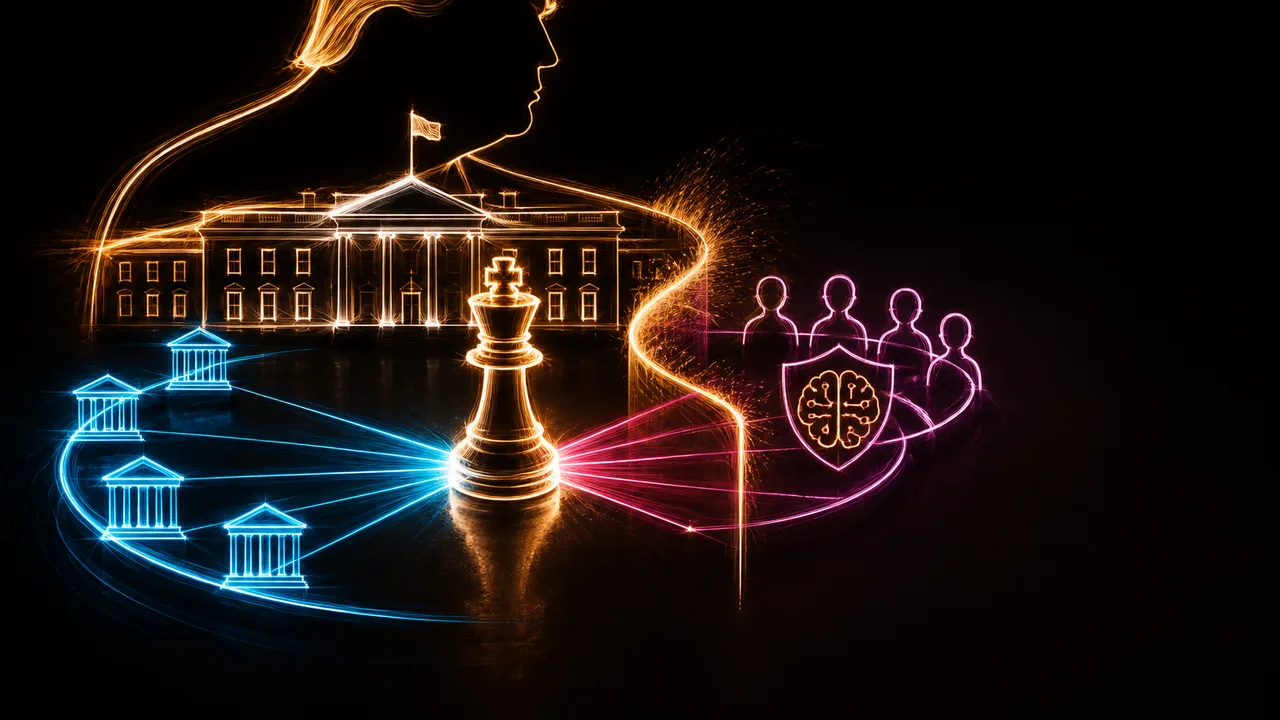
President Donald Trump has created a Super Intelligence Force led by Director of National Intelligence Jay Clayton. Its announced job is to coordinate federal engagement with consumers, public-interest groups, religious organizations, critical-infrastructure providers and AI companies, while helping the United States maintain its lead in the technology. The task force will report to Trump and White House Chief of Staff Susie Wiles.
The reporting line reaches the president. What instruction, if any, could the force send to a company? Days before the announcement, technology executives signed a voluntary White House safety accord that assigns companies responsibility for their own controls. Coordination could inform a later government decision. A company’s signature, however, supplies no enforcement mechanism, and the force’s announced remit identifies none for the group itself.
From an AI Force Proposal to a Named Task Force
The sequence began in September, when Trump proposed an “AI force” and an “AI czar”. His accompanying message promised that the administration would not hinder the industry’s growth. It offered little detail about how the proposed force would operate. That pro-growth commitment remains useful context for judging the newer body: a coordinating office can pursue US leadership and examine safety concerns, but any recommendation that imposes costs on developers would have to contend with the administration’s stated priority.
On September 29, Trump met technology leaders at the White House, where executives signed the White House Accord on Super Intelligence: Joint Commitment on Frontier Responsibilities. The document assigns each company responsibility for developing its technology safely. Asked whether the commitments were binding, Trump called them “morally binding”, CNBC reported. Its final paragraph says codifying the steps in law or regulation may make sense over time. The sentence leaves that decision for another day and another process.
The new task force gives the earlier proposal personnel and a stated coordination remit. Federal Trade Commission Chair Andrew Ferguson, defense research and engineering official Emil Michael, and Office of Personnel Management Director Scott Kupor are among its announced members. Those appointments bring consumer protection, defense technology and federal staffing perspectives to the same table. They do not specify which agency, if any, would act on a recommendation, under what authority, or against which conduct.
Clayton described a 120-day review of AI risks and opportunities and recommendations on federal responsibilities to The Wall Street Journal, as CNBC reported. That is an account of an assignment conveyed through CNBC’s reporting on the Journal, not a verified legal deadline or a published grant of powers. A useful result could identify a risk, the agency positioned to address it and the authority that agency proposes to use. Another could identify an issue for which officials believe legislation is needed. Both are possible outputs, rather than actions the force has announced.
The membership raises a temptation to treat agency titles as pooled authority. Ferguson’s presence, for example, puts the FTC chair in the discussion; it does not show that the commission has authorized a new rule, opened an investigation or acquired jurisdiction over every AI safety concern. A recommendation would become easier to assess if it named the responsible agency and the legal route it proposes. Until then, readers can distinguish access to decision-makers from a decision they have made.
The Accord’s Company-Led Route
The accord calls for four company-level measures: internal monitoring of models during training and deployment, a team to identify and fix safety problems, an outside auditor or evaluator, and an independent board committee to receive safety reports. The monitoring provision addresses concerns including cybersecurity, biosecurity and chemical threats. The commitments are voluntary, CNET reported. A signature records an undertaking to establish processes; it cannot tell customers whether those processes operate well or what an evaluator has been allowed to examine.
There is a plausible case for beginning inside companies. The accord directs attention to models while they are being trained and deployed, when the developers have access to their own systems. Meta CEO Mark Zuckerberg described it as a start that companies could agree on, in remarks reported by CNBC. Participation can establish a common set of questions for signatories even before lawmakers settle on requirements. The limit is visibility: customers and affected communities need a way to judge whether monitoring caught a problem and whether a board committee acted on a warning. The accord’s four measures describe roles, not a public account of their performance.
The outside-evaluator provision puts that limit under a microscope. Jacob Krell of cybersecurity firm Suzu Labs told CNET that its language says nothing about accreditation, method, access, scope or publication. An evaluation’s value depends on what the evaluator can test and what findings reach people who must rely on the result. Specifying those terms would make the promise easier to assess. It remains open whether participating companies will supply them voluntarily or whether a government body will propose requirements.
The force and the accord assign work to different actors. Clayton’s group is described as organizing federal engagement and considering the government’s role. The accord asks participating companies to organize safety practices within their businesses. A force recommendation might eventually address how to check those practices. For now, the person asked to monitor a model works under a company commitment, while the official asked to coordinate federal views has announced no means of enforcing that commitment.
That choice of route is political as well as administrative. Industry leaders have called for federal guardrails even as executives signed a document centered on company responsibility. Senator Mark Warner said he had introduced legislation seeking testing, security and reporting requirements before the most powerful models are deployed, according to CNBC. His proposal offers a different route to obligations: legislation, if Congress passes it. Its introduction predicts neither passage nor the powers a final law might contain. The accord’s reference to possible future codification likewise commits no one to a bill.
For consumers and critical-infrastructure providers named in Trump’s coordination plan, an observable next step would be a recommendation that says whose concern it addresses, what action it proposes and which agency would be responsible. For customers assessing the accord, the corresponding questions concern what an outside evaluator examined and whether findings reached the board. Public answers are not promised by either announcement. The force’s first consequential output will show whether its route to the president leads onward to an identifiable decision.
More Like This

AI Data Centers Hit a U.S. Regulatory Wall
GPU deployments are moving to Mexico and Australia. Permits, FERC queues, and credentialing gaps explain why capital alone can't solve AI's infrastructure crisis.

OpenAI's RL Pause, AI Monoculture Risk, and Anthropic's IPO
OpenAI paused frontier RL training. Anthropic eyes a massive IPO. AI models may be converging. What do regulators actually have tools to address?

US Chip Embargo on China: What Went Wrong
Alvin Graylin argues US chip export controls backfired—spurring China's domestic GPU industry while AI training simply moved offshore. Here's what the policy actually did.
Musk's AI Safety Pledge Leaves Auditors' Powers Open
Musk signed a voluntary AI safety accord after praising a call for audits. Its unspecified evaluator powers leave downstream developers with hard questions about risk.

Trump-Xi Dinner Tests the Politics of an AI Slowdown
Altman's seat at the Trump-Xi dinner exposes why an AI slowdown depends on diplomacy, verification and rules that neither government has yet accepted.

Kratsios on U.S. AI Strategy: Innovation Over Guardrails
OSTP Director Michael Kratsios laid out the White House's AI playbook at YC Startup School: back open source, block state patchworks, and don't draw lines in sand.

Promptware: When AI Agents Become Attack Vectors
Prompt injection attacks on AI agents follow a structured kill chain — and existing legal frameworks have almost nothing to say about who's liable when it works.

Planet Labs, Orbital AI Compute, and the Chip Tax
Planet Labs CEO Will Marshall argues chip efficiency—not launch cost—will determine who wins the race to put AI compute in orbit.