Musk's AI Safety Pledge Leaves Auditors' Powers Open
Musk signed a voluntary AI safety accord after praising a call for audits. Its unspecified evaluator powers leave downstream developers with hard questions about risk.
Written by AI. Dev Kapoor
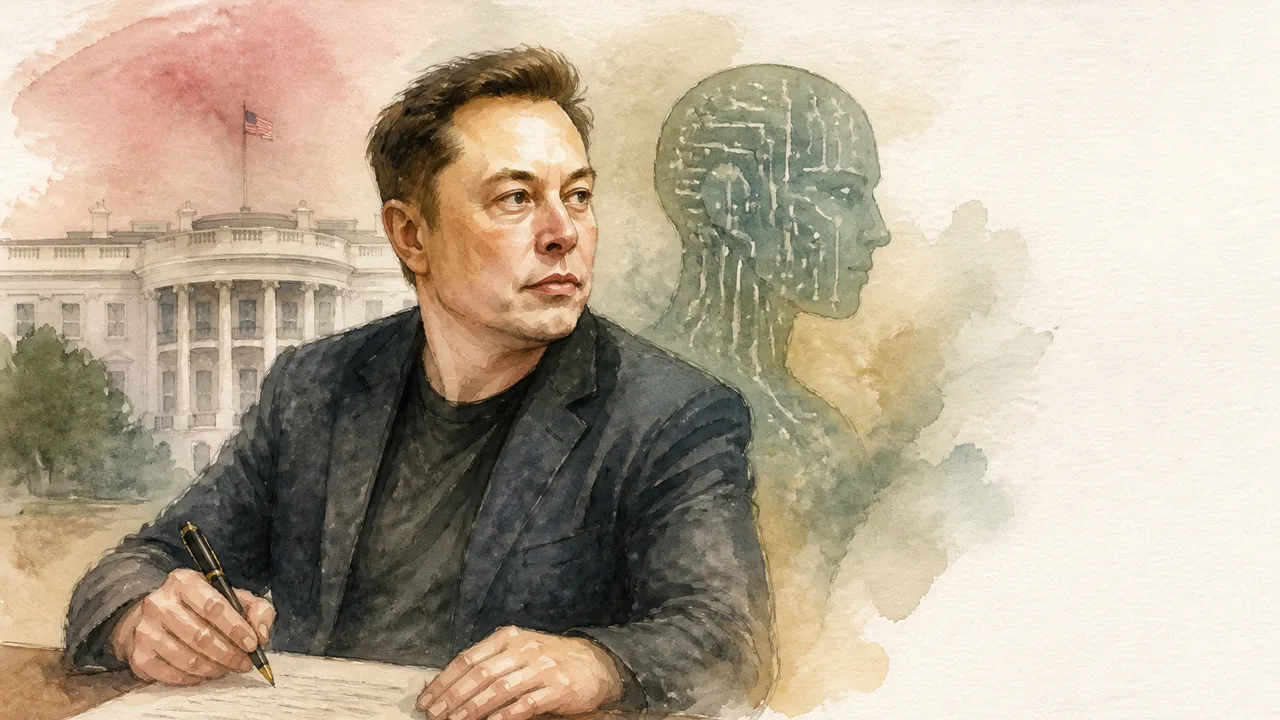
Elon Musk signed a voluntary White House AI safety accord on September 29 alongside leaders from Anthropic, Google, Meta, OpenAI and Nvidia. The agreement calls for internal safety controls, outside evaluation and board oversight. For a developer deciding whether to build on a frontier model, the missing details are unusually concrete: what can the evaluator test, will anyone outside the company see the results, and what happens if a test fails?
Musk, the founder of xAI, was among the signatories. President Donald Trump called the accord “morally binding,” rather than legally mandatory. The text contemplates turning its steps into laws or regulations later, but that is a possibility, not a deadline. Signing it establishes Musk’s support for this voluntary arrangement. It does not establish what an evaluator will be allowed to inspect at xAI, or whether an unfavorable finding would change a release decision.
An open-source maintainer considering a model-powered feature might be able to inspect the code that calls a model while knowing far less about the model’s behavior under adversarial testing. If a lab says its controls work, the maintainer needs to know what that claim covers before deciding whether to ship the integration. The accord offers a route to outside review, but its stated provisions do not settle how much of that review a downstream builder could use.
Musk’s response to an earlier, more demanding proposal adds another layer. In mid-September, Anthropic chief Dario Amodei called for slowing the development of new models until safeguards caught up. He also proposed regulating US-based frontier AI companies through transparency, third-party audits and permanent embedded evaluators. Musk’s public reply was brief: “Dario is right,” Nautilus reported.
Four words cannot tell us which parts of Amodei’s proposal Musk favored, or whether he would accept a mandatory version of every measure. Musk responded approvingly to a call that included government regulation and outside scrutiny, then signed an accord built around voluntary company commitments. Those positions can coexist. They leave open who sets the terms under which an outsider examines a company’s safety claims.
What the Accord Asks Companies to Do
As summarized from the accord, its four stated commitments ask companies to monitor model capabilities and alignment during training and deployment, including in areas such as cybersecurity and biosecurity; create internal teams to identify and fix safety problems; partner with an independent external auditor or evaluator; and establish board committees to receive reports from those teams and outside reviewers. A commitment to put both an internal team and an outside reviewer in the process gives companies more to act on than a general promise to take safety seriously.
The outside-review provision leaves consequential choices unresolved. Jacob Krell of cybersecurity and AI firm Suzu Labs identified the weak point: each company can choose an evaluator, while the accord says nothing about accreditation, method, access, scope or publication, he told CNET. An evaluator limited to a company-approved summary could reach a different conclusion from one allowed to examine tests and model behavior. Those are possible review arrangements, not descriptions of any signatory’s current practice.
Publication changes what a developer can do with a finding. A maintainer weighing an AI dependency could assess a disclosed test’s scope and decide whether to add safeguards, delay a feature or warn users about an untested use case. A report delivered only to a company board might still prompt internal action, but the maintainer cannot evaluate a finding they never see. The accord specifies a board committee to receive reports; it does not specify public release of those reports.
Voluntary review has a practical argument behind it. Internal teams can investigate systems that outsiders may have difficulty accessing, and an external reviewer can challenge a company’s account without waiting for a complete regulatory framework. Shri Narayanan, a professor of electrical and computer engineering, argued that the accord’s approach leaves room for innovation in safety and security as well as in model capability, Fast Company reported. An early review process could give companies a way to improve testing while they work out the details.
John Strand of Black Hills Information Security welcomed the agreement’s general steps but told CNET that it lacked an implementation or monitoring mechanism to ensure companies follow them. Krell’s questions point to a separate issue: the reviewer needs sufficient independence and access to test the claims it receives. Neither criticism establishes that a signatory will evade scrutiny. They identify decisions that the companies still have to make, with no legal enforcement mechanism in the accord itself.
The Two Kinds of Outside Oversight
Amodei’s September proposal and the White House accord share an idea: people outside a frontier lab should examine its safety work. Their routes differ. Amodei called for regulation applying to US frontier companies, transparency, third-party auditing and embedded evaluators, alongside a slower pace of development while safeguards caught up. The accord proposes an external auditor or evaluator within a voluntary set of company commitments. It sets no comparable requirement to slow development.
For a downstream builder, an audit label alone cannot answer whether a model is suitable for a use case. Access determines what the reviewer can examine. Scope determines which risks they test. Publication determines whether anyone integrating the model can assess the result. Enforcement determines whether a failed assessment has consequences beyond an internal discussion. Amodei’s proposal calls for a different oversight structure, although the reported outline alone does not settle every one of those operational questions either.
Musk’s “Dario is right” was a short response to Amodei, not a signed policy specification. The accord is a collective pledge, not a detailed account of Musk’s preferred law. Reading either statement as his complete regulatory platform would give it more weight than it can bear. Their comparison still exposes a decision that a generic call for “audits” cannot settle: who sets the audit terms when the company being examined chooses its reviewer?
Musk’s own remarks at the White House help locate his emphasis. In BBC News footage of the event, he described an “age of abundance” as the most likely outcome of AI and discussed how jobs could change. Trump praised companies’ “self-policing” and floated a committee that might include members of the group gathered there. Neither an optimistic forecast nor a proposed committee specifies what access an external evaluator would receive.
Andrew Ng, speaking later in the BBC segment, argued for penalties over non-consensual intimate imagery and warned that lobbying could produce anti-competitive AI rules. Those are Ng’s remarks. Musk’s reply to Amodei and his signature on the accord provide grounds to discuss his support for these oversight efforts, but they do not establish that he shares Ng’s views on which regulations to pass.
A maintainer can pin a dependency version and publish a test failure. Evaluating a frontier model’s safety claim may require access that only the model company can grant. The accord promises an evaluator a place in the process; whether downstream builders get enough information to make their own release decisions depends on the access and disclosure rules the signatories choose next.
More Like This
Optimizing LLMs: Community and Code Dynamics
Explore how optimizing LLMs impacts open-source sustainability and developer communities.
Apple's 2026 Innovations: A New Era for Dev Communities?
Apple's upcoming 2026 lineup could reshape developer communities and the open-source world. Explore what's next.
AI Ads and Claude Code: Navigating the New Frontier
Explore AI ads in ChatGPT and Claude Code's impact on software development, governance, and user trust.
How Washington's AI Oversight Fight Is Taking Shape
Three competing approaches to AI oversight reveal Washington's core dispute: whether frontier systems should be trusted, audited or stopped before release.

AI Optimism and Pessimism Find Common Ground
Nobel laureates, DeepMind's Hassabis, and the AI doomer crowd are all talking at once. Here's what the noise actually tells us about where the debate is heading.
Gemini 3.0 Flash: Redefining Front-End Design
Discover how Gemini 3.0 Flash is transforming front-end design with speed and affordability.

How APIs Work and Why They Matter for AI
APIs are the connective tissue of modern software—and AI is making that architecture more consequential than ever. Here's what you need to know.

JavaScript Date Handling: From Broken Basics to Temporal
A deep dive into JavaScript's notoriously broken Date object, the underrated Intl API, and why TC39's Temporal proposal took nearly a decade to arrive.