Trump's Space Academy: Where NASA Ends and the Military Begins
An executive order creating a U.S. Space Academy sounds like a training win. The open questions about governance, funding and civilian control are harder.

Written by AI. Amelia Nwofor

President Trump signed an executive order in late August 2026 directing the creation of a U.S. Space Academy, a new institution intended to train future NASA leaders, according to NASA's own news release. The announcement, timed alongside a ceremony honoring the Artemis astronauts, landed as good news in most coverage. Ars Technica and AeroTime both reported the academy would be led by NASA, and BGR framed it as a workforce pipeline story: more engineers, clearer career paths, a bigger bench for the space economy.
The more complicated reading came from an expert op-ed carried by space.com, which argues the proposal could blur the line between NASA and the armed forces. That argument deserves a careful hearing, and so does the case for the academy. Both rest on the same fact: an institution's mission is defined less by its name than by its governance.
What the Order Actually Does
Here is the first thing to check, and the record on it is thin. An executive order is a direction, not a building. It does not appropriate money, and Congress holds the purse. Nothing in the available reporting indicates a site, a budget, a curriculum, or an enrollment target has been settled. Ars Technica's framing was pointed: "here's what we know," and much of what follows in such coverage is what remains unknown. Readers should treat the academy as proposed infrastructure until an authorization bill moves and appropriations follow.
That distinction matters for every question below. A governance sketch on paper can be designed well or badly; the design is still negotiable.
The Case for a Dedicated Academy
The strongest version of the pro-academy argument is straightforward. The United States already builds service academies for the Army, Navy, Air Force, Coast Guard, and Merchant Marine, and those institutions have done two things well for over a century: they produce trained officers on a predictable timeline, and they create a shared professional identity across cohorts. If space is now a permanent domain of national activity, the argument runs, it deserves the same kind of dedicated institution.
There is a workforce case too. NASA's astronaut corps is tiny, and the broader space economy has grown faster than the education pipelines feeding it. A single institution with clear admissions criteria, federal funding, and guaranteed career pathways could pull students who currently face a vague path of "get an engineering degree, then hope." The existing military academies graduate roughly 4,000 officers a year combined; a space-focused analogue, even at modest scale, would be a real addition to technical education.
The civilian framing in the executive order, with NASA in the lead, also gives the academy a defined institutional parent. NASA has run cooperative education programs and university partnerships for decades. Extending that model into a degree-granting academy is an evolution, not a rupture.
The Case for Worry
The space.com op-ed's core concern is institutional fusion: a school connected to national space ambitions could normalize the merger of civilian exploration with defense priorities. The history here is the evidence base. NASA was created in 1958 explicitly as a civilian agency, partly so that American space activity would be legible to the world as peaceful. The Space Act that founded it requires NASA to devote itself to peaceful purposes. For nearly seventy years, that civil-military separation has been a design feature of U.S. space policy, tested but never abandoned.
The op-ed, as the brief and the piece itself make clear, is policy analysis rather than an assessment of an enacted program. Its questions, though, are the right ones, and they can be stated concretely:
- Who commands the graduates? If the academy produces military officers, they will serve under the Space Force and related commands. If it produces civilians, they serve NASA. If it produces both, the institution needs two distinct tracks with different obligations, and the reporting so far does not describe one.
- Who sets the curriculum? A NASA-led academy teaching orbital mechanics is unremarkable. A NASA-led academy whose curriculum is shaped by military requirements starts to look like something else, and the difference lives in the fine print of whatever charter emerges.
- What happens to open research? NASA's science output depends on publication and international collaboration. Military education operates under classification norms. A hybrid institution has to choose, and the choice affects far more people than its own students.
- Where does international partnership fit? The Artemis program depends on treaties and partner agencies. Partner nations watch how the United States trains its space leadership, and an academy that reads as a defense institution complicates the cooperation NASA's own programs rely on.
The Middle of the Terrain
The binary framing of the coverage, academy as opportunity versus academy as militarization, flattens some real middle ground. The United States Air Force Academy houses extensive classified research, but the Naval Academy and Coast Guard Academy coexist with civilian maritime institutions, and the Merchant Marine Academy graduates civilians who can be commissioned in wartime. Precedent exists for service academies that serve mixed civil and defense functions without collapsing the distinction.
The comparison cuts the other way too. The Merchant Marine Academy is a useful caution: an institution with a dual identity spends real energy managing the tension between its commercial-civilian mission and its military readiness role. Dual-mission schools work, but they do not make the tension disappear. They manage it, continuously, through governance choices.
What Would Actually Settle the Questions
If you want to evaluate this proposal without waiting for the outcome, watch for five things, in roughly this order:
- Congressional authorization. An executive order can create a task force; only Congress can create a service academy on the model of the existing five. Watch for a bill, and watch who sponsors it.
- The funding line. Where the money appears in the budget tells you who controls the institution. A NASA appropriation and a Defense Department appropriation produce very different academies.
- The charter language. The statute should state whether graduates take civilian or military obligations, and whether the curriculum is governed by NASA, by a board, or jointly.
- Research and publication policy. Any commitment to open science, export-control boundaries, and classification rules will be written here or nowhere.
- Admissions structure. Congressional nominations shape the service academies; a different mechanism would signal a different kind of institution.
Why This Story is Bigger than One School
The academy proposal arrives at a moment when the civil-military boundary in space is under pressure from every direction: commercial launch providers selling to both NASA and the Pentagon, growing counterspace capabilities abroad, and a Lunar program whose logistics increasingly overlap with national security interests in cislunar space. Against that backdrop, a new institution is a small thing with symbolic weight out of proportion to its size. Institutions teach the next generation what the field is for. The question the op-ed raises, and the question Congress should press, is what the first class of a U.S. Space Academy would be taught about who their work belongs to.
The record so far consists of one executive order, a handful of news reports, and one op-ed's concerns. None of the hard decisions have been made. That is precisely why the moment matters: the governance choices are still open, and the people who pay attention now will be the ones who can judge, in three or four years, whether the academy that emerges kept NASA's civilian character or let it erode by increments.
By Amelia Nwofor, Science Desk Editor
More Like This
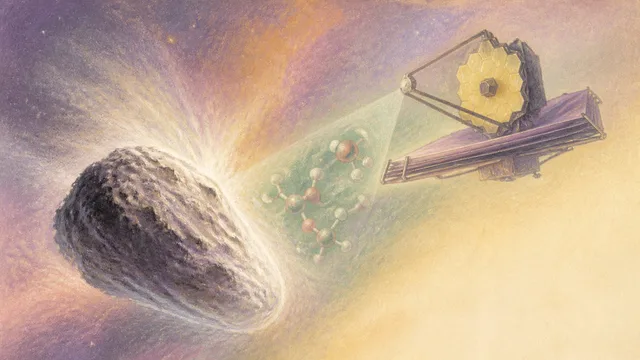
Webb Detects Methane on Interstellar Comet 3I/ATLAS
Webb's MIRI instrument detected methane on interstellar comet 3I/ATLAS after perihelion—a timing that hints at buried volatile layers from another planetary system.
Exploring the Enigma of Negative Time in Quantum Physics
Dive into the perplexing world of negative time in quantum physics with insights from Prof. Aephraim Steinberg.

Kirchhoff's Circuit Laws: A Student's Rules That Held Up for 180 Years
In 1845 a 21-year-old student wrote two circuit rules. Twenty years later, Maxwell's equations revealed they were conservation laws all along.
Leadership and Legacy: The ISS Change of Command
Explore the symbolic ISS Change of Command, highlighting international cooperation and leadership in space.

Anil Menon Reaches the ISS on His First Spaceflight
NASA astronaut Anil Menon launched to the ISS on July 14 aboard Soyuz MS-29. His eight-month mission raises questions about what space cooperation looks like next.
NASA's Crew-12 Mission: A Leap Towards Mars
Crew-12 mission advances space exploration, featuring ISS experiments and spacecraft upgrades for future Mars missions.

How Newton Calculated Pi With Calculus
Newton didn't set out to calculate pi—he built a universal method for finding areas under curves. Pi was just what came out when he tested it on a circle.
Neil Armstrong: The Reluctant Hero of Apollo 11
Neil Armstrong flew 78 combat missions, survived two near-fatal crashes, and walked on the moon—then spent the rest of his life insisting it was all just luck.