Troy Was Real — But Not How Homer Told It
Hittite cuneiform tablets and Bronze Age archaeology suggest a real conflict at Troy — one far stranger and more geopolitically tangled than the Iliad admits.

Written by AI. Helen Papadopoulos
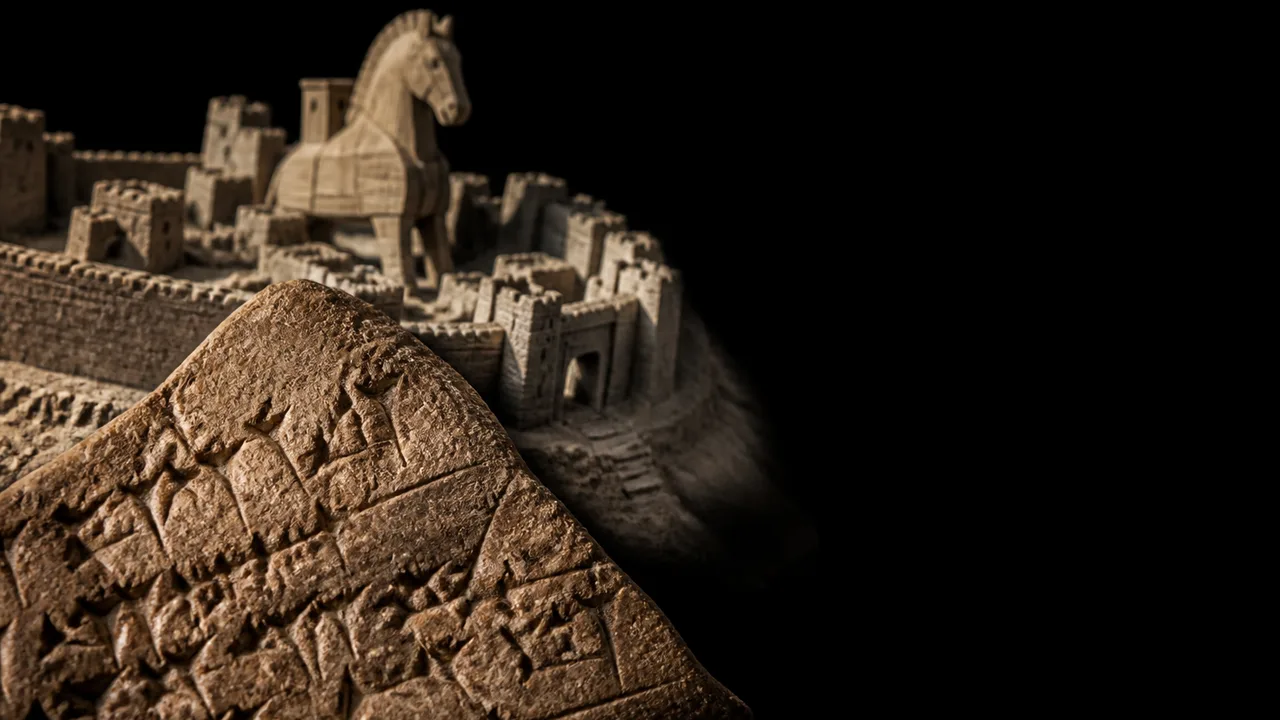
Photo: AI. Pippa Whitfield
The question of whether the Trojan War actually happened is, by now, almost the wrong question. What the archaeology and the Hittite cuneiform record together suggest is stranger and more instructive than a simple yes or no: there were probably multiple wars at Troy, fought over decades by powers whose names Homer either scrambled beyond recognition or omitted entirely. The Greeks remembered a war. What they forgot — or never knew — was that one of history's great empires was the other major player in it, and that empire doesn't appear anywhere in the Iliad.
That empire was the Hittites. And their absence from Homer is, in its way, the most interesting thing about the whole puzzle.
The City Beneath the City Beneath the City
Before any of the geopolitics can land, the site itself needs establishing. Hisarlik, in northwestern Turkey near the mouth of the Dardanelles, was identified throughout the 19th century as the probable location of ancient Troy. Heinrich Schliemann's excavations from 1870 to 1890 confirmed the presence of an imposing Bronze Age fortified citadel — though Schliemann, impatient and dynamite-happy, destroyed a substantial portion of what he was trying to find. His colleague Wilhelm Dörpfeld identified ten or more distinct settlement layers at the site; later work by Carl Blegen and subsequent excavators refined the stratigraphy considerably.
The layers most relevant to any historical Trojan War are Troy 6 (roughly 1750–1300 BC) and Troy 7A (1300–1180 BC). Modern scholarly consensus, as History Time's Pete Kelly notes in his recent documentary treatment of the subject, generally treats these as a continuous site: "modern scholarly consensus generally holds that these two represent a single archaeological site with the sub-layer of Troy 7A being a more well-fortified continuation of Troy 6." Troy 6 was the wealthier, grander city; Troy 7A shows the archaeology of a community bracing for violence — denser housing within the walls, repaved gates, improved drainage, reinforced towers. Someone at Hisarlik, across the 13th century BC, was expecting a siege.
Eratosthenes, the 3rd-century BC polymath who also correctly calculated the Earth's circumference, placed the fall of Troy at 1184 BC. The archaeological destruction of Troy 7A is dated to around 1180 BC. That correspondence is striking enough to take seriously.
What the Greeks Didn't Write Down
Here is where the frustration sets in. The Mycenaean Greeks of the late Bronze Age had a writing system — Linear B, a syllabic script deciphered in 1952 by Michael Ventris. Scholars have recovered more than 5,000 Linear B tablets from sites including Knossos, Pylos, and Mycenae. Not one of them names a Mycenaean king. Not one mentions Troy or Ilion by name. The tablets are, almost exclusively, palace administrative records: grain inventories, bronze rations, livestock tallies. As Kelly drily observes, the Greeks "used their writing system to account for the production and distribution of goods and materials by the palatial centers. It did not record the political situation of the time."
The Greeks, in other words, had writing but no history — at least none that survived. For the political and military story of the late Bronze Age Aegean, we have to go east.
Enter the Hittites
The Hittite Empire, centered on their capital Hattusa in the Anatolian highlands, was one of the great powers of the ancient Near East — rivals to Egypt and Babylon, correspondents of pharaohs, rulers of a vast cuneiform archive that modern archaeology has been slowly decoding since the early 20th century. And in those tablets, Troy appears. Not as Troy or Ilion, but as Wilusa — a prominent kingdom in northwestern Anatolia that the Hittites tracked closely, negotiated with, occasionally warred over, and eventually made a vassal state.
The identification of Wilusa with Troy/Ilion is not universally settled, but it commands broad scholarly acceptance. The geographic fit is strong. And the name Ilion itself may be embedded in Wilusa — the "W" being a digamma, an archaic Greek letter that had dropped out of use by Homer's time, which would render Wilusa as something like Ilusa or Ilion.
The Hittite records reveal a Wilusa that was anything but a backwater. It sat at the strategic junction between the Aegean and the Black Sea, controlled major trade routes, and found itself caught between two expanding powers: the Hittites pressing westward from the Anatolian plateau, and the Mycenaean Greeks — whom the Hittites called Ahhiyawa — pushing eastward from the Aegean coast and islands.
A King Named Alaksandu
One of the most arresting documents in this whole archive is what scholars call the Alaksandu Treaty, drawn up between the Hittite king Muwatalli II and a king of Wilusa named Alaksandu. The treaty made Wilusa a Hittite vassal, obligating it to supply troops to Hatti in wartime. The Hittite king, in return, guaranteed Alaksandu's throne against internal and external threats — including, in a remarkable passage, protecting the succession rights of Alaksandu's designated heir even if that child was born of a concubine and the population rejected him.
The name Alaksandu is a Hittite rendering of an apparently Greek name: Alexandros. Which is the alternative name of the Trojan prince Paris in Homer's Iliad. Paris-Alexandros, son of Priam, the man who started the whole war by taking Helen from Sparta. The coincidence — if it is one — is the kind that makes historians sit very still for a moment.
This doesn't mean Alaksandu of Wilusa is Paris of Troy. The names are linguistically related but the figures are separated by at least half a century and the Hittite king appears to protect Alaksandu's rule rather than fight against it. But it suggests that something real was being half-remembered, garbled across four centuries of oral transmission, when Homer composed his epic.
The War the Hittites Recorded
The so-called Tawagalawa Letter, dated to around 1250 BC and believed to be authored by Hattusili III, contains the most direct reference to an actual military confrontation over Wilusa. Written by the Hittite king to his Ahhiyawan counterpart, it refers to "the matter of the land of Wilusa concerning which he and I were hostile to one another and we have made peace." A real conflict over Troy, between the Mycenaean Greeks and the Hittite Empire — settled diplomatically, at the level of great kings, sometime around the mid-13th century BC.
Herodotus placed the Trojan War at approximately 1250 BC. The correspondence is again uncomfortable to dismiss.
And yet the Hittite record creates as many puzzles as it resolves. The city of Wilusa continued to exist after this mid-13th century conflict. Subsequent Trojan kings appear in the Hittite archive. One of them, Walmu, was deposed by an unnamed "evil one" and needed Hittite military assistance to be restored — a political drama with its own faint echoes of Homeric narrative (a king displaced, powerful outsiders taking sides). Meanwhile, a Hittite text from Tudhaliya IV's reign lists the great kings of the known world — Egypt, Babylonia, Assyria, Ahhiyawa — but then has the word Ahhiyawa scratched out by royal scribes, apparently reflecting a reassessment: by the later 13th century, the Mycenaeans no longer rated as a great power in Hittite eyes.
The Greeks were losing their grip on western Anatolia. The Hittites were overstretched. Troy sat between them, fortifying its walls, packing its houses tight against the citadel, waiting.
The Silence at the End
Around 1180 BC, the silence arrives for everyone at once. Hattusa was sacked and burned; the Hittite Empire ceased to exist as a political entity. Pylos was destroyed, its Linear B tablets preserving last-minute emergency preparations against an attack from the sea — preparations that failed. Mycenae, Tiryns, Thebes, all suffered severe damage. And Troy 7A was sacked, burned, and finished as a significant power.
The Medinet Habu inscription of Ramesses III records a seaborne coalition — the "Sea Peoples" — sweeping through the eastern Mediterranean, destroying Hatti and Alashia (Cyprus) and eventually attacking Egypt. Whether any of these groups included Mycenaean Greeks remains debated; some scholars read the Egyptian term Ekwesh as Ahhiyawans. The evidence is suggestive but not conclusive.
What is certain is that the entire Bronze Age world unraveled within a few decades. Troy fell with it. The Mycenaeans fell too, perhaps shortly before or shortly after, the causal sequence still genuinely unclear to modern scholarship.
Homer composed the Iliad — or the oral traditions that crystallized into it — roughly four centuries after all of this. He remembered a coalition of Greek warriors, a fortified city across the Aegean, a war that lasted ten years, and a burning. He forgot — because his world had forgotten — that the Hittite Empire had existed at all. Memory of them was apparently total: not a single Greek or Roman source names the Hittites. An entire civilization erased from cultural memory so completely that their rediscovery in the early 20th century, from their own archives, came as a genuine shock to the scholarly world.
The Iliad is not a history. But it may be the echo of several histories, compressed and mythologized across four centuries of darkness, stripped of their geopolitical context, and rebuilt around the logic of gods and heroes because that was the only framework that survived. Paris didn't steal Helen; Mycenaean war bands made repeated aggressive incursions into northwestern Anatolia against a city that was also a Hittite vassal. It's less poetic but considerably more interesting — and the walls at Hisarlik, thickened against a siege that archaeology confirms eventually came, are still there to be read.
More Like This
WW1 Trench Life: What the Western Front Was Really Like
From Pals' Battalions to the Vickers gun, a new documentary unpacks the grim machinery of survival on the WW1 Western Front in unflinching detail.

Common History Myths That Schools Still Teach
From Napoleon's height to Viking helmets, a new video maps the historical myths that textbooks kept alive—and asks why bad history is so hard to dislodge.
Asherah: Was She the Wife of the God of Israel?
Inscriptions, figurines, and Ugaritic myth suggest ancient Israelites worshipped a goddess alongside Yahweh. The evidence is real. The debate is very much alive.
Waco Siege: Ancient Echoes in Modern Tragedy
Explore the 1993 Waco siege through the lens of ancient cult dynamics and modern law enforcement challenges.
Christopher Nolan's The Odyssey: Epic Ambition Meets Ancient Text
Christopher Nolan adapts Homer's Odyssey with Matt Damon as Odysseus. Here's what the project signals about Hollywood ambition, classical storytelling, and the director's arc.
Homer's Odyssey and Mycenaean Religion: Fact vs. Myth
Homer set the Odyssey in the Bronze Age but wrote it 500 years later. How accurate is his religion? Linear B tablets reveal a startling gap.
Pliny the Younger's Letters on the Eruption of Vesuvius
Pliny the Younger's two letters to Tacitus remain the only eyewitness account of Vesuvius's eruption in 79 AD — and they still read like dispatches from the end of the world.
How the Square Root of 2 Shook Ancient Greek Mathematics
The Pythagoreans believed whole numbers governed all of reality. One diagonal line—and one brave mathematician—proved them catastrophically wrong.