Traveling in Iraq: What American Tourists Find There
Drew Binsky's seven-day Iraq trip with his wife challenges the country's war-zone image—but the full picture is more layered than any single video can capture.

Written by AI. Mariel Fontaine
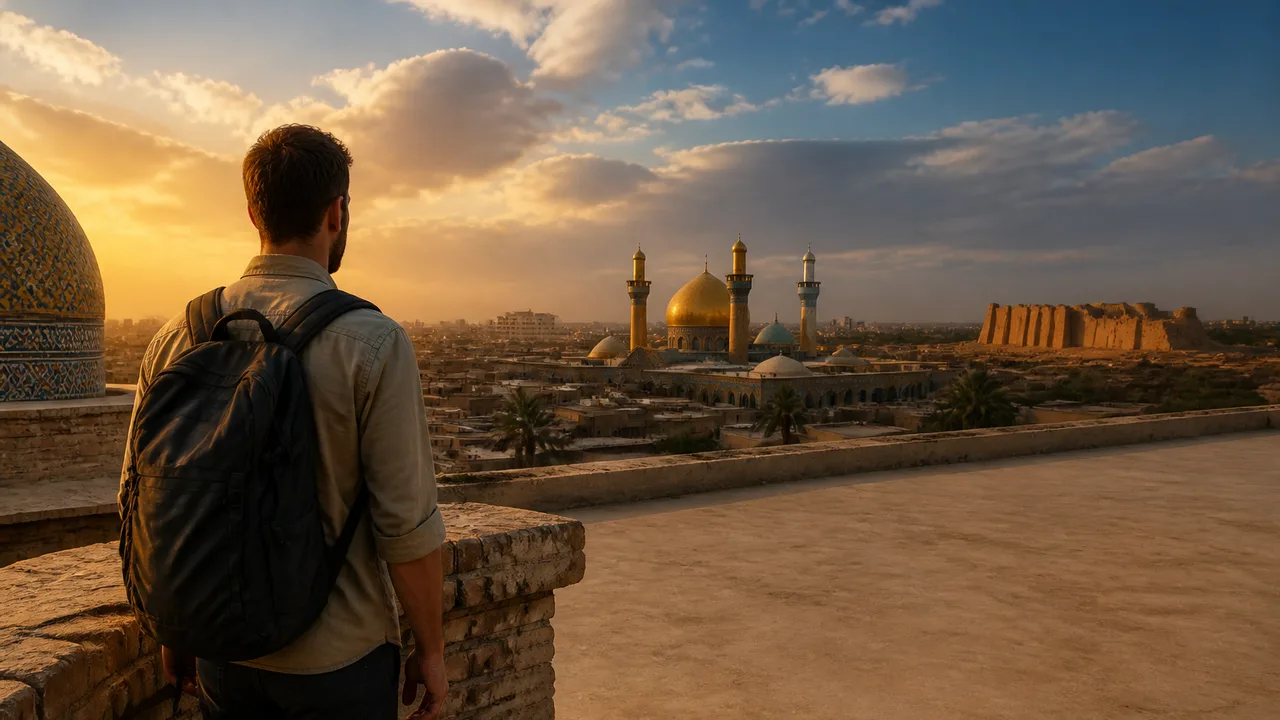
Photo: AI. Asha Kingsley
The country most Westerners picture when they hear "Iraq" is assembled almost entirely from news footage: smoke columns over Baghdad, checkpoint barriers, the rubble of Mosul. That image has a long half-life. It also has a specific geography—conflict reporting concentrates where conflict is most active, which is not evenly distributed across a country the size of California. What Drew Binsky and his wife Diana set out to do in a recent 32-minute documentary is document what the rest of Iraq looks like when you actually walk into it.
Their route covered Baghdad's old town, a road trip south to the ancient ruins of Babylon, and then onward to Karbala—the epicenter of Shia pilgrimage, which draws more than 50 million visitors annually and carries its own security architecture. The framing, made explicit from the opening, is corrective: the video exists to challenge the dominant Western perception of Iraq as uniformly dangerous. That framing is worth holding onto, because it shapes everything Binsky chooses to include and, inevitably, what he doesn't.
What the streets of Baghdad actually looked like
The footage from Baghdad's old town is genuinely striking—not because it depicts a peaceable kingdom, but because it depicts something far more recognizable than the average Western viewer expects. Ten million people live in this city. The copper market has artisans who have been working the same trade for 45 years. Cafes have maintained the same clientele across three generations. A man sells DVDs on the street from a business that started with cassette tapes in the 1980s and never quite pivoted away from physical media. That last detail is either poignant or grimly practical depending on your read—probably both.
Binsky's local guide, Barakhan, who describes himself as a traveler holding "the world's worst passport" and has visited 70 countries on an Iraqi document, functions as the video's most valuable voice. His mission, stated plainly, is "breaking stereotypes about Iraq." That agenda makes him a useful guide and a partial one simultaneously. He knows exactly what he wants visitors to see, and his curation is genuine if not comprehensive.
The old Jewish quarter of Baghdad is one of the video's more quietly significant stops. Barakhan explains that Baghdad's Jewish community departed in the 1950s and 1960s, leaving behind buildings that were respected and left untouched—and therefore left to deteriorate. Some have recently been renovated. It is a small, textured detail about a city that contains enormous amounts of history in a very small space, and it is the kind of thing you only encounter by actually being there with someone who knows it.
The gap between perception and ground truth—and why it's complicated
One of the sharpest exchanges in the video comes from a young Baghdadi named Osama, encountered on the street while holding a rose he'd picked from somewhere nearby. Asked about safety, he frames the change in generational terms: "I remember growing up thinking how the news would be boring in different countries because they didn't have all the drama that we had." He is describing a childhood of daily explosions and deaths as something now, mercifully, receding. That is not the same as saying the danger is gone.
Binsky himself offers a useful data point almost in passing: on a previous visit, he filmed at a market that was bombed the following day. Barakhan quickly adds, "But that was actually the last bombing." This exchange gets dropped and the tour moves on. A journalist covering Iraq's security situation would dwell on it longer. A travel vlogger cannot—the genre has different obligations—but readers should register it for what it is: a reminder that the trajectory is positive without being linear, and that "much safer" and "safe" are not interchangeable descriptions.
The US State Department currently rates Iraq at Level 3: Reconsider Travel, citing terrorism, kidnapping, and armed conflict as active concerns. That rating applies to the entire country, which includes areas that genuinely remain dangerous—parts of the north, border regions, and locations with ongoing militia activity. Baghdad and the southern religious cities operate under different security conditions than those zones, but they are all technically Iraq, and a travel decision requires knowing the difference.
Babylon, and what it costs to have no tourists
The Babylon sequence is the emotional center of the video, and the most thought-provoking from a tourism economics standpoint. The ruins are original, dating back 2,600 years. Hammurabi's civilization lies approximately ten feet beneath the visible surface, according to a guide on-site. Alexander the Great lived and died within these walls. The Babylonians, Binsky notes, gave humanity the 60-minute hour, the seven-day week, and some of the earliest maps ever produced.
And there is almost no one there.
"If this place was in Rome," Binsky observes, "it'd be busier than the Vatican. They'd be making millions of dollars a day." The absence of tourists is framed as sad, and it is—but it is also economically diagnostic. Heritage tourism in unstable or perception-damaged regions tends to arrive in waves after stability is established, not during the establishment of that stability. Iraq's challenge is that the reputational damage from two decades of conflict lingers long after security conditions improve in key areas. The country lacks both the infrastructure to handle a surge in visitors and the visitor base that would justify building that infrastructure. It is a coordination problem with real costs: the artisans, the guides, the site custodians, the restaurants in what was once Saddam Hussein's grand riverside palace—all of them benefit from visitors, and visitors remain extremely rare.
The Saddam palace detail deserves more attention than it gets. Binsky and Diana eat lunch there; it has been converted into a restaurant complex with river views. What strikes me is the description Barakhan gives of what it meant to live near that palace under the old regime: "Even passing by this palace, we couldn't point to the wall. Imagine. And now we are sitting here eating lunch. You see within 30 years how things change."
That is not a small thing. It is exactly the kind of structural change that does not translate into news coverage but fundamentally alters what daily life feels like.
Karbala and the limits of a single frame
The final leg of the journey—Karbala—operates under different logic from everything that came before. This is not tourism in any conventional sense; it is pilgrimage infrastructure scaled to extraordinary numbers. Over 20 million people attend the annual Arbaeen commemoration at the shrine of Imam Hussein, grandson of the Prophet Muhammad, making it arguably the largest annual human gathering in the world. The security presence Binsky describes on the road south is heavy and deliberate: Karbala has been a target for sectarian violence, and the protective apparatus around it reflects that history.
What Binsky finds inside the shrine—the architecture, the collective grief, the strangers feeding other strangers on the floor—is exactly what Karbala's reputation among Shia Muslims suggests it would be. He is Jewish, he notes without drama, and he finds the experience among the most spiritually affecting of his travels. That observation lands cleanly. There is no conflict in it. It is simply a person encountering something larger than the category he brought with him.
What one video can and cannot settle
Binsky concludes that "the world is far safer, far kinder, and far more hospitable than the headlines make it seem." That is likely true in the aggregate, and Iraq is a reasonable example of a place where the gap between media image and street-level reality is genuinely enormous. The hospitality documented throughout—strangers offering perfume as gifts, a tuk-tuk driver pulling over at an intersection to buy water for passengers and refusing payment, a man handing over his single rose—reads as culturally authentic rather than performed for the camera.
But the honest version of this story holds two things at once: the image of Iraq in the Western imagination is badly distorted by decades of crisis coverage, and Iraq remains a country with active security considerations that vary significantly by region and require genuine research before travel. Those two facts are not in tension with each other. The first one being true does not make the second one irrelevant.
The more interesting question, which Binsky's video opens without quite pursuing, is what changes first: the reality on the ground, or the perception that keeps people away and therefore slows the economic development that makes continued stability more likely. Iraq's tourism infrastructure is nascent by any measure. Babylon has no souvenir shop worth mentioning and no crowds to justify one. The question of whether cautious travelers or the travel industry should move first is one that every destination emerging from conflict has had to answer—and the answer usually involves more risk than the cautious side of that ledger would prefer.
More Like This
Navigating India's Treacherous Roads Amid Landslides
Explore the risks and resilience on India's roads as travelers face life-threatening landslides in the Himalayas.
Air New Zealand's Business Class Dilemma
Air New Zealand's new business class faces criticism for its lack of privacy and direct aisle access, raising questions about its competitive edge.
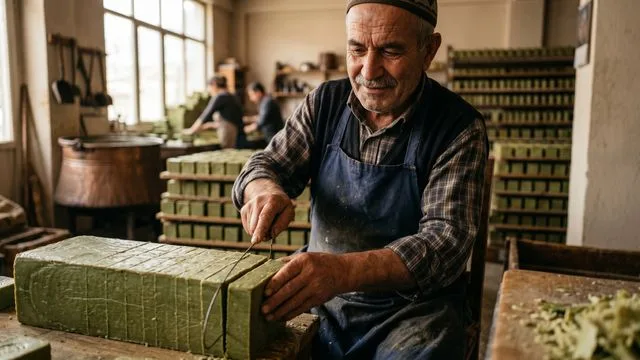
Turkey's Olive Oil Soap Maker Bets on Patience
Doktoroğlu Soaps makes 8 million bars a year the old way. The real story is what a year-long production cycle does to your cash flow—and your nerve.
California's "Don't Stop" Towns Have a Deeper Story
A viral video warns drivers not to stop in 12 California towns. The crime stats are real. So is everything the warning leaves out about the people who live there.
California's Most Remarkable Abandoned Places
From a concrete ship with a dance floor to nuclear missile bunkers beneath a tourist park, California's abandoned places hold stories the state never bothered to tell.
Dubai's Crisis Has a Worker Problem No One's Covering
Dubai's economic model was built on migrant labor with almost no rights. Now, with airstrikes and a blockaded strait, those workers face the worst of the fallout.
JetBlue Buys Spirit's LaGuardia Slots for $58.5M
JetBlue won 22 Spirit Airlines LaGuardia slots for $58.5M. Here's what it means for fares, Frontier, and travelers who depended on cheap Northeast flights.
Everyday Prices in Poland: What Tourists Should Know
A look at everyday goods prices in Poland compared to the US, what Krakow's costs reveal, and what travelers miss when they budget by hotel rates alone.