TimescaleDB: Extending PostgreSQL for Time Series Data
TimescaleDB turns PostgreSQL into a time series engine—but there's a licensing shift you should know about before committing to production.

Written by AI. Dev Kapoor
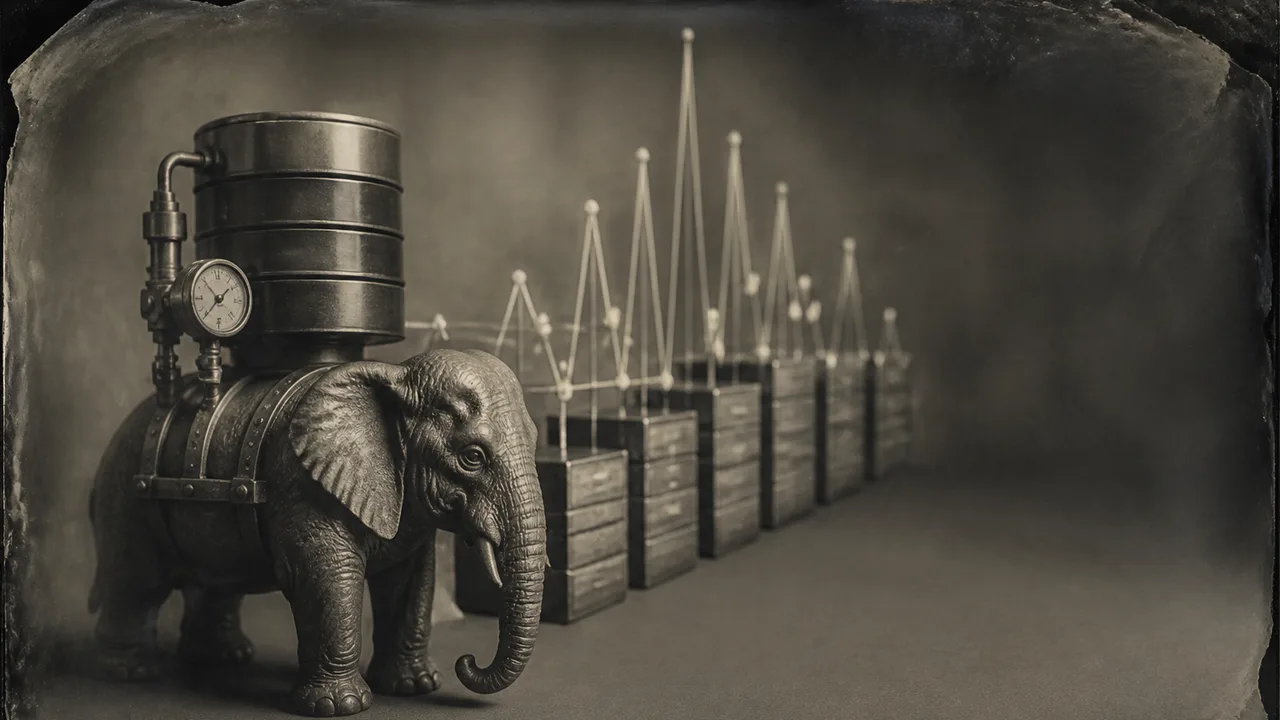
Photo: AI. Otieno Okello
There's a particular flavor of engineering hubris that trips up a lot of developers, and The Coding Gopher names it cleanly at the top of his recent video: "I treated PostgreSQL as the ultimate all-in-one database... I figured if it could handle that, it could handle literally anything."
It's an honest confession. Postgres earns that overconfidence. Strict ACID compliance, multi-version concurrency control, write-ahead logging — as a foundation for relational data, it's genuinely hard to beat. The problem isn't Postgres. The problem is the assumption that excellence in one domain translates to universality. It doesn't, and time series workloads are where that assumption gets expensive.
The B-Tree Cliff
To understand why vanilla Postgres struggles with high-frequency data ingestion, you need to understand how it manages indexes. Every insert updates a B-tree index, which offers O(log n) search complexity — fast and elegant, until scale turns it into a liability.
Imagine you're tracking thousands of IoT sensor readings per second across a fleet of devices. As your table grows into hundreds of millions of rows, the B-tree index tracking all that data grows with it. Eventually it no longer fits in RAM. At that point, the OS starts swapping memory pages to disk, and what the video describes as "the B-tree cliff" kicks in: your database starts thrashing disk on basic index lookups, queries that ran in milliseconds now take minutes, and someone's getting paged at 3 a.m. The video is deliberately dramatic about the degradation, and the underlying mechanism it describes is accurate — this is a well-documented failure mode for write-heavy, append-mostly workloads in standard relational databases.
The traditional answer was to migrate to a purpose-built NoSQL time series database, rewrite your queries, and wave goodbye to joins and ACID guarantees. TimescaleDB's pitch is that you shouldn't have to make that trade.
What Hypertables Actually Do
TimescaleDB is a Postgres extension, not a fork. That distinction matters architecturally and politically, but more on the political part in a moment. Its core mechanism is the hypertable: to your application, it looks exactly like a standard Postgres table. You use standard SQL, standard drivers, your existing ORM. Under the hood, though, TimescaleDB automatically partitions your data into time-based chunks — physically separate tables covering specific intervals, like a day or a week. You can add a second partition dimension too, like device ID, which maps naturally to IoT or multi-tenant observability workloads.
The payoff is direct. Because inserts are chronological, all your heavy write traffic lands on the most recent chunk. That chunk's B-tree index stays small enough to live comfortably in RAM. The cliff disappears. Meanwhile, when you run a SELECT query with a time range in the WHERE clause, the query planner uses chunk exclusion to skip every chunk outside that window before the scan even starts. You're bypassing gigabytes of irrelevant data before touching a row.
Compression That Actually Makes Sense for This Workload
Storage is the other axis where vanilla Postgres gets punishing at scale. TimescaleDB handles this with a hybrid row-columnar engine. Recent chunks stay in row format — optimal for transactional writes. As data ages and those chunks go read-only, a background worker compacts them into columnar format.
The compression gains can be substantial. Time series data is highly repetitive by nature, which makes it well-suited to algorithms like Gorilla compression for floats, delta-of-delta encoding for timestamps, and dictionary compression for strings. A real-world case study published on dev.to documented a production dataset shrinking from 150GB to 15GB — a 90% reduction. That's one dataset with one specific shape of data; your mileage will vary depending on cardinality, repetition rate, and update patterns. But the directional claim holds: columnar compression on repetitive time series data tends to be aggressive.
The analytical performance benefit follows naturally from the storage format. When identical data types sit contiguously on disk, CPUs can apply SIMD vectorization to aggregate large datasets far faster than scanning row-based tables.
Continuous Aggregates vs. Materialized Views
For analytics dashboards — a stock monitoring tool, a metrics observability layer, anything where you're ingesting thousands of events per second but users want pre-aggregated windows — Postgres's standard materialized views fall short. Refreshing a materialized view requires recalculating the entire thing from scratch. At scale, this is either expensive or stale; rarely both affordable and fresh.
TimescaleDB's continuous aggregates solve this differently. They use invalidation logs to track which underlying data has changed, then incrementally update only the affected time buckets. As the video explains: "When you query a continuous aggregate, Timescale instantly stitches together the precomputed historical data with the raw unmaterialized data residing in the most recent chunks." The result is a dashboard that reads mostly from precomputed aggregates but gets the latest seconds of data from live chunks — fast and current simultaneously.
Hyperfunctions and HyperLogLog
The extension also ships over 200 custom SQL functions called hyperfunctions, many written in Rust. These cover the analytical operations that are genuinely painful to express in standard SQL — time-weighted averages, arbitrary-interval bucketing, percentile calculations across billions of rows.
Particularly interesting is HyperLogLog, a probabilistic data structure for approximate distinct counting. The exact-count approach — COUNT(DISTINCT ...) — requires memory proportional to dataset size, which becomes prohibitive at scale. HyperLogLog instead maintains a compact binary sketch of the data, using a tiny, fixed memory footprint regardless of dataset size. The sketches are also mergeable: if you've pre-aggregated data into hourly roll-ups, you can merge the HyperLogLog sketches from each hour without recounting duplicates across time windows. Queries that would otherwise take hours can return in a fraction of a second.
The tradeoff is that the count is approximate, not exact. That's a legitimate consideration depending on your use case — fine for operational dashboards, potentially problematic for billing or compliance reporting. The PostgreSQL-HLL extension, maintained by the community and available on GitHub, brings this capability to vanilla Postgres outside of TimescaleDB as well.
The Part the Tutorial Doesn't Cover
Here's where I have to do the thing the technical explainer format usually skips: the license.
TimescaleDB's community edition is open source, but it's not Apache 2.0 across the board. In 2023, Timescale moved certain features — including some of the more advanced compression and tiered storage capabilities — to the Timescale License (TSL), a source-available license that restricts use for competing database-as-a-service offerings. The core community edition remains free, and most teams evaluating TimescaleDB for in-house production workloads won't bump into these restrictions. But if you're building a product that itself offers database services, or if your legal team has strong feelings about source-available code, you'll want to read the license carefully before it becomes an architecture decision you can't easily undo.
This is the kind of governance context that's orthogonal to "does the hypertable pattern work?" — and the answer to that question is yes, it clearly does — but directly relevant to "should we depend on this in production?" Those are different questions, and teams that discover the answer to the second one too late after building on the first tend to have memorable postmortems.
Sam Altman told TechCrunch that ChatGPT hit 800 million weekly active users. That's the kind of scale where database architecture decisions have catastrophic blast radii when they're wrong. But most teams aren't operating at that scale — and the licensing question bites long before you hit Timescale's technical ceiling.
Worth Your Time
The Coding Gopher's framing is fair: if your workload is standard CRUD, Postgres alone is the right tool and adding TimescaleDB's overhead doesn't buy you anything. But if your primary query axis is a timestamp — observability metrics, financial tick data, IoT telemetry, anything where you're writing time-ordered data at high frequency — vanilla Postgres is fighting the workload rather than fitting it.
TimescaleDB's architecture is genuinely clever. The hypertable abstraction is elegant. The compression approach is well-matched to how time series data actually behaves. And the continuous aggregate design solves a real problem that materialized views conspicuously fail to solve.
What the video is really documenting isn't that Postgres is wrong. It's that every database is a set of tradeoffs optimized for a particular shape of problem. The honest engineering question is always: does the shape of my problem match the shape of these tradeoffs? For time series at scale, TimescaleDB argues — pretty convincingly — that it fits better than the alternative of either suffering through vanilla Postgres or migrating to a NoSQL system and losing everything relational you depend on.
Just read the license first.
More Like This
What Your Linux Distro Actually Says About You
From Ubuntu to NixOS, your Linux distro choice reveals more than a technical preference—it maps an entire engineering philosophy and value system.

pg_durable Brings Crash-Proof Workflows to PostgreSQL
Microsoft's pg_durable extension lets PostgreSQL handle durable, crash-proof workflows natively—no Temporal, no cron, no external queue. Here's what that actually means.

Apple Silicon vs IBM TM1: The EPM Market Disruption
Dr. Ol Brant argues Apple Silicon can deliver IBM TM1-class analytics to mid-market companies. Here's what that claim actually means—and what it leaves open.
Optimizing Database Queries: Lessons from T3 Chat
Unpacking T3 Chat's journey from sluggish queries to lightning-fast performance.
Google Opens Bigtable Trials As Database Wars Heat Up
Google's offering 10-day Bigtable trials without billing requirements. What this move signals about the evolving NoSQL database landscape.
Bridging the Gap: C++ Workshop Tackles Industry Reality
Amir Kirsh's workshop addresses the persistent divide between academic C++ and production code—and questions whether one-day training can solve it.

Cinematic iPhone Video on a Budget Runs on Apple's Terms
Connor Smith shows how to shoot cinematic iPhone video for under $100. But the best workflow depends on Apple's closed stack—and that's the real story.
Alberto Brandolini on Managing Software Model Complexity
EventStorming creator Alberto Brandolini argues at GOTO 2025 that bounded contexts and visual maps are the antidote to software's inevitable drift toward chaos.