Apple Silicon vs IBM TM1: The EPM Market Disruption
Dr. Ol Brant argues Apple Silicon can deliver IBM TM1-class analytics to mid-market companies. Here's what that claim actually means—and what it leaves open.

Written by AI. Alex Volkov

Photo: AI. Kasper Winter
Around 1980, a man named Manny Perez was doing financial planning on mainframes at Exxon. The system was slow and expensive, so he did what engineers do when they're annoyed enough: he rebuilt it. His radical call was to keep the data in memory rather than on disk. The IT orthodoxy of the era said that was wrong. He did it anyway. By 1981, he had something that was fast in a way nobody had seen before. In 1983, he left Exxon, bought an IBM PC, and built his dream product in his attic. He called it Table Manager 1—TM1.
That origin story is one of the better ones in enterprise software. A lone engineer, a contrarian architectural choice, a product built in an attic. It has all the right textures. Dr. Ol Brant, founder of Kyra AI, tells it well in a recent video—and he has skin in the game, having spent years as a TM1 practitioner before IBM recognized him as a global champion in data and AI.
But Brant isn't telling this story to celebrate TM1. He's telling it to explain why losing it matters.
What TM1 Actually Does (And Why Most People Have Never Heard of It)
The standard business analytics stack runs on spreadsheets. Excel, Google Sheets, variations on the theme. And spreadsheets are genuinely useful—two-dimensional grids that handle most of what most businesses need most of the time.
The problem is that most businesses aren't actually two-dimensional. A finance team modeling revenue needs to think across time periods, geographies, product lines, sales channels, customer segments, and multiple scenario assumptions simultaneously. Try to represent that in a flat grid and you either end up with a rats' nest of linked tabs or you accept that you're collapsing dimensions and losing fidelity.
TM1's answer was a multidimensional in-memory database. Rather than rows and columns, data lives in a structure that can hold four, six, or eight dimensions at once—and because it's all in memory, it recalculates instantly when you change an assumption. Brant describes it as the difference between a reporting tool and a thinking tool: "I can change one assumption and watch the whole thing recalculate in front of me. And I can trace a result back to the driver that moved it."
That's not a minor upgrade from a spreadsheet. That's a different epistemology of business analysis. The reason so few people know TM1 exists is the same reason many genuinely powerful enterprise tools stay invisible: it requires significant custom implementation, the hardware requirements are steep (hundreds of gigabytes of RAM for serious workloads), consultant day rates run into the thousands of dollars, and projects routinely take six months to a year or longer. Multi-million-dollar TM1 deployments are normal. The mid-market was priced out before the conversation even started.
The Acquisition Trail and the Stagnation Thesis
Perez built something special. Then the acquisitions started.
Applix bought TM1, and then Cognos acquired Applix—a deal verified by SEC filings and reported by Tech Monitor at the time. Cognos was itself acquired by IBM in 2008, and in 2016, IBM rebranded the whole suite as Planning Analytics powered by TM1. The engine kept its name; it got a new web interface layered on top.
Brant's core frustration is what happened—or more precisely, didn't happen—during those years under corporate ownership. "The scripting language is stuck in the '90s," he says. "Anyone who's written in Turbo Integrator or wrestled with rules and feeders knows exactly what I mean. It works, but it feels like it's frozen in time before the internet." Meanwhile, GPU computing went from specialty hardware to commodity infrastructure. On-device silicon scaled in ways that would have sounded like science fiction to Perez in his Exxon days.
Brant's word for what happened to TM1 is "enshittification"—Cory Doctorow's term for the pattern where tech platforms degrade over time as they extract more value than they create. It's a pointed word choice. Whether IBM's stewardship of TM1 fits the clinical definition of enshittification or simply reflects the low innovation priority that befalls legacy enterprise software under large-company ownership is a question worth sitting with. The two look identical from the user's seat, but they imply different things about intent.
The Apple Silicon Angle
Here's where Brant's argument gets interesting and, if you're willing to follow it, structurally plausible.
The main barrier keeping TM1-class analytics out of the mid-market was never really the software concept—it was the hardware cost. Keeping hundreds of gigabytes of data in memory, on always-on servers, required serious enterprise infrastructure. That wasn't a feature; it was a moat that kept prices high and the addressable market small.
Apple Silicon changes the denominator. The M-series chips are built around unified memory architectures that give the CPU and GPU shared, high-bandwidth access to system memory in configurations that would have been data-center-grade hardware just a few years ago. A Mac Studio sitting on a desk can now handle memory-resident workloads that previously demanded rack-mounted servers with enterprise support contracts.
Brant's company, Kyra AI, is built explicitly around this shift. The pitch is: TM1-class multidimensional analytics, running on-premises on hardware the customer controls, priced and packaged for mid-market finance teams. The video description frames it bluntly: "The Mac Studio is a serious threat to IBM's High-End Computing dominance because those workloads can now be run faster, cheaper and safer on device."
That's a real structural argument. It's not just about Apple making fast chips—it's about the cost curve of memory-intensive computing finally crossing a threshold where an in-memory analytics engine doesn't require data-center economics to operate. Brant is betting that the mid-market—companies that genuinely need multidimensional planning tools but couldn't justify a million-dollar implementation—represents a legitimate gap that better hardware finally makes serviceable.
What the Argument Leaves Open
The honest version of this story requires noting what Brant doesn't fully address, because he's a founder making a product pitch wrapped in an origin story.
The TM1 criticism—scripting language frozen in time, limited evolution of the core engine—is something practitioners have been saying for years, and it's grounded in real experience with the tool. But IBM's Planning Analytics product has continued to receive updates, and the question of how much the core engine needed to change versus how much the interface and integration layer needed modernization is more contested than Brant's framing suggests.
The mid-market opportunity is real in concept. Whether Kyra AI specifically can execute on it—building the out-of-the-box workflow that TM1 never offered, delivering the implementation simplicity the pitch promises, competing with well-capitalized players like Anaplan and Oracle EPM—is an entirely separate question that a five-minute founder video can't answer.
And the Apple Silicon advantage, while structurally sound, comes with its own constraints. On-premises hardware means the customer owns the infrastructure burden. Cloud-based EPM competitors offer elasticity and managed updates that on-device deployment doesn't. For some mid-market buyers, on-premises is a feature (data sovereignty, security, predictable costs). For others, it's a dealbreaker.
Brant acknowledges the love-letter-turned-challenge framing openly: "I love TM1. I still do. Which is exactly why I can't watch such a great idea sit neglected and overpriced while an entire mid-market goes without."
That's a founder's honest position. The technology gap he's identifying is real. The question of whether Kyra is the right entity to fill it—and whether Apple Silicon is sufficient hardware leverage to unseat tools with decade-long enterprise relationships—is the one that the market will answer, not the pitch.
The EPM space has seen this pattern before: an incumbent technology that was genuinely pioneering, acquired into a large company, maintained without meaningful innovation, and eventually flanked by a faster-moving challenger with lower cost structure. Sometimes the challenger wins. Sometimes the incumbent's installed base and enterprise relationships prove stickier than the technology gap suggests they should. The architecture of Brant's argument is sound. The execution is still theoretical.
More Like This

Supreme Court Blocks Trump's Bid to Fire Fed's Lisa Cook
The Supreme Court's 5-4 ruling blocking Trump's firing of Fed Governor Lisa Cook is a win for central bank independence—but a narrow, provisional one.
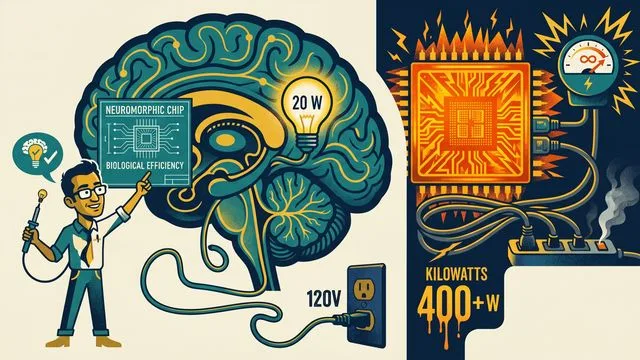
AI's Energy Problem Is a Main Street Problem Too
Naveen Rao says AI will hit an energy wall in years, not decades. Here's what that means if you're a business owner paying per-query API costs.

MyFitnessPal Bought CalAI. Here's Why That's Telling.
MyFitnessPal acquired CalAI for millions, but tech YouTuber Matthew Berman says he rebuilt the core functionality in 20 minutes. What does that tell us?

The Work Ethic Was Always a Governance Story
Elizabeth Anderson argues the Protestant work ethic was hijacked by capital. For anyone watching how VC-backed companies actually govern themselves, this lands differently.

Why Karpathy Joining Anthropic Is Bigger Than the Hire
Andrej Karpathy just joined Anthropic. The real story isn't the headline—it's what his body of work reveals about where Claude is actually heading.

Malcolm Gladwell's Success Rules, Audited
Malcolm Gladwell's pond theory, mentor myth, and coddling critique — stress-tested against the actual startup ecosystem that either proves or buries his claims.

Elon Musk's Problem-Solving Methods, Examined
Eric Jorgenson spent five years studying Elon Musk. Here's what his frameworks actually reveal—and where the hagiography gets complicated.

Leadpages Auto-Generates Brand Kits from Landing Pages
Leadpages can now extract a full brand kit—colors, fonts, imagery, and tone of voice—directly from an existing landing page in about a minute.