Theodore Roosevelt Practiced Judo, but What Was His Rank?
Theodore Roosevelt trained in judo with Yoshiaki Yamashita at the White House. His honorary black belt came later; claims of a lifetime rank remain disputed.
Written by AI. David Oyelaran
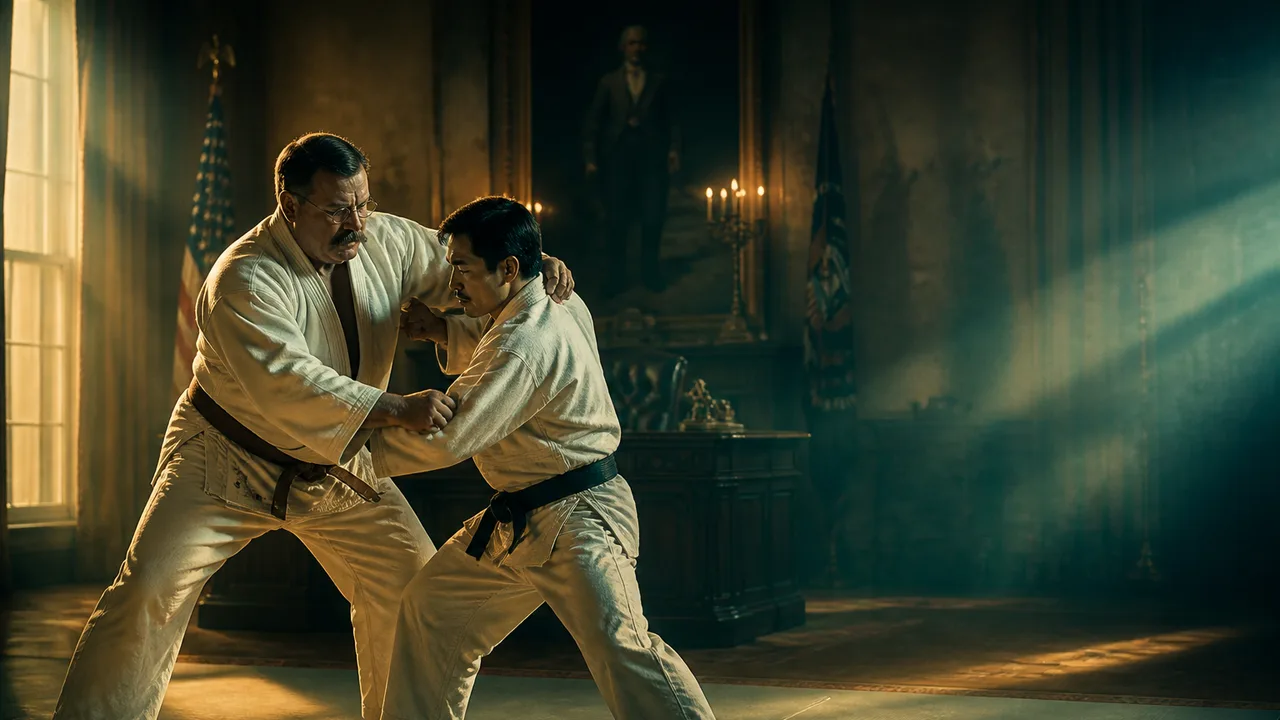
Theodore Roosevelt practiced judo at the White House under Yoshiaki Yamashita. That sentence gives us two people to remember. The familiar version of the story often leaves room for only one: the president, wearing a black belt.
Roosevelt did receive an honorary black belt from the United States Judo Association, but the award came after his death. Descriptions of his ability during his lifetime have placed him at brown belt, while later accounts have assigned him still higher ranks. A Martial History Team examination of those claims finds no evidence that Roosevelt earned a formal judo rank while he was alive. His training with Yamashita is the firmer part of the history.
That still leaves a substantial story. A Japanese instructor brought his expertise into an American president’s household at a time when judo was gaining attention beyond Japan. Roosevelt’s interest made that encounter easier for Americans to notice. The question of what belt he wore can help clarify the encounter, provided the belt does not take over the whole room.
An Honor Given After a Lifetime
The United States Judo Association presented Roosevelt with an honorary black belt at Sagamore Hill in Cove Neck. The association’s stated reason was his role in “embracing the sport of Judo.” Its wording tells us what the award commemorated: an organization chose to honor a former president’s connection to the practice.
An honorary award can be significant without serving as a record of training completed. Roosevelt’s case invites three separate questions. Did he practice judo? Yes. Did a judo association later honor him with a black belt? Yes. What rank did he earn while alive? The documented training does not come with a documented promotion.
Those questions collapse easily in a short retelling. “Roosevelt received a black belt” is true if the reader understands that the award was honorary and posthumous. “Roosevelt was a black belt,” standing alone, suggests a lifetime achievement in judo. The missing words change what the sentence asks a reader to picture.
Brown-belt descriptions present a related difficulty. They place Roosevelt somewhere on a scale familiar to readers and offer a more modest claim than black belt. Yet a description of someone as brown-belt-level does not, by itself, show that an instructor awarded that person a brown belt. Later claims have called Roosevelt a brown belt or a black belt; the certainty of those labels varies. Treating brown belt as a settled credential would replace one tidy anecdote with another.
The strongest case for remembering Roosevelt through the honorary award is straightforward. He took an interest in judo, practiced with an instructor from Japan and later received recognition from a judo organization for embracing the sport. No one needs to turn that recognition into an earned rank to explain why his participation caught attention. A president’s choice of physical training was already newsworthy.
The Teacher in the Presidential Story
Yoshiaki Yamashita taught Roosevelt at the White House. In the belt version of the story, Yamashita risks becoming a name attached to Roosevelt’s achievement, as if his purpose in the history were to certify the president. Turn the sentence around and another history appears: Yamashita brought a Japanese martial art to a prominent American student, and that student’s position gave their lessons an unusual public profile.
The two men occupied different places in that exchange. Yamashita brought the expertise. Roosevelt brought the attention attached to the presidency. Keeping both in view helps explain how a practice could travel across borders without suggesting that its history began when a powerful American tried it.
Early twentieth-century American interest in physical training also forms part of the setting. Fitness was tied to ideas about masculinity and national strength, and Roosevelt prized strenuous activity. Judo could enter that conversation as a method of training the body, even as it carried a history and discipline developed elsewhere. Presidential enthusiasm may have made it easier to write about judo in the United States; it cannot account on its own for the knowledge needed to teach it.
Some later accounts place Roosevelt’s training under the broader label of jiu-jitsu. That vocabulary can make an already crowded story harder to follow. Readers looking for a single, neat credential may encounter different names for Japanese grappling alongside different claimed belt levels. The safest way through is to keep the people and actions clear: Roosevelt trained, Yamashita taught, and the honorary judo award came later.
What a Belt Can Carry
A belt is an efficient piece of storytelling. It gives a reader a color, a hierarchy and an apparent answer to “How good was he?” Roosevelt’s life supplies the rest of the image: a president associated with vigorous action finds another demanding pursuit. The image is memorable enough to outlive the details that made it possible.
But the honorary award and the White House lessons speak to different kinds of recognition. The association recognized Roosevelt’s embrace of judo after his death. Training under Yamashita describes what he did while alive. One is a later commemoration; the other is an encounter between teacher and student. When the two become a single claim about rank, the later honor starts doing the work of a lifetime training record.
There is a public-history consequence, too. A story built around the president’s belt asks how much judo Roosevelt mastered. A story that names Yamashita asks how judo reached an American audience and whose skill made that encounter possible. Both questions can interest a reader, but only one keeps the instructor visible from the start.
Roosevelt need not disappear to make room for Yamashita. His participation helps explain why this episode has remained memorable. His status brought attention to a practice that Americans were encountering through people who knew how to teach it. Yamashita’s presence prevents that attention from being mistaken for authorship.
The enduring detail is a White House lesson with Roosevelt as the student. Years later, an association gave that student an honorary black belt. Yamashita had already done the teaching.
More Like This

Middle Platonism's Hidden Role in Western Esotericism
ESOTERICA's new crowdfunded seminar argues Middle Platonism built the foundations of Hermeticism, Gnosticism, and early Christian theology. Here's what that means.
How Omens Entered the Politics of the Thirty Years' War
A comet in 1618 drew competing interpretations as war spread across Europe. Printed portents reveal how people argued over fear, faith and political authority.
Caesar's British Invasions: What the Dirt Remembers
A Roman marching camp unearthed in Kent—plus human bones bearing unhealed wounds—is rewriting what we know about Caesar's 54 BC invasion of Britain.
Why October's Name Still Carries the Number Eight Today
October is the tenth month, but its name means eight. The mismatch preserves an older Roman calendar and reveals how societies reorganize public time.
Rapa Nui Archaeology Challenges Collapse Theory
New archaeological research by Nicolas Cauwe challenges the Easter Island ecological collapse theory, revealing Rapa Nui resilience, cultural transition, and colonial devastation.
Colonel John Alexander's Life at the Edge of Official Reality
Colonel John Alexander commanded Green Berets, ran Pentagon psychic programs, and investigated UFOs. His 3-hour Why Files interview maps a career lived at the edge of official reality.